Introduction
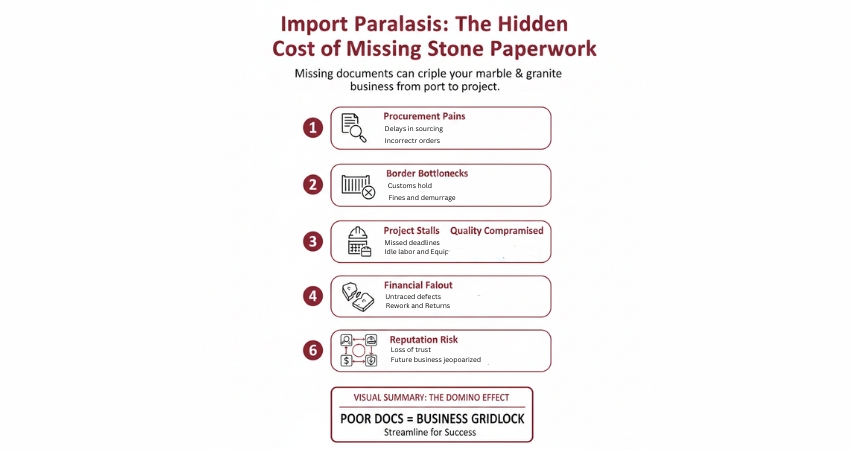
In the world of natural stone especially marble and granite import documentation is essential for avoiding delays and operational risks. Behind every container of stone lies a complex web of documentation: packing lists, certificates of origin, invoices, bills of lading, quality control reports, and more. When any of this paperwork is missing, incomplete, or incorrect, the consequences can ripple through every department of your company.
Missing documentation doesn’t just cause delays at the border. It undermines your procurement process, sabotages project schedules, hampers quality control, disrupts finance operations, and risks your company’s reputation. In other words, poor marble and granite import documentation can paralyze your import business.
In this blog, we explore how missing or faulty documentation affects every stakeholder in your organization from procurement managers and site project managers to quality engineers, finance teams, and top level leadership. Then, we’ll offer practical solutions to build a robust documentation system that minimizes risk and maximizes efficiency.
Why Proper Import Documentation Is Critical in Marble & Granite Business
Before diving into the pain points, it’s important to understand why documentation matters so much in the marble and granite import industry:
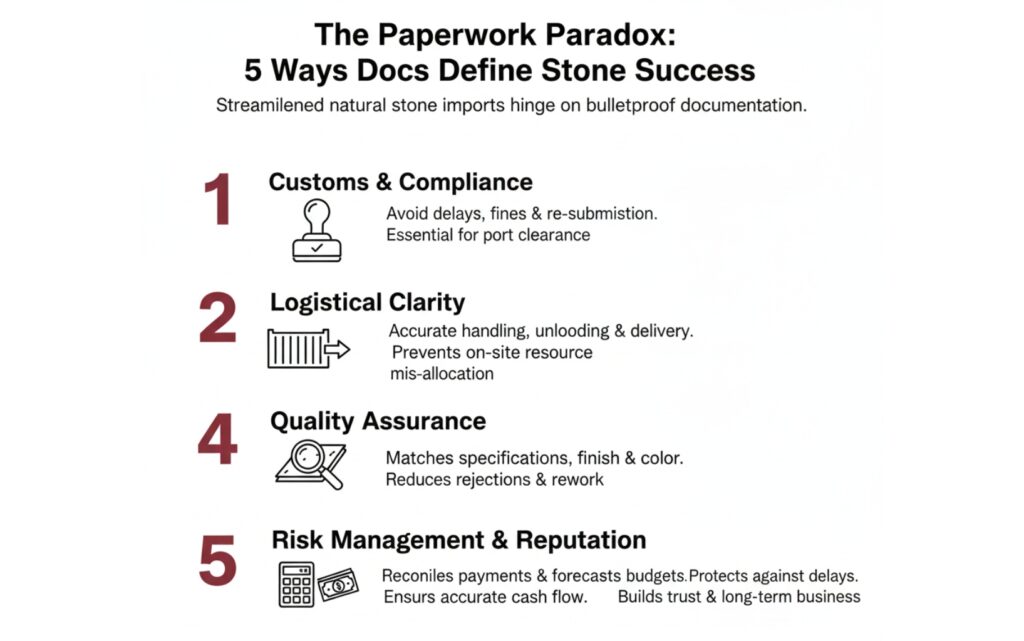
- Customs & Regulatory Compliance
Natural stone falls under customs regulations, and each shipment often requires precise documents to clear customs. Missing or incorrect papers can trigger delays, inspections, or even fines. Without a bill of lading, certificate of origin, or properly filled packing list, customs authorities may refuse to release shipments or demand re‑submission.
“For more details on international customs procedures for natural stone, see the official guidelines here. - Logistical Clarity
Documents like packing lists, weight declarations, and slab specifications help logistics teams and freight forwarders accurately plan handling, unloading, and delivery. If information on the number of slabs, dimensions, or surface finishes is missing, the receiving party may be caught by surprise, leading to mis‑allocation of resources on-site. - Quality Assurance
For natural stone, quality is heavily dependent on specification: thickness, finish, calibration, color tone, and more. Without QC reports, specification sheets, and sample approvals attached to the documentation, engineering teams may receive slabs that don’t match expectations, leading to rejections, rework, or even safety risks. - Financial Transparency
Financial teams rely on invoices, pro forma documents, and cost breakdowns to reconcile payments, forecast budgets, and handle cash flow. If documents are missing or unclear, payments may be delayed, receipts may not match, and financial projections may go off track. - Risk Management & Reputation
Missing documentation raises risk at every level: risk of non‑compliance, financial loss, project delays, and damaged reputation. For senior leadership and owners, this risk translates into wasted resources, unhappy customers, and potential long‑term business damage.
Most problems importers face today are directly caused by missing or inaccurate marble and granite import documentation.”
How Missing Documentation Impacts Different Departments
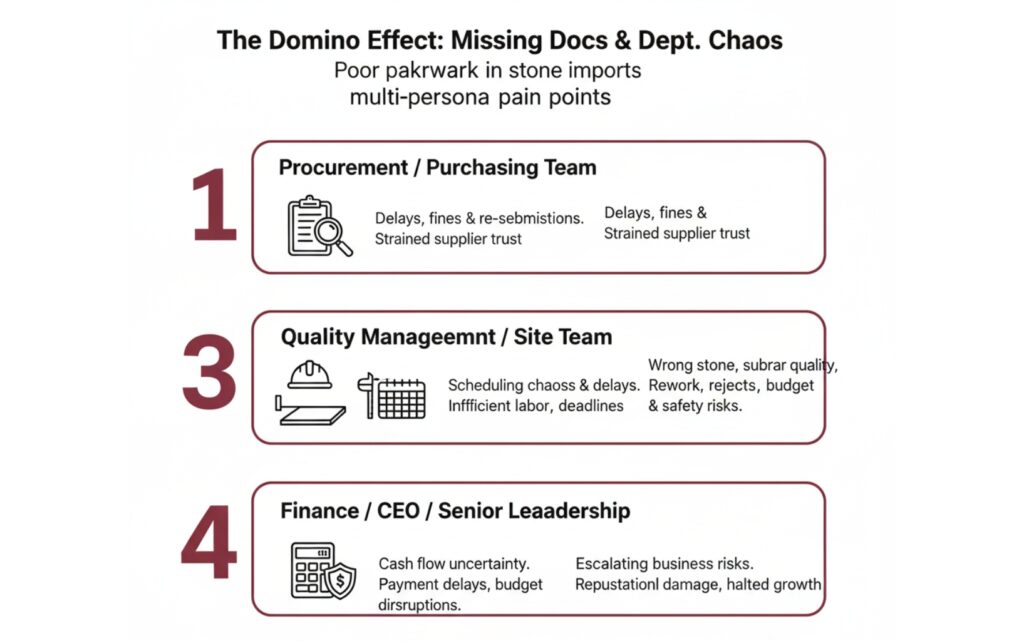
Missing marble and granite import documentation creates different pain points for each department involved in the import cycle.
1. Procurement / Purchasing Team
Pain Point: Incomplete marble and granite import documentation delays customs clearance and disrupts supplier relationships.
- When the Bill of Lading (B/L), Packing List, or Certificate of Origin (COO) is missing or incorrect, procurement teams face significant challenges. Customs agents may reject the shipment, leading to demurrage charges (storage fees), fines, or the need to re-submit corrected documents.
- Procurement staff must spend time chasing suppliers for missing paperwork follow-ups, reminders, and sometimes even renegotiations if the supplier repeatedly fails to comply.
- These delays can erode supplier trust and reliability. A supplier that consistently fails to deliver proper documentation may not be a dependable long-term partner.
- The procurement team must also weigh the cost of non-compliance: is it better to rush the paperwork and pay penalties, or to hold off until everything is correct even if project schedules suffer?
Impact: Increased workload, frustration, reduced efficiency, and strained supplier relationships.
2. Project Management / Site Team
Pain Point: Without proper marble and granite import documentation, project managers cannot plan workloads or installation schedules accurately.
- Without a correct packing list or accurate slab specification sheet, project managers don’t know exactly what’s arriving: how many slabs, their sizes, or their finish. That lack of clarity prevents them from properly planning labor, installation crews, or site logistics.
- Delays in documentation mean that site teams can’t commit to manpower or equipment. They may have to wait for corrected paperwork before proceeding, costing time and money.
- If documentation is missing on arrival, important decisions such as whether to accept the shipment, reject certain slabs, or adjust the installation plan may need to be postponed until proper verification is done.
- Replanning becomes necessary: not just to adjust manpower, but potentially to adjust the sequence of work, especially if critical slabs are missing or the delivered stone differs from what was specified.
Impact: Project timelines are disrupted, labor becomes inefficient, and the trust of clients is jeopardized due to missed deadlines.
3. Quality / Engineering Team
Pain Point: Quality engineers depend on accurate marble and granite import documentation to confirm thickness, color, finish, and calibration.
- Quality engineers rely on documentation such as specification sheets, QC reports, sample approvals, and dimensional tolerances. Without these, they may not be able to verify whether the delivered slabs match the approved standard.
- In the absence of proper documentation, the risk of installing out-of-specification slabs increases. Slabs might be too thin, too thick, have an incorrect finish, or deviate in color hues. This leads to rejections, rework, or disposal.
- Manual verification becomes time-consuming and prone to error. Trying to manually measure and test every slab without documentation slows down the site and increases installation costs.
- If defective or mismatched slabs are installed, there may be structural or aesthetic failures — cracks, uneven joins, color mismatches which can damage the company’s reputation or require expensive remediation.
Impact: Higher reject rates, increased labor costs, quality issues, and risk of compromised installations.
4. Finance / Accounting Team
Pain Point: Inconsistent cash flow, payment delays, and budget disruption.
- Invoices, pro forma documents, and cost breakdowns are essential for the finance team to reconcile payments and manage cash flow. Missing or incomplete bills mean uncertainty about the actual landed cost of stone.
- Without documentation such as packing lists or certificates of origin, finance may not be able to verify shipping costs, duties, or other fees. This lack of transparency can lead to overpayment or underpayment.
- Payment processes are delayed. The finance team may refuse to pay until they have all supporting documents, which may in turn frustrate suppliers and put procurement teams under pressure.
- Forecasting becomes unreliable. If the finance department can’t predict how much cash is needed for the next shipment because paperwork is unclear, it cannot effectively plan for future imports or projects.
- There may also be accounting mismatches: the amounts on shipping documents, invoices, and bank statements may not align, leading to time consuming audits, corrections, and reconciliations.
Any gaps in marble and granite import documentation make it difficult for finance to reconcile payments and duties.
Impact: Payment delays, cash flow uncertainty, increased administrative burden, and strained supplier relationships.
5. Owner / CEO / Senior Leadership
Pain Point: Business risks escalate, reputation suffers, and operational inefficiencies multiply.
- From an owner’s perspective, missing documentation isn’t just an administrative nuisance it’s a strategic risk. Delays cost money, and repeated documentation failures can signal a weak operation.
- Project delays and rework due to poor documentation hurt the company’s credibility. Clients begin to doubt whether you can deliver reliably.
- Risk of legal or regulatory penalties looms if customs or tax authorities identify noncompliance.
- Operational inefficiency translates into wasted resources: idle labor on site, demurrage fees at the port, rework, and poor cash flow.
- Over time, a pattern of such issues can discourage investors, harm client relationships, and limit business growth.
Impact: Reduced profitability, reputational damage, operational chaos, and long term business risk.
Leadership often sees poor marble and granite import documentation as a sign of operational weakness.”
Building a Robust Documentation System Best Practices & Solutions
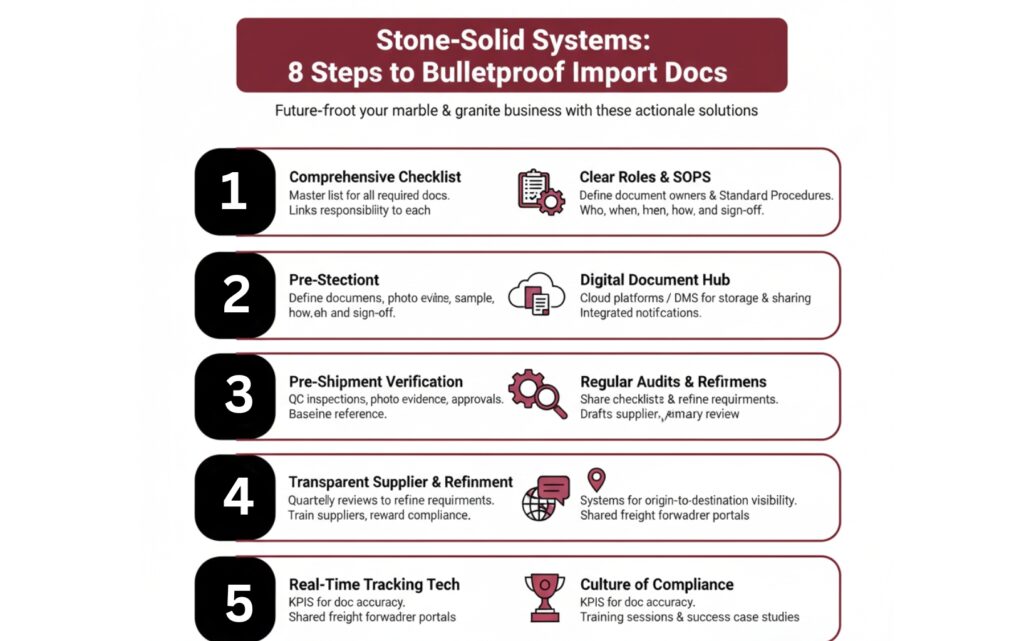
So, how can you prevent the nightmare outlined above? Here are practical, actionable solutions to build and maintain a rock-solid import documentation system tailored to serve all personas in your company.
1. Create a Comprehensive Documentation Checklist
- Develop a master checklist that specifies every required document for each shipment: B/L, packing list, COO, invoice, QC report, sample approvals, calibration certificates, etc.
- Link each document to who is responsible for verifying it (Procurement, QC, Finance).
- Use this checklist for every order, and make sure it is integrated into your ERP or CRM system if you have one.
2. Define Clear Roles & Responsibilities
- Assign a document owner for each role: e.g., procurement is responsible for sending documents to the freight forwarder, Quality for verifying QC reports, Finance for collecting final invoices.
- Create SOPs (Standard Operating Procedures) to outline the process: when each document is required, how it should be formatted, who signs off, and when it should be filed.
3. Use Digital Tools to Track Documentation
- Implement a document management system (DMS) or use cloud-based platforms (e.g., Google Drive, SharePoint, a dedicated import management system) to store and share documentation.
- Use collaboration tools (e.g., shared dashboards) so that procurement teams, quality engineers, project managers, and finance can all access the same up-to-date docs.
- Integrate notifications and workflows: when a document is uploaded, relevant stakeholders get alerted to review and approve.
4. Pre-Shipment Verification & Sample Approvals
- Before the supplier ships, require a pre-shipment QC inspection and sample approvals. Ask for photographic evidence, QC certificates, and dimension checks.
- Ensure that these verification steps are documented and approved by your quality team. That way, if any specification deviates later, you have a baseline reference.
- Maintain a library of approved sample stones, with photos, measurements, and specification sheets, so that everyone from procurement to design knows exactly what the approved standard is.
5. Regular Audits & Continuous Improvement
- Conduct quarterly or semi-annual documentation audits to assess whether documents were consistently submitted, compliant, and accurate.
- Use the audit findings to refine your documentation checklist and SOPs. If the procurement team consistently misses some documents, adjust the workflow; if finance frequently finds invoice discrepancies, create a reconciliation step.
- Train your suppliers: share your documentation checklist with them. Explain how missing or wrong documents cost the company time and money, and reward reliable suppliers who consistently comply.
6. Establish Transparent Supplier Communication
- Communicate clearly with your suppliers about the importance of documentation. Share your checklist and format requirements before every order.
- Ask suppliers to send draft packing lists, invoices, and QC reports ahead of shipment for preliminary verification.
- Create a feedback loop: after each shipment, review which documents were missing or incorrect, and discuss corrective measures with your supplier.
7. Leverage Technology for Real-Time Tracking
- Use import tracking systems that provide visibility from origin to destination. These platforms often allow you to upload your documentation within the system, and link them to shipment milestones (e.g., “Loaded on Vessel,” “Arrived at Port,” “Customs Cleared”).
- Use a shared portal with your freight forwarder, so that your team can track status and documentation simultaneously. This removes the “black box” of shipping.
8. Embed Documentation into Your Company Culture
- Make documentation a key performance indicator (KPI) for procurement, quality, and finance teams. Reward teams that consistently submit or verify complete, accurate paperwork.
- Train all relevant stakeholders on why documentation matters: hold quarterly training sessions or workshops to underline how missing paperwork affects everyone — from project delays to financial risk.
- Celebrate success: when a shipment clears smoothly, or when a documentation process improves, share that as a case study internally.
A strong checklist helps standardize marble and granite import documentation across procurement, QC, logistics, and finance teams.
Long Term Benefits of a Strong Documentation System
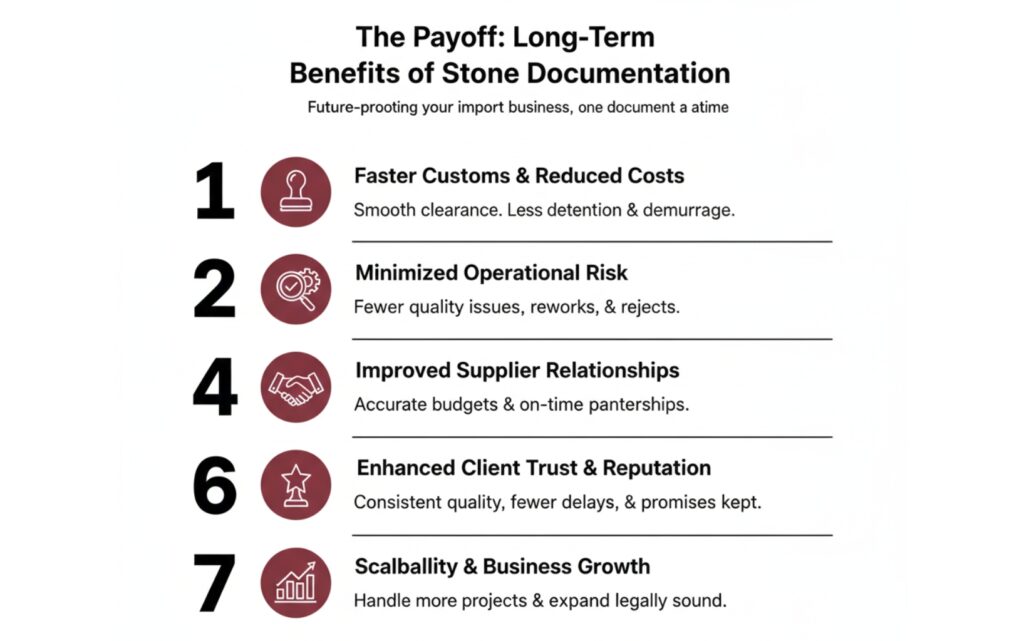
Implementing a rigorous system to manage marble and granite import documentation isn’t just a bureaucratic exercise it brings real, long-term competitive advantages to your business:
- Faster Customs Clearance
With all required marble and granite import documentation in place, customs processes move more smoothly, reducing detention time and demurrage costs - Reduced Operational Risk
A documented and pre verified QC process means fewer quality surprises, especially when supported by accurate marble and granite import documentation. You minimize the risk of rework, rejects, and costly returns You minimize the risk of rework, rejects, and costly returns. - Improved Cash Flow and Forecasting
Finance teams get clarity and consistency, enabling better cash flow management, more accurate budgets, and on-time payments. - Higher Supplier Reliability & Accountability
Suppliers understand your documentation standards and become more disciplined. Over time, you build stronger, more reliable partnerships. - Enhanced Reputation with Clients
Project delays are minimized, quality is consistent, and you deliver what was promised — boosting your reputation among clients and building trust through strong marble and granite import documentation workflows. - Scalability and Growth
As your business grows, the documentation process will scale with you. A solid system allows you to take on more projects, import more stone, and expand to new markets without repeated errors. - Regulatory Compliance & Audit-readiness
Having a wellmaintained documentation system ensures that your company is prepared in case of audits, regulatory inspections, or compliance checks all supported by accurate marble and granite import documentation.
Conclusion
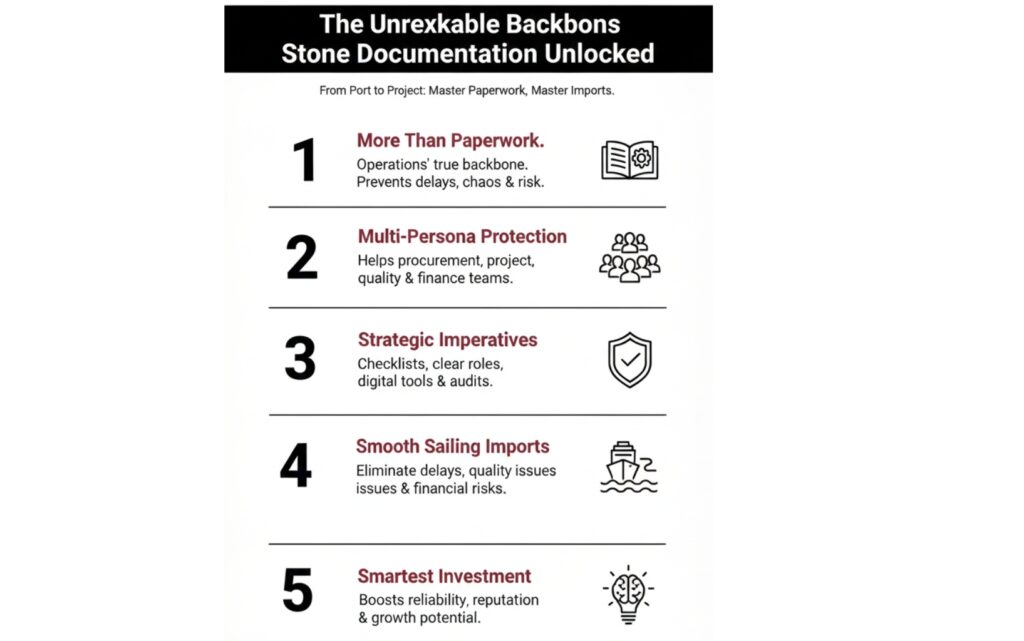
In the high-stakes world of marble and granite import, documentation is far more than paperwork it is the backbone of your entire operation. Missing or incorrect documents don’t just delay shipments; they cripple procurement processes, derail project schedules, compromise quality, strain finances, and risk your company’s reputation.
By addressing multi‑persona pain points from procurement managers to project leads, quality engineers, finance teams, and top leadership — you can build a documentation process that serves everyone. Implementing clear checklists, assigning responsibilities, using digital tools, auditing regularly, and fostering transparency with suppliers are not just nice-to-haves: they are strategic imperatives.
If you want your importing business to run smoothly — without the constant risk of customs delays, quality issues, or financial misalignment — investing in robust documentation is one of the smartest decisions you can make.
Ready to turn your documentation from a liability into a competitive strength?
Contact our import operations consultants today for a free audit of your current process we’ll help you build a documentation system tailored to your team, your suppliers, and your long-term business goals.