
In the marble and granite supply chain, surprises are rarely good news., surprises are rarely good news. A shipment delayed by two weeks. A container arrives with inconsistent thickness. A slab color that subtly but critically differs from the approved sample. Unexpected demurrage fees erasing your margin.
For importers of marble and granite, these issues are not operational inconveniences; they are profit risks, reputation risks, and relationship killers.
As global supply chains become more complex in 2026 driven by volatile freight costs, stricter project timelines, and increasingly demanding clients the difference between a profitable importer and a struggling one often comes down to a single factor:
How predictable your stone supply chain really is.
This guide is written for importers who want to move beyond firefighting and toward a zero surprise supply chain one built on visibility, standardization, accountability, and trust.
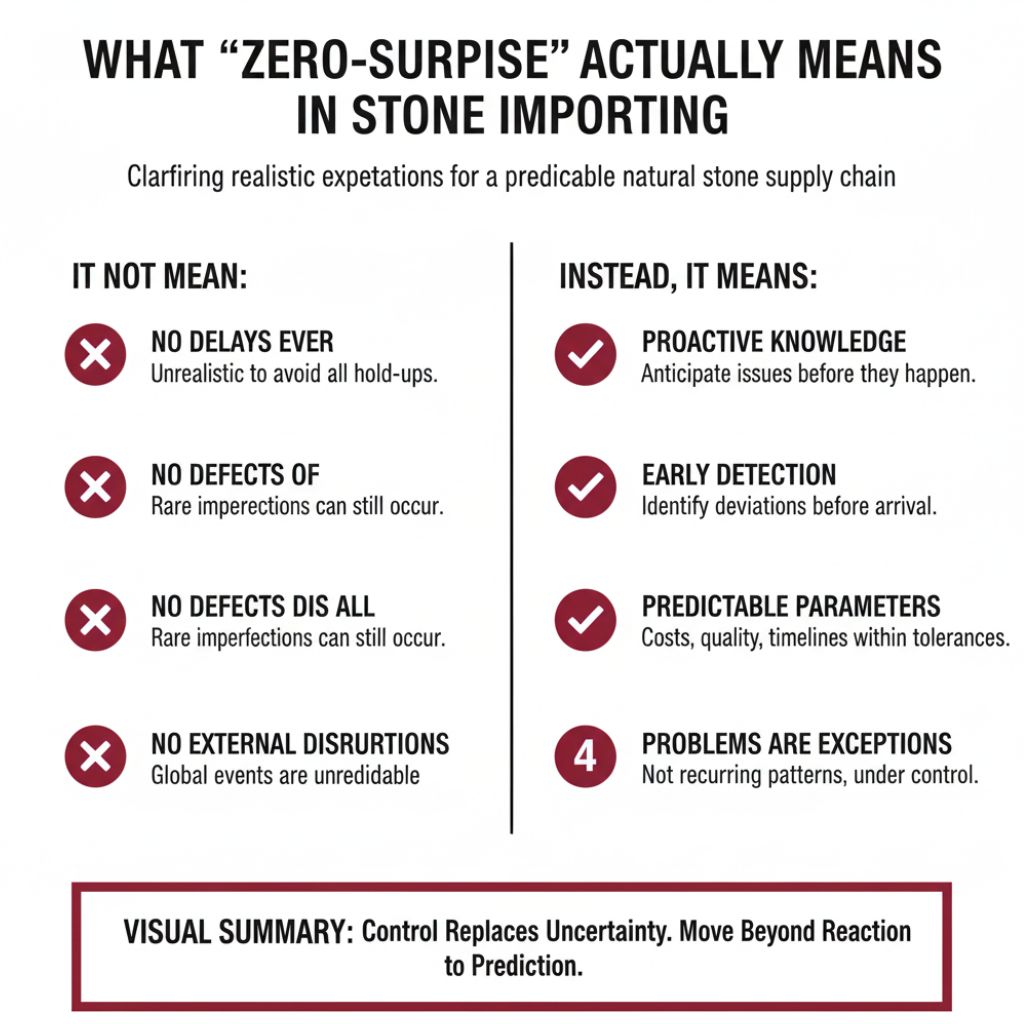
What “Zero Surprise” Actually Means in Stone Importing
Let us clarify something upfront.
A zero surprise supply chain does not mean: • No delays ever • No defects at all • No external disruptions
That is unrealistic.
A zero surprise supply chain means: • You know what will happen before it happens • Deviations are identified early, not discovered at arrival • Costs, quality, and timelines are predictable within defined tolerances • Problems are exceptions, not patterns
In short: control replaces uncertainty.
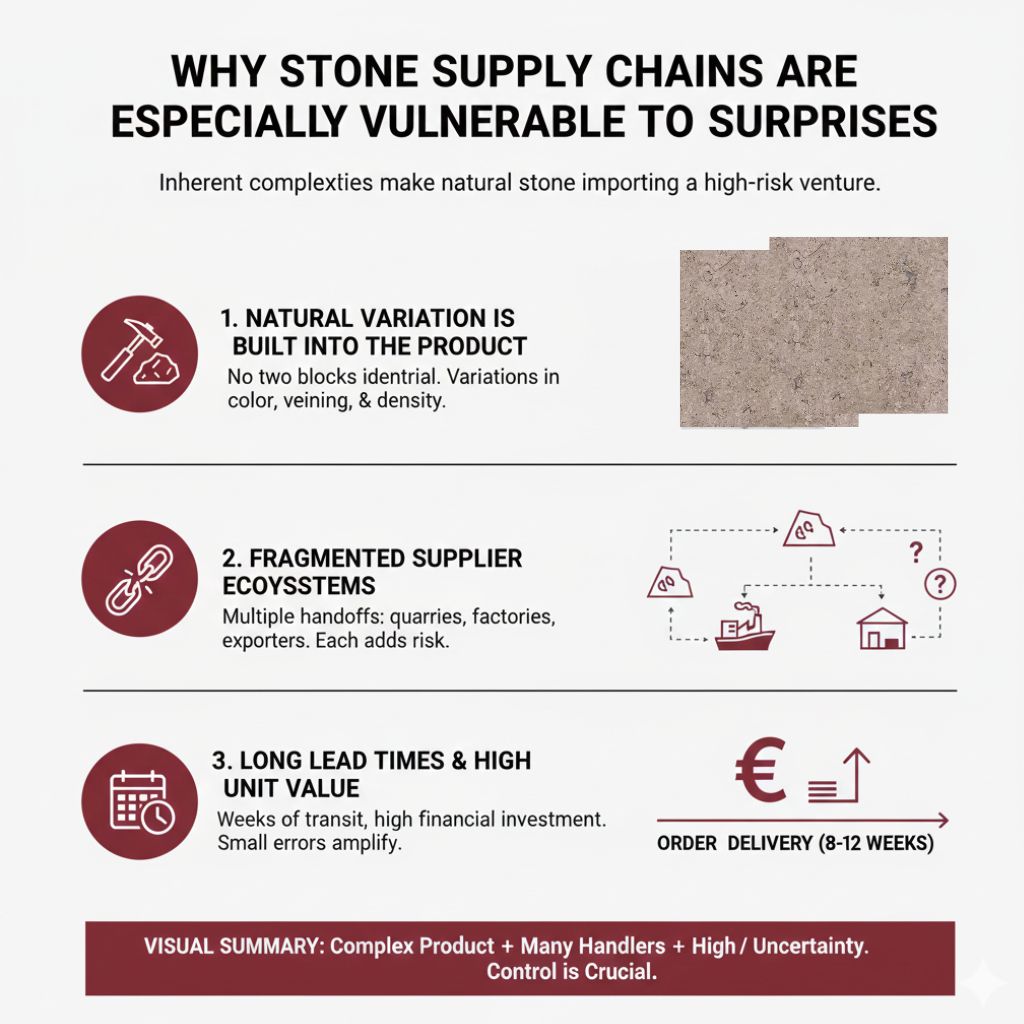
Why Marble And Granite Supply Chains Are Especially Vulnerable to Surprises
Natural stone is fundamentally different from most industrial products.
- Natural Variation Is Built Into the Product
No two blocks are identical. Variations in: • Veining • Shade • Crystal structure • Density
are natural realities. Without tight controls, these variations become disputes.
- Fragmented Supplier Ecosystems
Unlike highly industrialized sectors, stone sourcing often involves: • Quarry owners • Independent factories • Third party processors • Local exporters • Freight forwarders
Each handoff increases risk.
- Long Lead Times and High Unit Value
A single container may represent: • 8 to 12 weeks of lead time • Tens or hundreds of thousands of euros in value • A critical dependency for an ongoing project
Small mistakes compound quickly.
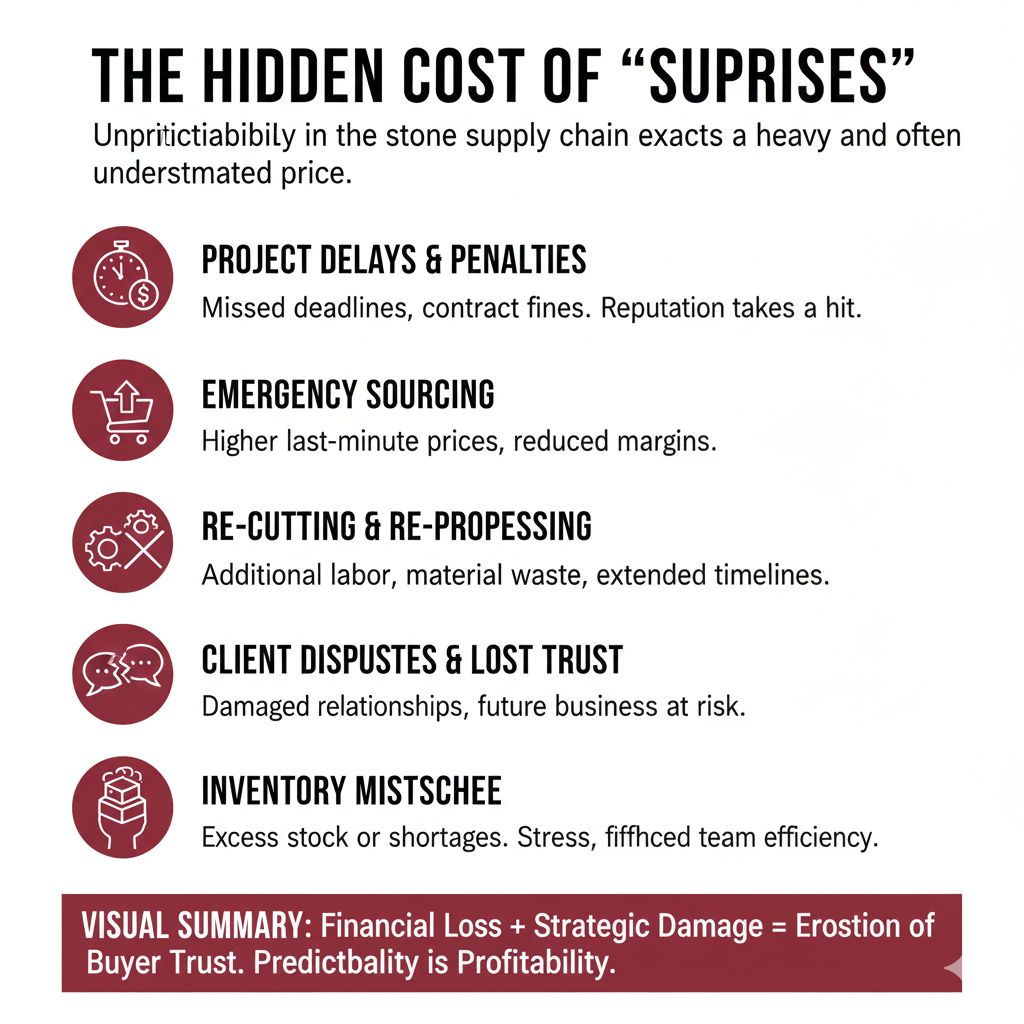
The Hidden Cost of “Surprises”
Many importers underestimate how expensive unpredictability really is.
Surprises lead to:
- Project delays and penalty clauses
- Emergency sourcing at higher prices
- Re-cutting and re-processing costs
- Client disputes and loss of trust
- Unexpected issues in the marble and granite supply chain lead to project delays and higher costs
- Inventory mismatches
- Internal stress and operational overload
Over time, the real cost is not just financial—it is strategic. Buyers stop seeing you as a reliable partner.
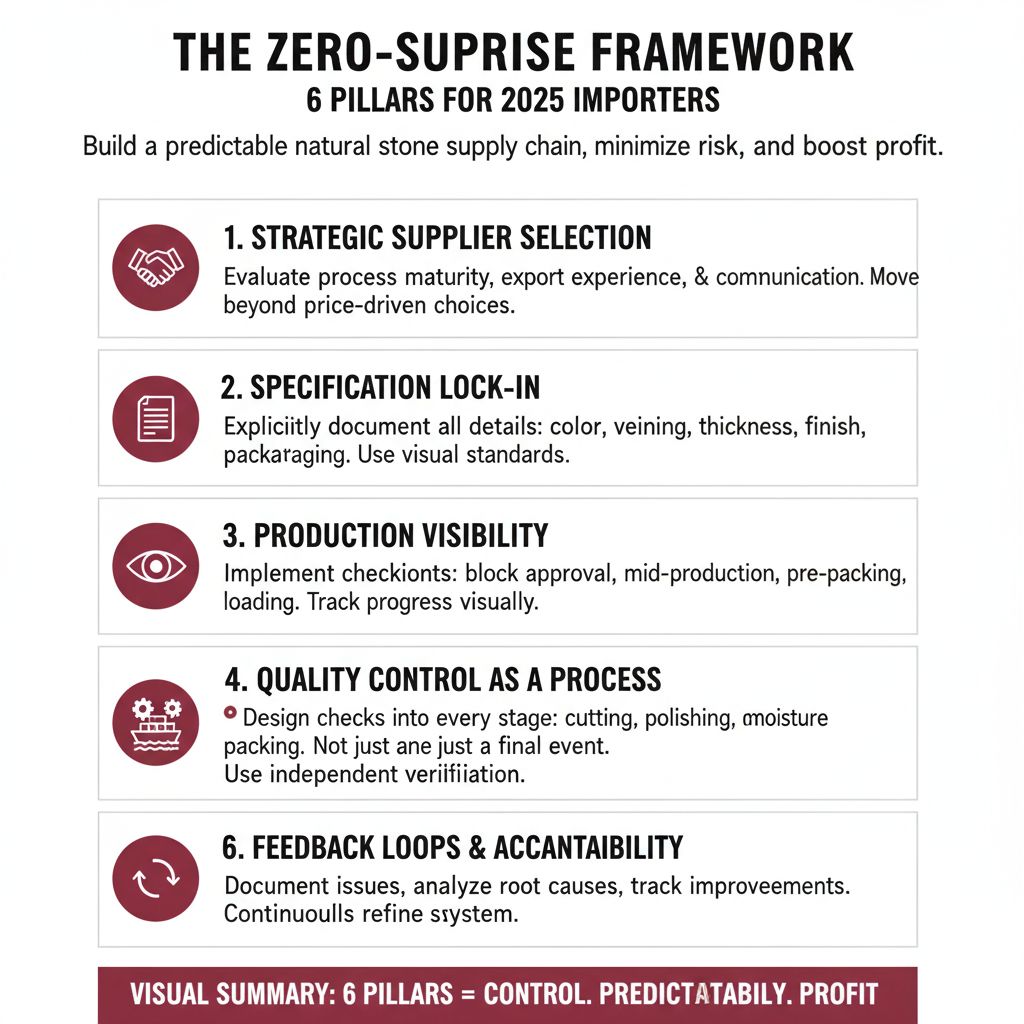
The Zero Surprise Marble And Granite Supply Chain 6 pillars for 2026 Importers
Building a predictable stone supply chain requires a system, not isolated fixes.
Below are the six pillars used by advanced importers to minimize surprises at scale.
Pillar 1: Strategic Supplier Selection (Not Price-Driven Sourcing)
The foundation of predictability is who you source from.
Many importers still choose suppliers based primarily on:
- Lowest price per square meter
- Fastest promised delivery
This is a short-term mindset.
What to Evaluate Instead
1. Process Maturity
Ask:
- Do they have documented production workflows?
- Are quality checks standardized or subjective?
- Is production reactive or planned?
2. Export Experience
A factory that exports occasionally behaves very differently from one that exports weekly.
Key indicators:
- Familiarity with EU standards
- Packaging discipline
- Documentation accuracy
- Claims handling experience
3. Communication Infrastructure
Predictability requires:
- Clear points of contact
- Fast response cycles
- Visual documentation (photos, videos, reports)
Silence is a red flag.
Pillar 2: Specification Lock-In Before Production Starts
One of the most common sources of disputes is assumed understanding.
Importers believe specifications are “obvious.”
Factories believe flexibility is acceptable.
This mismatch creates surprises.
What Must Be Locked In Explicitly
A zero-surprise importer documents:
- Exact stone name (commercial + quarry reference if possible)
- Acceptable color range (with visual references)
- Veining direction and intensity
- Thickness tolerance
- Surface finish definition
- Edge treatment
- Packaging method
- Labeling format
Nothing is left implicit.
Visual Standards Matter
Written specs alone are insufficient.
Best practice includes:
- Approved slab photos
- Marked-up images showing acceptable vs unacceptable variations
- Physical samples retained by both parties
When disputes arise, reference clarity resolves them quickly.
Pillar 3: Production Visibility (Before the Container Is Closed)
Most surprises happen because importers learn too late.
By the time the container arrives, options are limited.
“For best practices in production checkpoints, refer to the Natural Stone Institute guidelines for stone inspection.”
The Visibility Gap
Traditional sourcing often looks like this:
- Order placed
- Silence for weeks
- “Container ready” message
- Arrival reveals issues
This is backward.
What Predictable Importers Do Differently
They implement production checkpoints:
- Block or slab selection approval
- Mid-production inspection
- Pre-packing verification
- Final container loading confirmation
Each stage includes:
- Photo documentation
- Measurement verification
- Quantity confirmation
This does not require on-site presence if systems are in place.
Pillar 4: Quality Control as a Process, Not an Event
Quality control is often treated as:
Embedding quality checks throughout the marble and granite supply chain reduces end-stage surprises.”
This approach misses systemic issues.
Process-Based Quality Control
Zero-surprise importers embed quality checks into:
- Cutting
- Polishing
- Calibration
- Packing
The goal is early detection, not end-stage rejection.
Independent vs Supplier QC
Advanced buyers often use:
- Third-party inspection services
- Hybrid models (supplier QC + external verification)
The key is independence and consistency.
A predictable supply chain does not rely on goodwill alone.
Pillar 5: Logistics Engineering in the Marble And Granite Supply Chain
Many importers treat logistics as an administrative task.
In reality, logistics design has a major impact on surprises.
Common Logistics-Driven Surprises
- Broken slabs due to incorrect packing
- Moisture damage
- Container imbalance
- Customs documentation errors
- Unexpected port charges
Predictable Logistics Practices
- Standardized crate designs
- Weight distribution planning
- Moisture protection protocols
- Pre-verified HS codes
- Clear Incoterms responsibility mapping
Logistics is where small details create large consequences.
Pillar 6: Feedback Loops and Supplier Accountability
Zero-surprise systems improve over time.
This only happens if:
- Issues are documented
- Root causes are analyzed
- Suppliers are held accountable
- Improvements are tracked
The Feedback Discipline
After each shipment:
- What went as expected?
- What deviated?
- Why?
- What will change next time?
Importers who skip this step repeat the same problems indefinitely.
The Role of Trust And Why It Must Be Engineered
Many importers say:
“We trust our supplier.”
Trust is valuable but unstructured trust is fragile.
Zero-surprise supply chains are built on:
- Transparency
- Documentation
- Measurable performance
- Mutual incentives
Ironically, strong systems increase trust rather than replace it
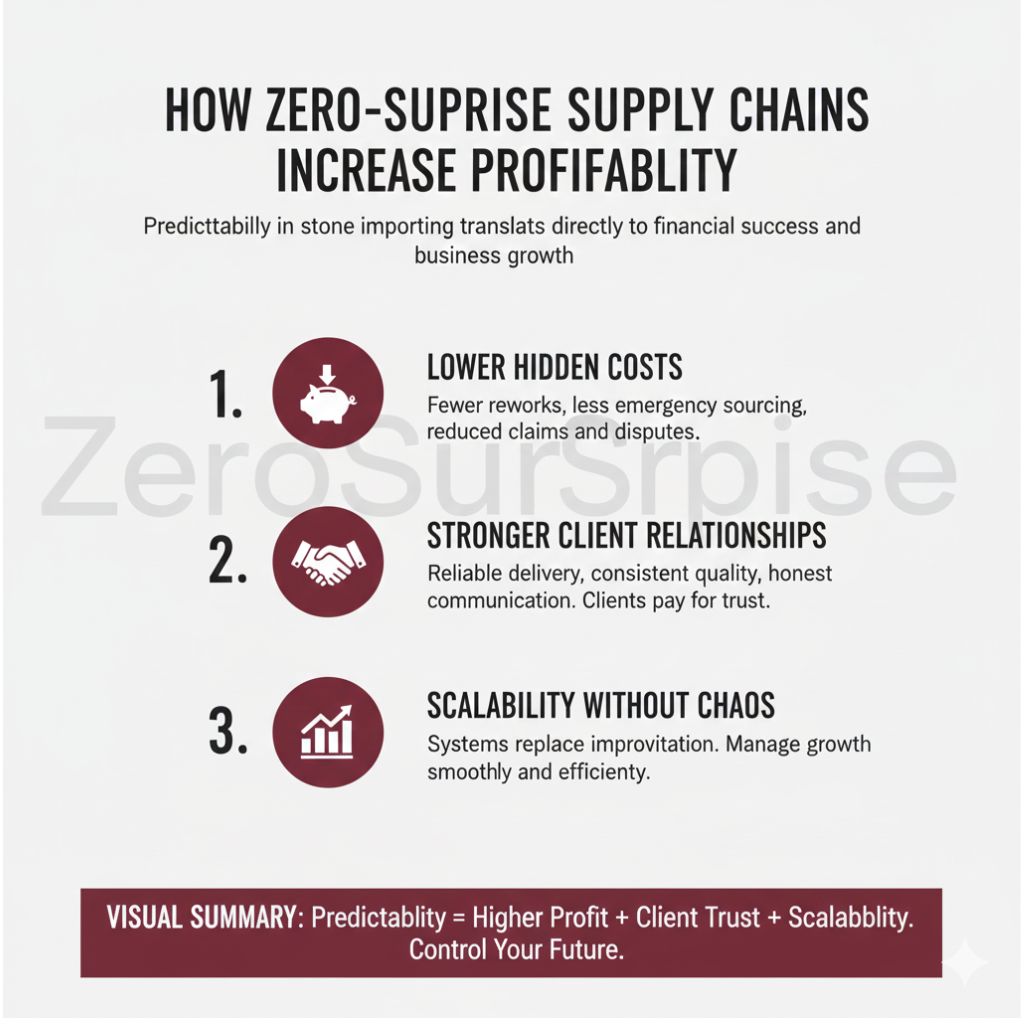
How Zero Surprise Supply Chains Increase Profitability
Predictability is not just operational it is financial.
1. Lower Hidden Costs
- Fewer reworks
- Less emergency sourcing
- Reduced claims and disputes
2. Stronger Client Relationships
Clients value:
- On-time delivery
- Consistent quality
- Honest communication
They pay for reliability.
3. Scalability Without Chaos
When systems replace improvisation, growth becomes manageable.
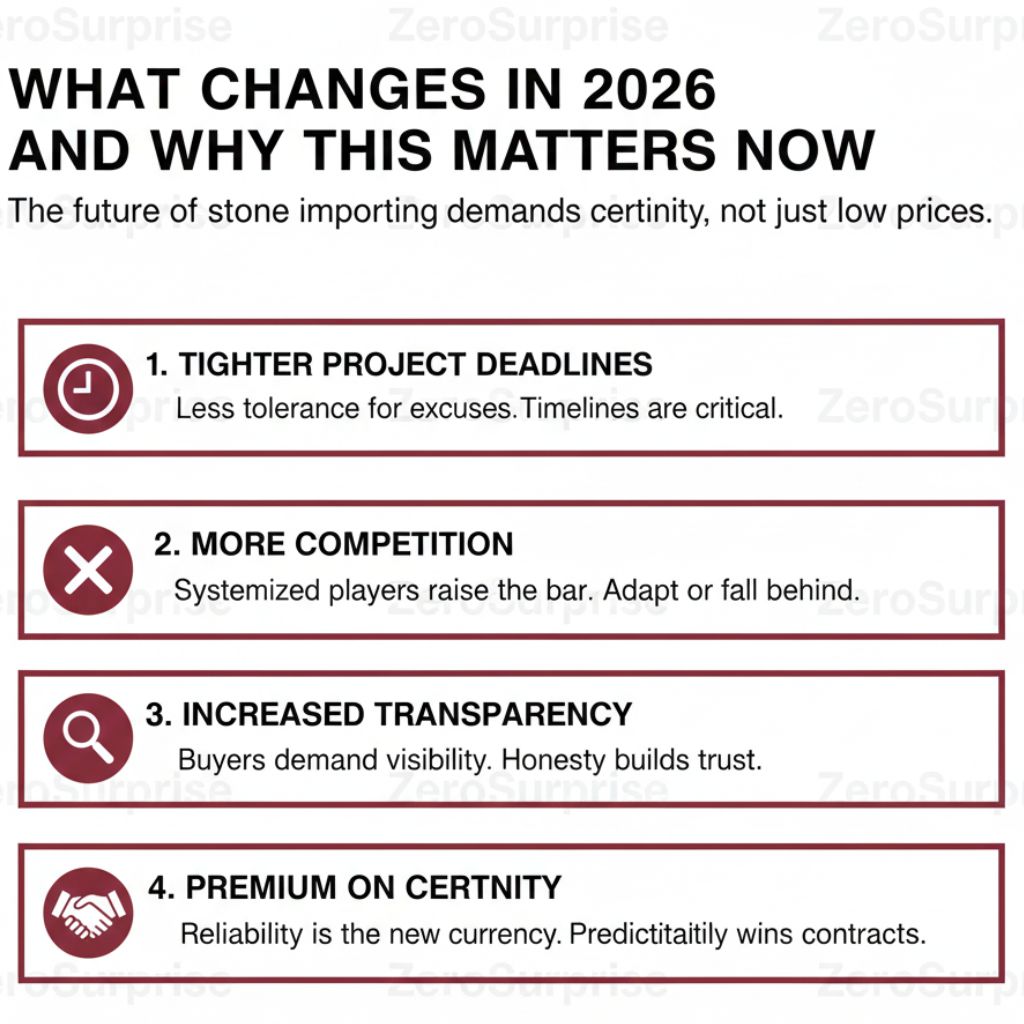
What Changes in 2026 and Why This Matters Now
In 2026, stone importers face:
- Tighter project deadlines
- Less tolerance for excuses
- More competition from systemized players
- Increased transparency expectations
Buyers are no longer impressed by low prices alone.
They want certainty.
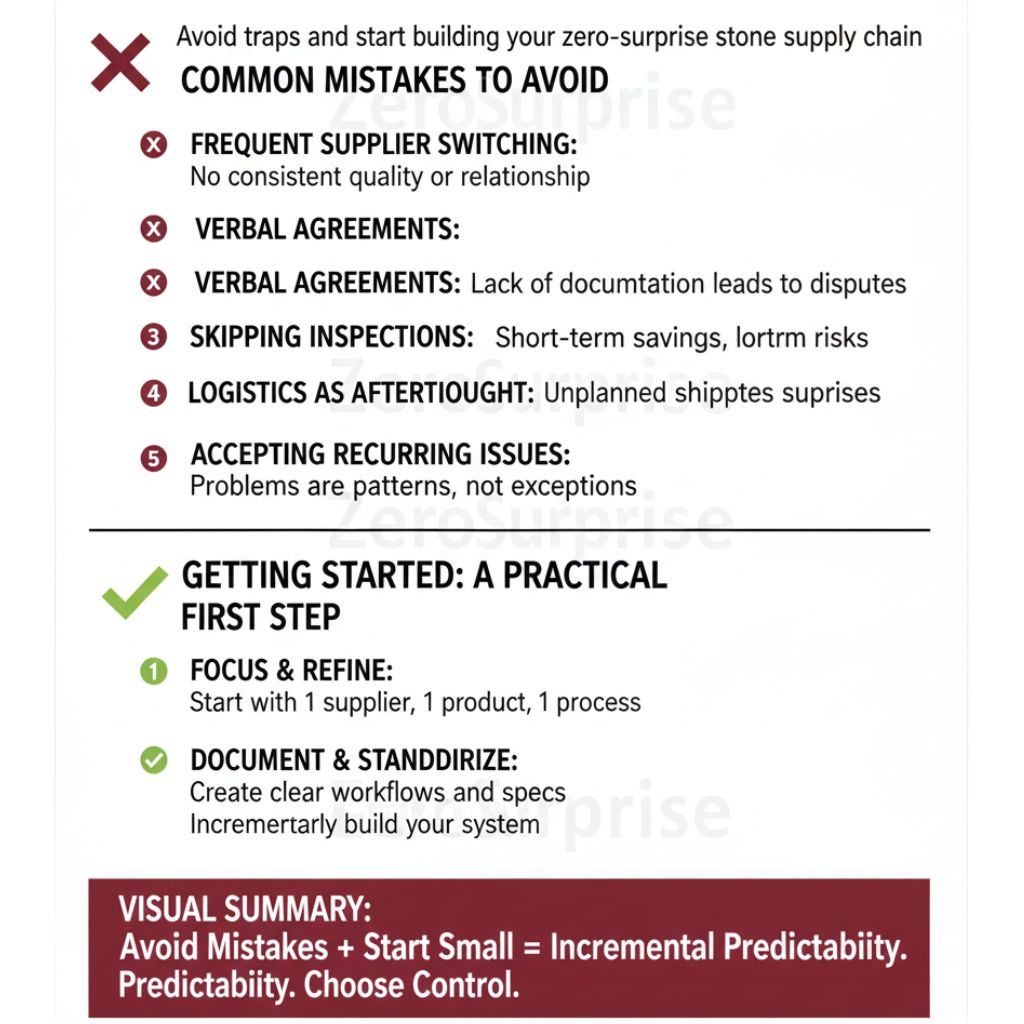
Common Mistakes That Prevent Zero Surprise Operations
Avoid these traps:
- Switching suppliers too frequently
- Over-relying on verbal agreements
- Skipping inspections to save cost
- Treating logistics as an afterthought
- Accepting recurring issues as “normal”
Predictability is a choice.
Getting Started: A Practical First Step
You do not need to overhaul everything at once.
Start with:
- One core supplier
- One product line
- One standardized process
Refine it. Document it. Replicate it.
Zero-surprise systems are built incrementally.
Final Thoughts: Predictability Is the New Competitive Advantage
In the stone industry, everyone has access to quarries.
Everyone claims quality.
Everyone promises competitive pricing.
What separates leading importers in 2026 is operational certainty.
A zero-surprise stone supply chain:
- Protects margins
- Strengthens reputation
- Enables growth
- Reduces stress
And most importantly, it turns sourcing from a risk into a strategic asset.
If your goal is to build a resilient, scalable marble and granite supply chain, predictability is no longer optional it is essential Contact US.