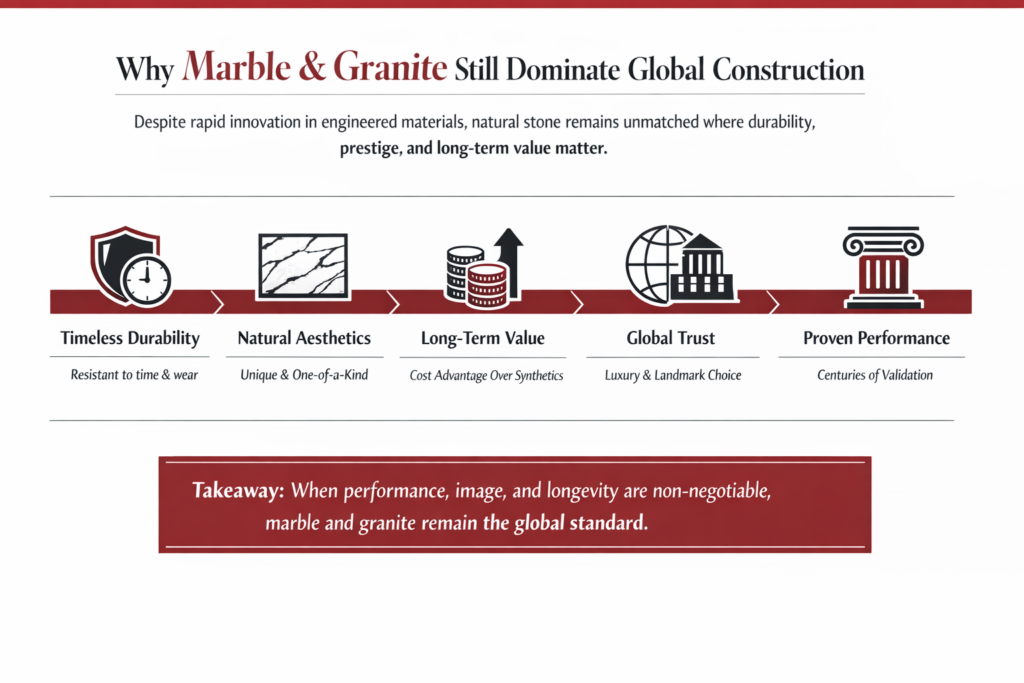
Despite rapid innovation in engineered materials, composites, and synthetic surfaces, marble and granite continue to dominate high value construction and architectural projects worldwide. From luxury residences and commercial landmarks to large-scale infrastructure developments, natural stone remains the material of choice when durability, aesthetics, and long-term value are non-negotiable.
This reality raises two critical questions for developers, importers, and industry professionals:
Why do marble and granite continue to outperform modern alternatives?
And why do some marble and granite suppliers succeed globally while others struggle to compete?
In this article, we explore the marble and granite industry, analyze the forces shaping the natural stone market, and share practical insights into sourcing, quality, and export dynamics. The goal is to help you understand what truly drives success in this industry.
Marble and Granite: More Than Traditional Building Materials
At first glance, marble and granite may appear to be legacy materials in an industry increasingly focused on innovation. In reality, they occupy a category of their own.
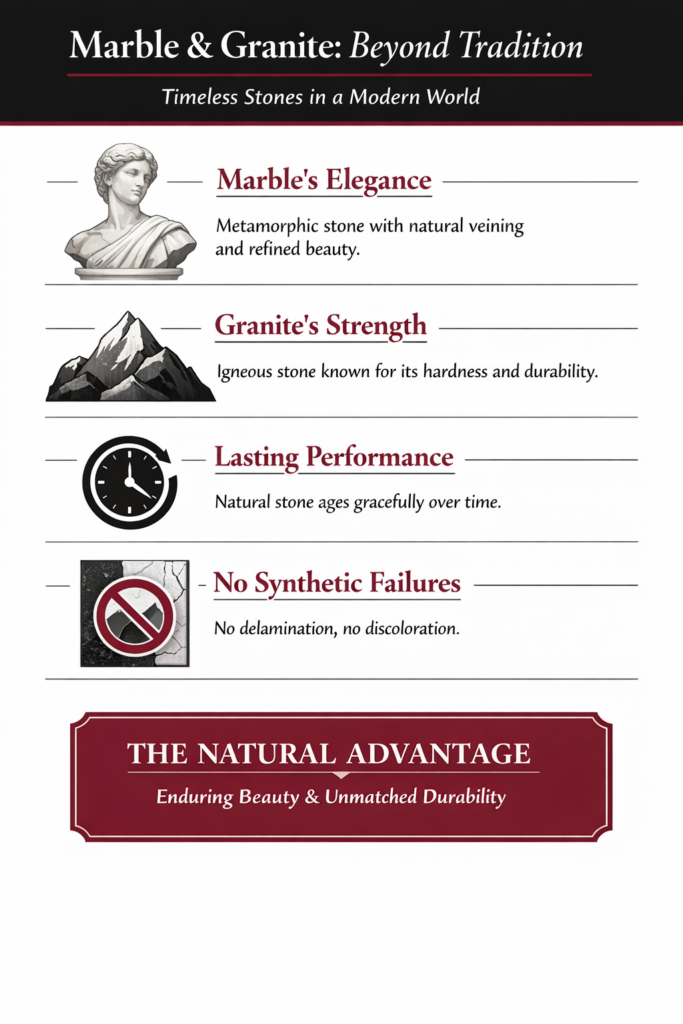
Marble is a metamorphic stone prized for its elegance, natural veining, and visual depth. It has been used for centuries in iconic architecture, sculpture, and refined interiors. Granite, an igneous stone, is known for its exceptional hardness, strength, and resistance to wear. These characteristics make it ideal for demanding environments and exterior applications.
What truly separates marble and granite from engineered materials is not just their appearance, but their performance over time.
Natural stone ages gracefully. It does not delaminate, discolor artificially, or lose structural integrity the way many synthetic alternatives do. In premium construction, longevity is not a preference. It is an expectation.
The Global Natural Stone Market at a Glance
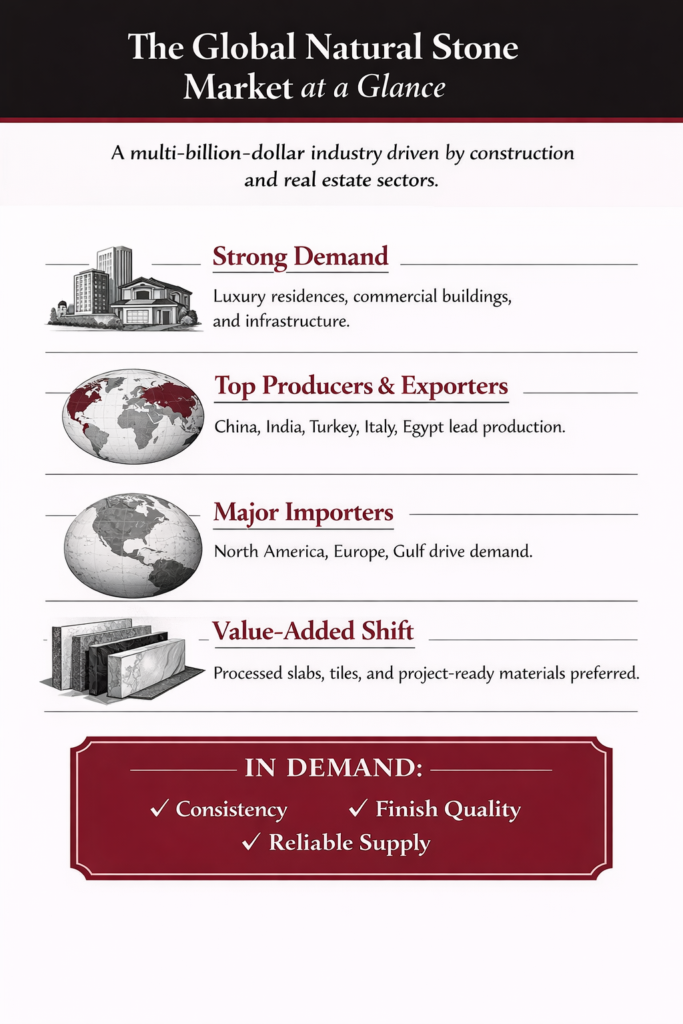
The natural stone market, particularly the marble and granite segment, represents a multi-billion-dollar global industry driven by construction, real estate, and infrastructure development.
Demand remains strong across several key sectors:
- Luxury residential projects
- Commercial buildings and hotels
- Airports, malls, and public infrastructure
- Urban redevelopment and landmark architecture
Leading producing and exporting countries such as China, India, Turkey, Italy, and Egypt continue to supply global markets. Major importing regions, including North America, Europe, and the Gulf, drive demand for high-quality stone products.
What stands out today is not just trade volume, but a clear shift toward value-added products. Buyers increasingly prefer processed slabs, tiles, and project-ready materials over raw blocks. This places greater emphasis on consistency, finish quality, and supply reliability.
Why Marble and Granite Continue to Dominate High-Value Projects
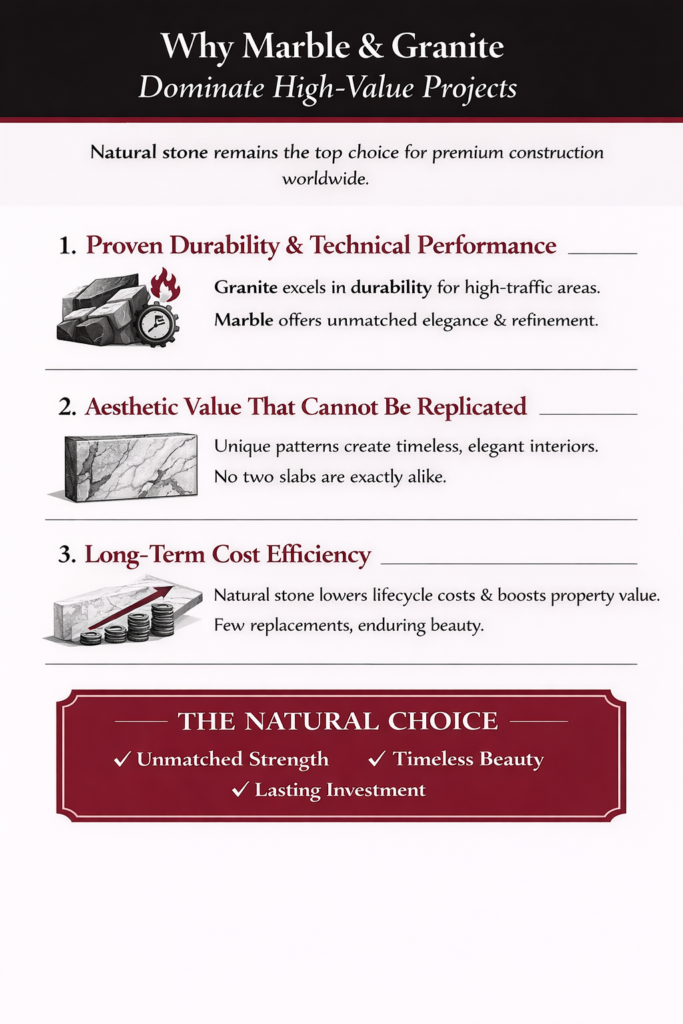
1. Proven Durability and Technical Performance
Granite offers exceptional compressive strength and resistance to heat, moisture, and abrasion. These characteristics make it ideal for:
- High-traffic flooring
- Exterior cladding
- Kitchen countertops
- Commercial and public spaces
Marble, while softer, remains unmatched in applications where visual impact and refinement are critical. Examples include hotel lobbies, staircases, facades, and luxury interiors.
For projects expected to perform for decades, natural stone provides a level of confidence that engineered materials often fail to match.
2. Aesthetic Value That Cannot Be Replicated
No engineered surface can truly replicate the depth, variation, and natural movement found in marble and granite.
Each slab is unique.
Each installation becomes distinctive.
For architects and developers working on premium projects, this uniqueness translates into design differentiation, brand value, and lasting appeal. This is why marble and granite remain central to iconic buildings across the globe.
3. Long-Term Cost Efficiency
While natural stone may carry a higher upfront cost, its lifecycle value is often superior.
Marble and granite:
- Require fewer replacements
- Maintain their appearance over time
- Contribute to higher property resale value
As decision-makers increasingly evaluate materials based on total cost of ownership, natural stone continues to justify its position in high-end construction.
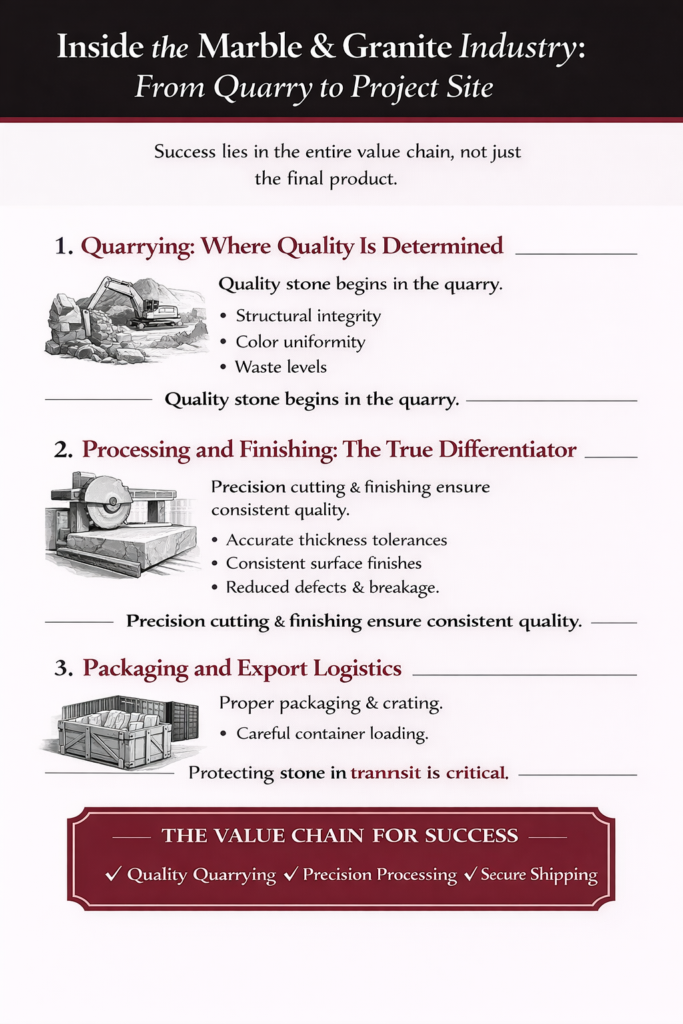
Inside the Marble and Granite Industry: From Quarry to Project Site
To understand why some suppliers succeed globally, it is essential to look at the entire value chain, not just the finished product.
Quarrying: Where Quality Is Determined
Quality stone begins at the quarry.
Block selection, extraction methods, and geological consistency directly affect:
- Structural integrity
- Color uniformity
- Waste levels
Poor quarrying practices lead to inconsistent material and high rejection rates. These are issues that no amount of downstream processing can fully correct.
Processing and Finishing: The True Differentiator
Modern buyers do not simply purchase stone. They purchase precision and predictability.
Advanced cutting and finishing technology allows suppliers to deliver:
- Accurate thickness tolerances
- Consistent surface finishes
- Reduced defects and breakage
Suppliers who invest in modern processing capabilities consistently outperform those relying on outdated methods.
Packaging and Export Logistics
In the marble and granite export business, damage equals lost margin.
Professional exporters understand that proper packaging, crating, and container loading are critical. Surface damage, breakage, or moisture exposure during transit can quickly turn a profitable shipment into a loss.
Successful marble and granite suppliers design export systems that protect the product until it reaches its final destination, without compromise.
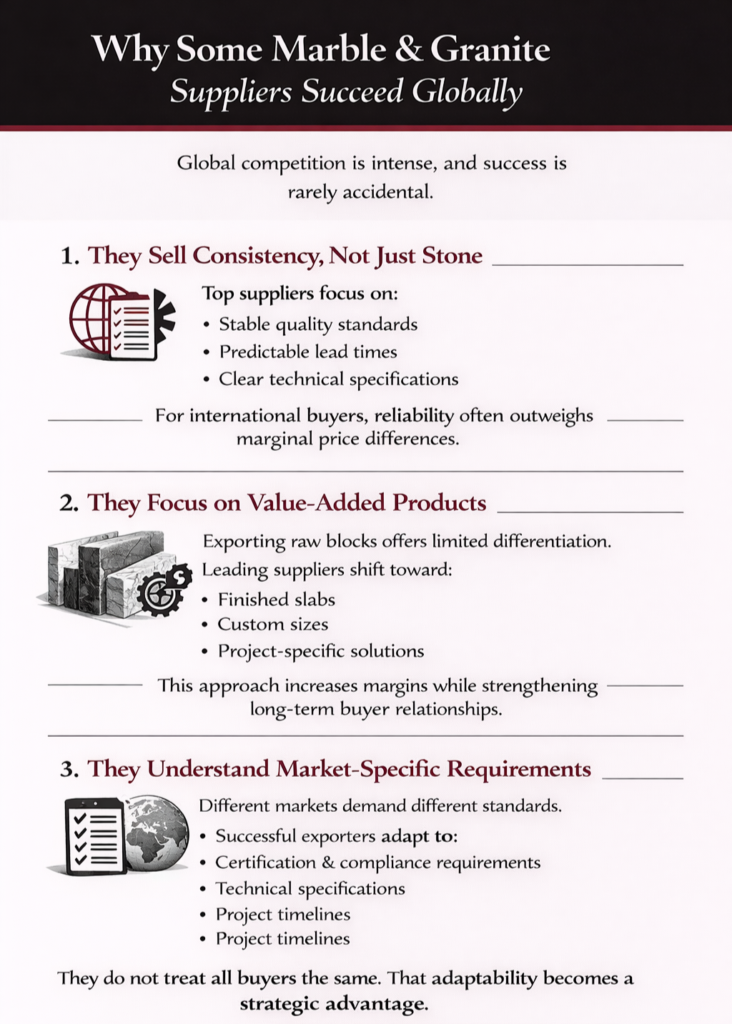
Why Some Marble and Granite Suppliers Succeed Globally
Global competition is intense, and success is rarely accidental.
1. They Sell Consistency, Not Just Stone
Top suppliers focus on:
- Stable quality standards
- Predictable lead times
- Clear technical specifications
For international buyers, reliability often outweighs marginal price differences.
2. They Focus on Value-Added Products
Exporting raw blocks offers limited differentiation. Leading suppliers shift toward:
- Finished slabs
- Custom sizes
- Project-specific solutions
This approach increases margins while strengthening long-term buyer relationships.
3. They Understand Market-Specific Requirements
Different markets demand different standards.
Successful exporters adapt to:
- Certification and compliance requirements
- Technical specifications
- Cultural expectations
- Project timelines
They do not treat all buyers the same. That adaptability becomes a strategic advantage.
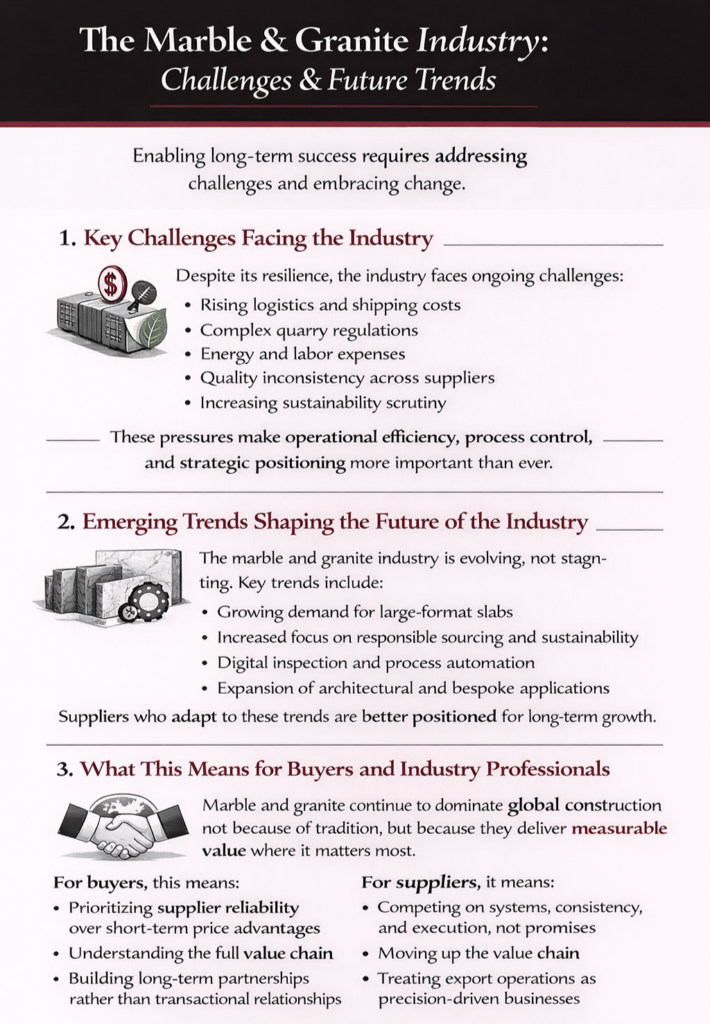
Key Challenges Facing the Marble and Granite Industry
Despite its resilience, the industry faces ongoing challenges:
- Rising logistics and shipping costs
- Complex quarry regulations
- Energy and labor expenses
- Quality inconsistency across suppliers
- Increasing sustainability scrutiny
These pressures make operational efficiency, process control, and strategic positioning more important than ever.
Emerging Trends Shaping the Future of the Industry
The marble and granite industry is evolving, not stagnating.
Key trends include:
- Growing demand for large-format slabs
- Increased focus on responsible sourcing and sustainability
- Digital inspection and process automation
- Expansion of architectural and bespoke applications
Suppliers who adapt to these trends are better positioned for long-term growth.
What This Means for Buyers and Industry Professionals
Marble and granite continue to dominate global construction not because of tradition, but because they deliver measurable value where it matters most.
For buyers, this means:
- Prioritizing supplier reliability over short-term price advantages
- Understanding the full value chain
- Building long-term partnerships rather than transactional relationships
For suppliers, it means:
- Competing on systems, consistency, and execution, not promises
- Moving up the value chain
- Treating export operations as precision-driven businesses
Conclusion: Natural Stone Is a Strategic Choice, Not a Commodity
In a market saturated with alternatives, marble and granite remain the benchmark for premium construction. Their dominance is not accidental. It is built on durability, aesthetics, and long-term value.
As the natural stone market continues to evolve, success will belong to those who recognize that marble and granite are not just materials, but strategic assets in global construction
Here is Inspiration and examples for interior and exterior projects.
The real question is no longer whether marble and granite will remain relevant, but who will supply them the right way.