Egyptian Marble Price Explained: Key Factors That Affect Cost Per Square Meter
Egyptian Marble price per sqm? is one of the first questions buyers ask when sourcing natural stone. But behind that seemingly straightforward number lies a complex structure of variables that directly influence the final cost. Whether you're a contractor, architect, importer, or procurement manager, understanding what drives marble pricing especially
Read More
Shipping Marble from Egypt Hidden Costs Nobody Tells You About in 2026
Two importers order marble from Egypt at the same price.One builds strong margins and scales his business. The other struggles with losses despite thinking he made a smart deal. What went wrong? The answer is simple: hidden costs. Most buyers focus only on the FOB or CIF price, assuming that’s
Read More
Egyptian Marble vs The World The Geographic Arbitrage Advantage 2026
When evaluating Egyptian Marble vs The World In the global natural stone market, the "Made in Italy" stamp has long been the gold standard for luxury. But in 2026, savvy B2B buyers like distributors, architects, and large-scale developers are looking past the label and toward the ledger. As energy costs
Read More
7 Operational Bottlenecks That Delay Marble and Granite Shipments and How to Avoid Them
Marble and granite shipments are critical to exporters. Every day, marble and granite exporters lose time and money due to preventable shipment delays. Whether it’s a busy quarry, slow logistics, or last-minute quality issues, these bottlenecks can disrupt cashflow, frustrate clients, and damage reputations. If you’ve ever faced delayed deliveries,
Read More
Essential Risk Management for Stone Importers in Times of Geopolitical Instability
Risk Management for Stone Importers has become a strategic necessity in today’s volatile geopolitical environment. The ongoing escalation involving Iran, Israel, and the United States has introduced renewed instability across global trade networks. While ports remain operational and commerce continues, indirect consequences are already affecting freight pricing, marine insurance structures,
Read More
Egyptian Marble and Granite 2026: How Egypt is Solving the European Supply Chain Crisis
Egyptian marble and granite 2026 are transforming how European importers solve supply chain crises.Picture a construction site in Southern Europe. The scaffolding is up.The installation teams are scheduled.The contractor is expecting delivery. But the stone containers are still at sea. Days pass. Then weeks. Work slows. Payment milestones shift. Penalty
Read More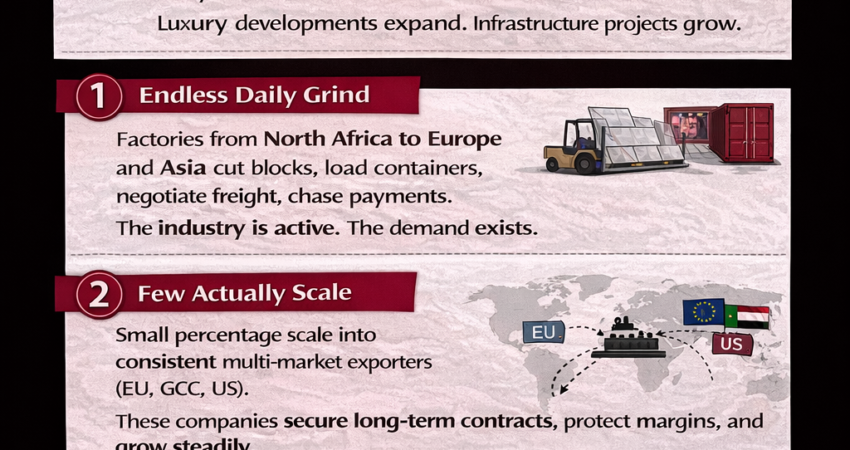
Why Some Marble Exporters in Egypt Stay Small And Others Scale Internationally
Marble exporters in Egypt Thousands of marble exporters operate globally yet only a small percentage build sustainable international brands. Across producing countries, from North Africa to Southern Europe and Asia, there are factories cutting blocks every day, loading containers, negotiating freight, and chasing payments. The industry is active. The demand
Read More
Marble and Granite Profitability: How Distributors Can Maximize Profit Per Square Meter
Marble and granite profitability is the key performance indicator that determines long term success for distributors and contractors in the natural stone industry. Every square meter counts not only in terms of material coverage but also in terms of margin optimization and net return. Understanding which stones generate the highest
Read MoreMarble and Granite Industry: Why Natural Stone Still Dominates Global Construction
Despite rapid innovation in engineered materials, composites, and synthetic surfaces, marble and granite continue to dominate high value construction and architectural projects worldwide. From luxury residences and commercial landmarks to large-scale infrastructure developments, natural stone remains the material of choice when durability, aesthetics, and long-term value are non-negotiable. This reality
Read More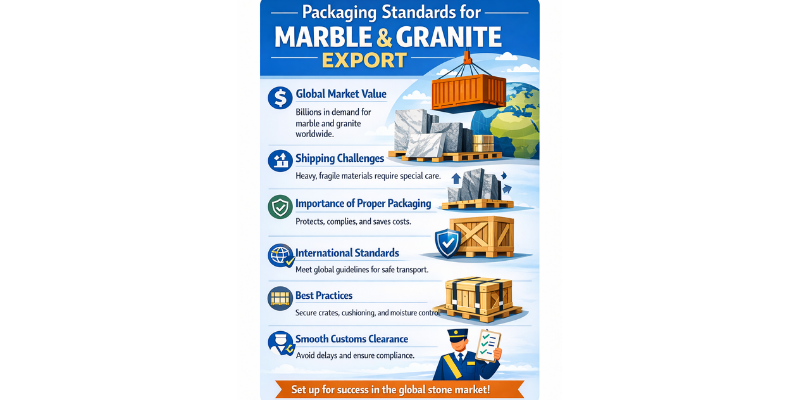
International Packaging Standards for Marble and Granite Export A Complete Guide
International Packaging Standards for Marble and Granite Export play a critical role in protecting high-value natural stone shipments across global markets. The global natural stone market is worth billions of dollars, with marble and granite being among the most sought-after materials for construction, interior design, and architectural projects worldwide. However,
Read More