Cheap stone is a decision every project manager has faced at least once.
You are reviewing bids. One stone supplier comes in significantly lower than the rest. On paper, it looks like a win: reduced material cost, improved margins, easier approval from finance. The pressure to optimize the project budget is real, and stone, being a high-volume material, seems like an obvious place to cut costs.
But experienced project managers know a hard truth that rarely appears in spreadsheets:
the initial price of stone is rarely its real cost.
In large scale developments such as hotels, commercial buildings, and residential projects, the choice of stone directly affects timelines, labor efficiency, maintenance cycles, client satisfaction, and even your professional reputation. What appears as a cost saving during procurement often reappears later as rework, delays, disputes, and budget overruns.
This article is a reality check.
Not from a supplier’s marketing perspective, but from a project level, cost of ownership lens.
We will break down:
- Why cheap stone creates false economies
- How stone quality impacts total project cost, not just material line items
- A clear comparison between initial price and real project cost
- ROI calculations that justify investing in the right stone
- Three real-world case scenarios across hospitality, commercial, and residential developments
- A practical visual cost calculator framework you can use internally
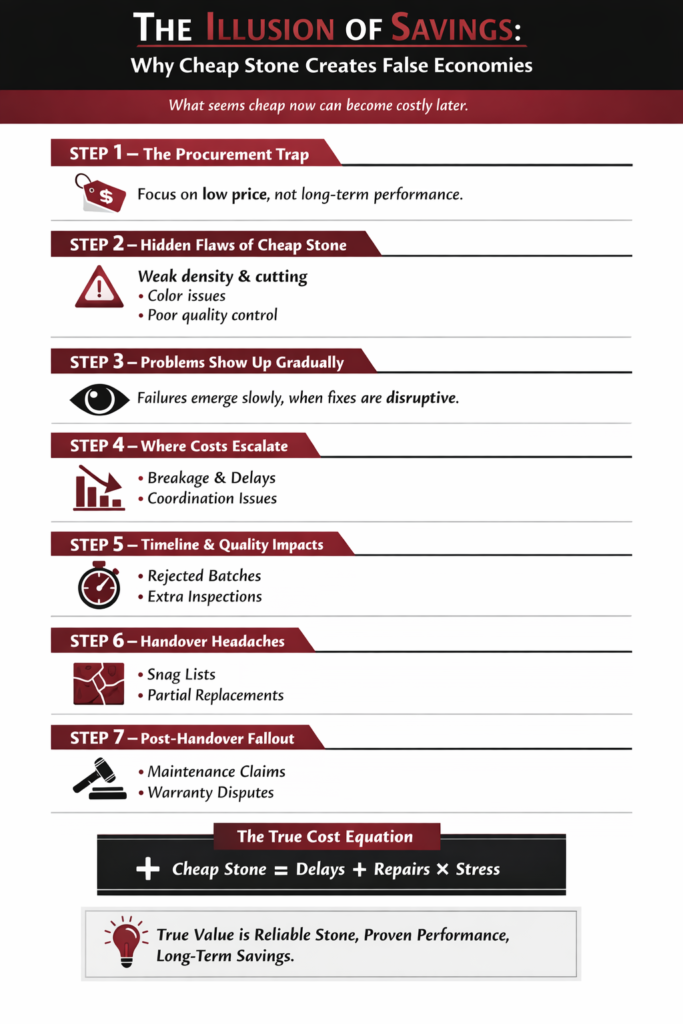
The Illusion of Savings Why Cheap Stone Creates False Economies
The Procurement Trap
Most procurement processes reward unit price optimization, not lifecycle performance.
When stone is evaluated primarily on:
- Price per square meter
- Visual similarity in samples
- Supplier promises rather than documented performance
The decision becomes dangerously short-sighted.
Cheap stone typically comes with hidden technical compromises, such as:
- Inconsistent density and porosity
- Poor cutting precision
- Unstable coloration or veining
- Inadequate quality control at quarry or factory level
These compromises rarely show up in the showroom sample. They show up on site.
Where the Real Costs Emerge
Cheap stone does not fail immediately. It fails gradually and expensively across multiple project phases:
| Phase | Hidden Cost Impact |
| Installation | Higher breakage rates, slower installation, skilled labor overruns |
| Coordination | Re-alignment with architects, consultants, and suppliers |
| Timeline | Delays caused by rejected batches or re-ordering |
| Quality Control | Increased inspections, mock-up revisions, approvals |
| Handover | Snag lists, aesthetic complaints, partial replacements |
| Post-handover | Maintenance claims, warranty disputes, reputational damage |
In other words, cheap stone shifts cost forward in time, then multiplies it in magnitude.
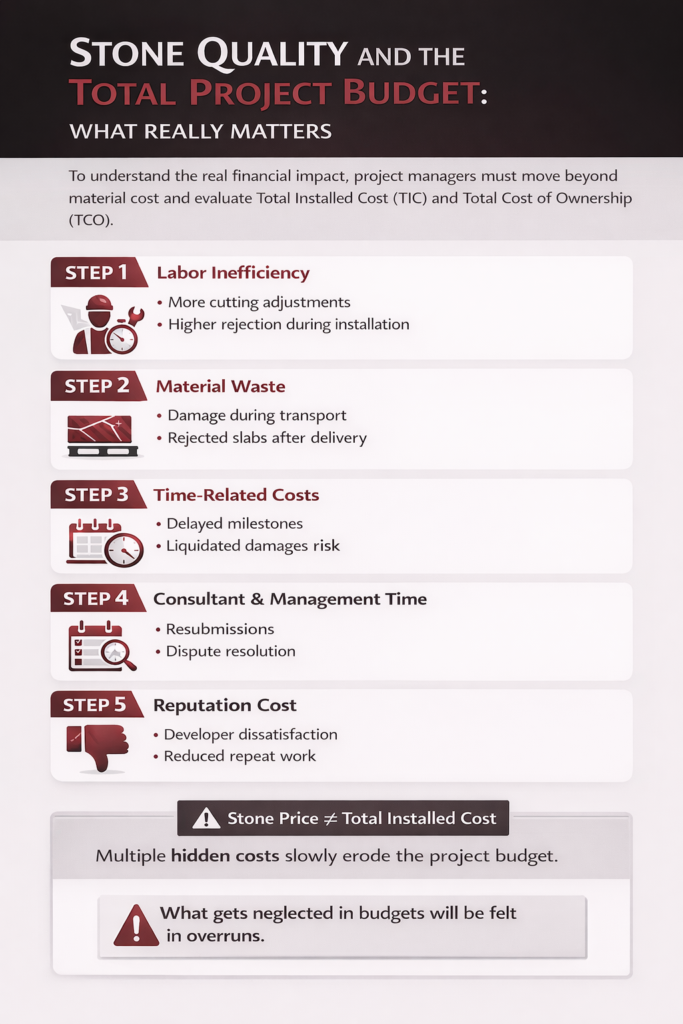
Stone Quality and the Total Project Budget What Really Matters
To understand the real financial impact, project managers must move beyond material cost and evaluate Total Installed Cost (TIC) and Total Cost of Ownership (TCO).
Cost Categories Most Budgets Ignore
When stone quality is compromised, the following costs increase, often silently:
- Labor Inefficiency
- More cutting adjustments
- Slower alignment
- Higher rejection during installation
- Material Waste
- Breakage during transport
- Higher off-cut ratios
- Rejected slabs after delivery
- Time-Related Costs
- Delayed milestones
- Extended site overheads
- Liquidated damages risk
- Consultant and Management Time
- Re-submissions
- Additional inspections
- Dispute resolution
- Reputation Cost
- Developer dissatisfaction
- Consultant distrust
- Reduced chances of repeat projects
None of these appear under “stone price per square meter.”
All of them hit the project budget.
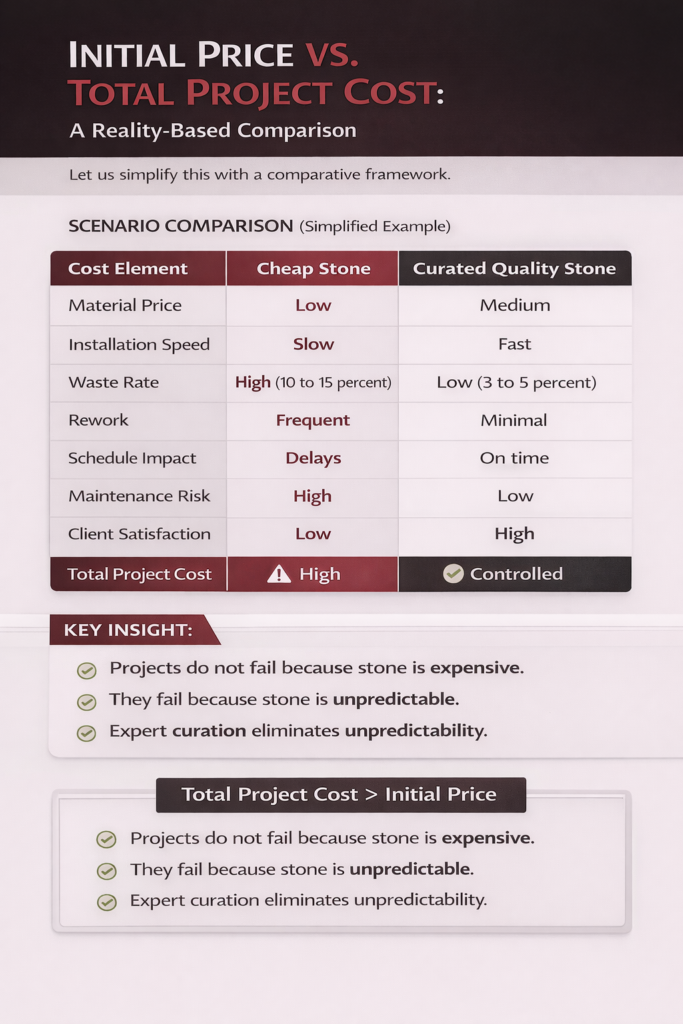
Initial Price vs. Total Project Cost: A Reality Based Comparison
Let us simplify this with a comparative framework.
Scenario Comparison (Simplified Example)
| Cost Element | Cheap Stone | Curated Quality Stone |
| Material Price | Low | Medium |
| Installation Speed | Slow | Fast |
| Waste Rate | High (10 to 15 percent) | Low (3 to 5 percent) |
| Rework | Frequent | Minimal |
| Schedule Impact | Delays | On time |
| Maintenance Risk | High | Low |
| Client Satisfaction | Low | High |
| Total Project Cost | High | Controlled |
Key Insight:
Projects do not fail because stone is expensive.
They fail because stone is unpredictable.
Expert curation eliminates unpredictability for more info.
Quality Differentiation: What “Good Stone” Actually Means
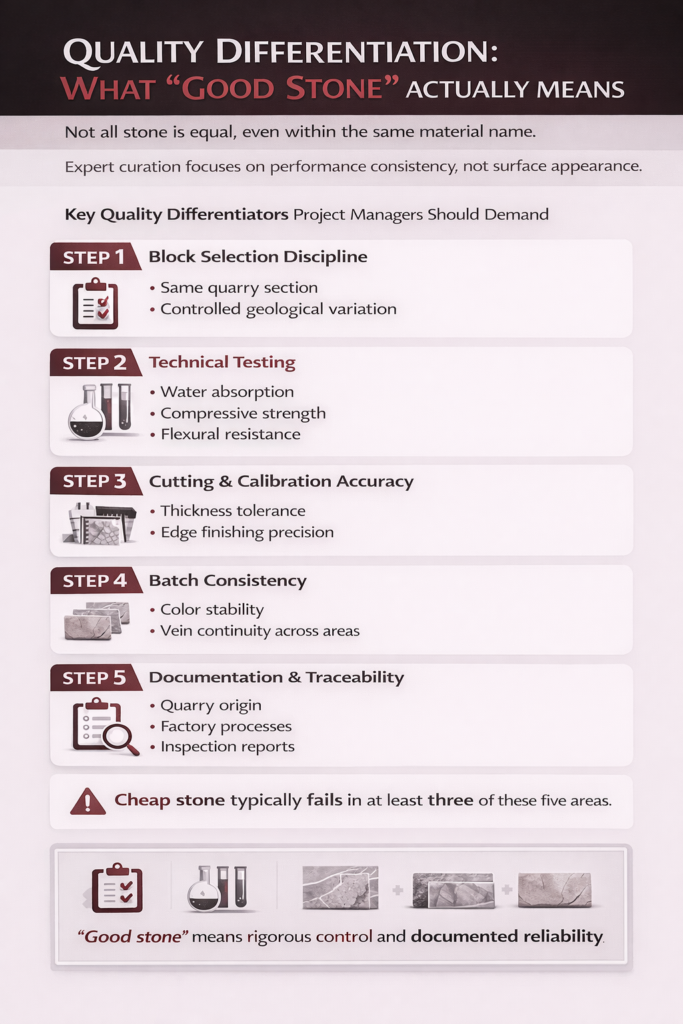
Not all stone is equal, even within the same material name.
Expert curation focuses on performance consistency, not surface appearance.
Key Quality Differentiators Project Managers Should Demand
- Block Selection Discipline
- Same quarry section
- Controlled geological variation
- Technical Testing
- Water absorption
- Compressive strength
- Flexural resistance
- Cutting and Calibration Accuracy
- Thickness tolerance
- Edge finishing precision
- Batch Consistency
- Color stability
- Vein continuity across areas
- Documentation and Traceability
- Quarry origin
- Factory processes
- Inspection reports
Cheap stone typically fails in at least three of these five areas.
Case Example 1: Luxury Hotel Project
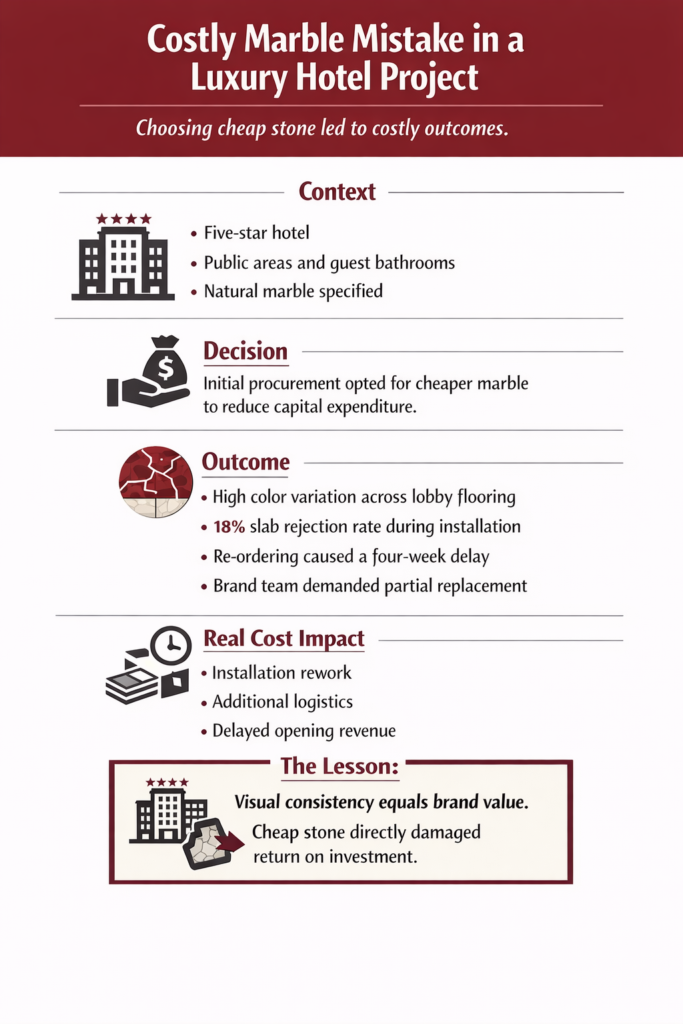
Context:
- Five-star hotel
- Public areas and guest bathrooms
- Natural marble specified
Decision:
Initial procurement opted for cheaper marble to reduce capital expenditure.
Outcome:
- High color variation across lobby flooring
- Eighteen percent slab rejection rate during installation
- Re-ordering caused a four-week delay
- Brand team demanded partial replacement
Real Cost Impact:
- Installation rework
- Additional logistics
- Delayed opening revenue
Lesson:
In hospitality, visual consistency equals brand value. Cheap stone directly damaged return on investment.
Case Example 2: Office Building
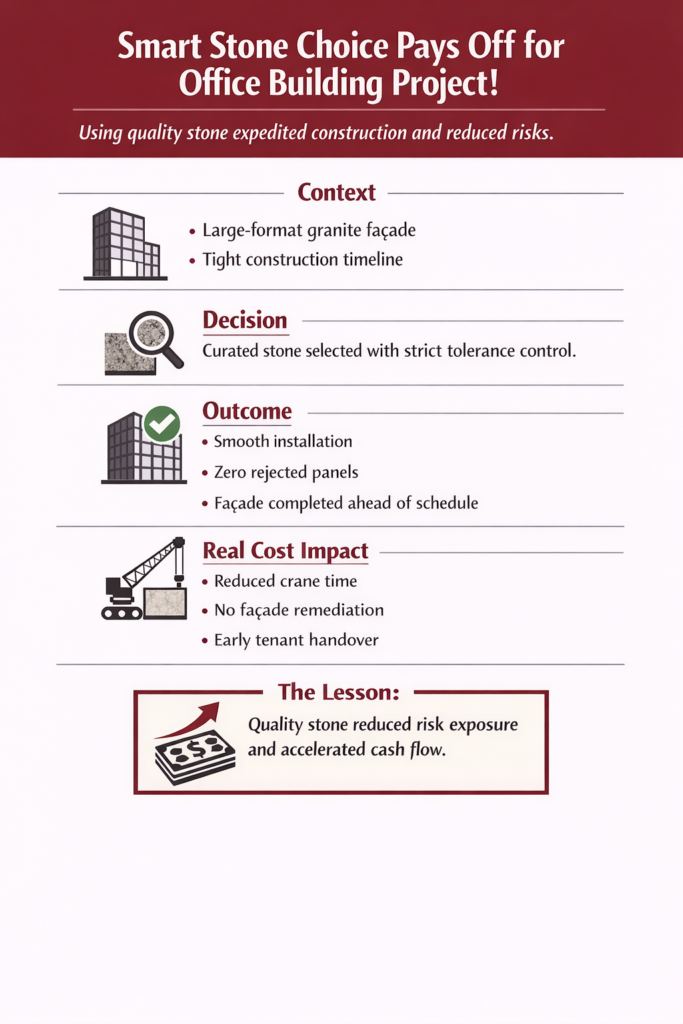
Context:
- Large-format granite façade
- Tight construction timeline
Decision:
Curated stone selected with strict tolerance control.
Outcome:
- Smooth installation
- Zero rejected panels
- Façade completed ahead of schedule
Real Cost Impact:
- Reduced crane time
- No façade remediation
- Early tenant handover
Lesson:
Quality stone reduced risk exposure and accelerated cash flow.
Case Example 3: Residential Development
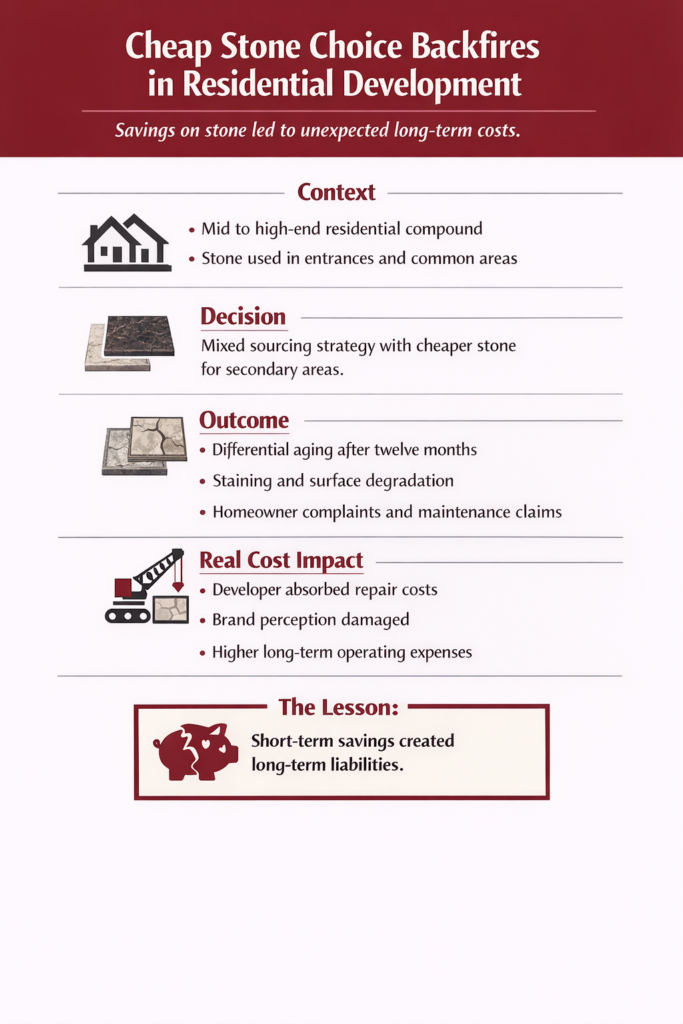
Context:
- Mid to high-end residential compound
- Stone used in entrances and common areas
Decision:
Mixed sourcing strategy with cheaper stone for secondary areas.
Outcome:
- Differential aging after twelve months
- Staining and surface degradation
- Homeowner complaints and maintenance claims
Real Cost Impact:
- Developer absorbed repair costs
- Brand perception damaged
- Higher long-term operating expenses
Lesson:
Short-term savings created long-term liabilities.
Conclusion: Cheap Stone Is Not a Cost Strategy
For project managers and real estate developers, stone is not just a material.
It is a risk variable.
The real question is not:
“How cheap can we buy stone?”
It is:
“How predictable can we make this project?”
Expertly curated stone reduces uncertainty, protects timelines, preserves budgets, and safeguards reputations.
In an industry where margins are tight and accountability is high, cheap stone is often the most expensive mistake on site.
The smartest projects are not built with the lowest prices.
They are built with the right decisions, made early.
Ready to make the right decision for your project? Contact us today to discuss how our expertly curated stone can protect your budget, timelines, and reputation.