Egyptian marble and granite 2026 are transforming how European importers solve supply chain crises.
Picture a construction site in Southern Europe.
The scaffolding is up.
The installation teams are scheduled.
The contractor is expecting delivery.
But the stone containers are still at sea.
Days pass. Then weeks. Work slows. Payment milestones shift. Penalty clauses activate. Cash flow tightens. Confidence erodes.
In today’s tightly synchronized global supply chains, a 30-day delay is not a logistical inconvenience it is a financial shockwave. Modern distribution operates on lean inventories and strict timelines. When materials fail to arrive, disruption spreads quickly across the entire project.
For years, sourcing decisions centered on one metric: unit price. Lower cost meant higher margin. That logic worked until volatility exposed its weakness.
Now, as we approach 2026, the real question has changed:
Are you buying cheaply or buying safely?
How Egyptian marble and granite 2026 solve supply chain challenges
Why It Worked for So Long
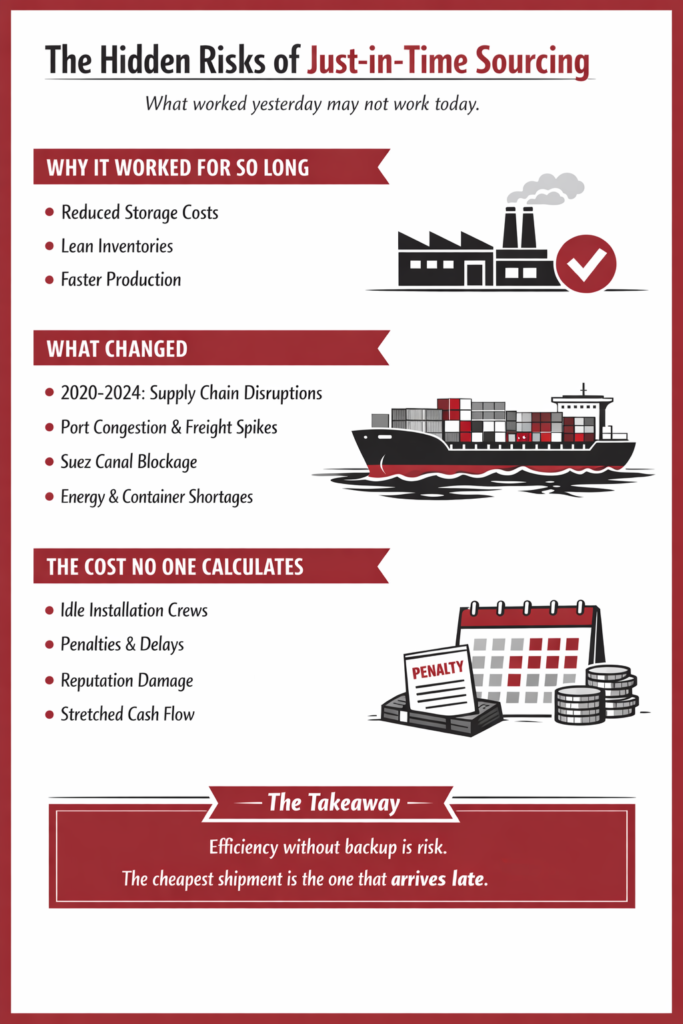
The Just-in-Time (JIT) model, widely associated with the production philosophy of Toyota Motor Corporation, revolutionized operational efficiency. It reduced storage costs, minimized idle inventory, and improved capital turnover.
Under stable trade conditions, JIT was brilliant. Companies moved faster. Balance sheets looked stronger. Warehouses became lean.
But JIT relies on uninterrupted flow. And global trade is no longer uninterrupted.
What Changed
Between 2020 and 2024, supply chains faced sustained disruption. Freight rates spiked unpredictably. Port congestion delayed shipments across continents. Energy costs surged. Container shortages created planning chaos.
Then came the 2021 blockage of the Suez Canal a single event that froze nearly 12% of global trade. That moment crystallized a new reality: efficiency without redundancy equals vulnerability.
Suddenly, “optimized” meant “exposed.”
The Cost No One Calculates
For marble and granite importers, delay carries consequences that rarely appear in supplier quotes:
Installation teams sit idle.
Developers enforce penalties.
Project reputations weaken.
Cash cycles stretch.
What looked like savings on paper often becomes loss in practice.
The industry learned an uncomfortable truth: the cheapest shipment is expensive when it arrives late.
The Shift Toward Just in Case Strategy
As volatility became structural rather than temporary, procurement strategy evolved.
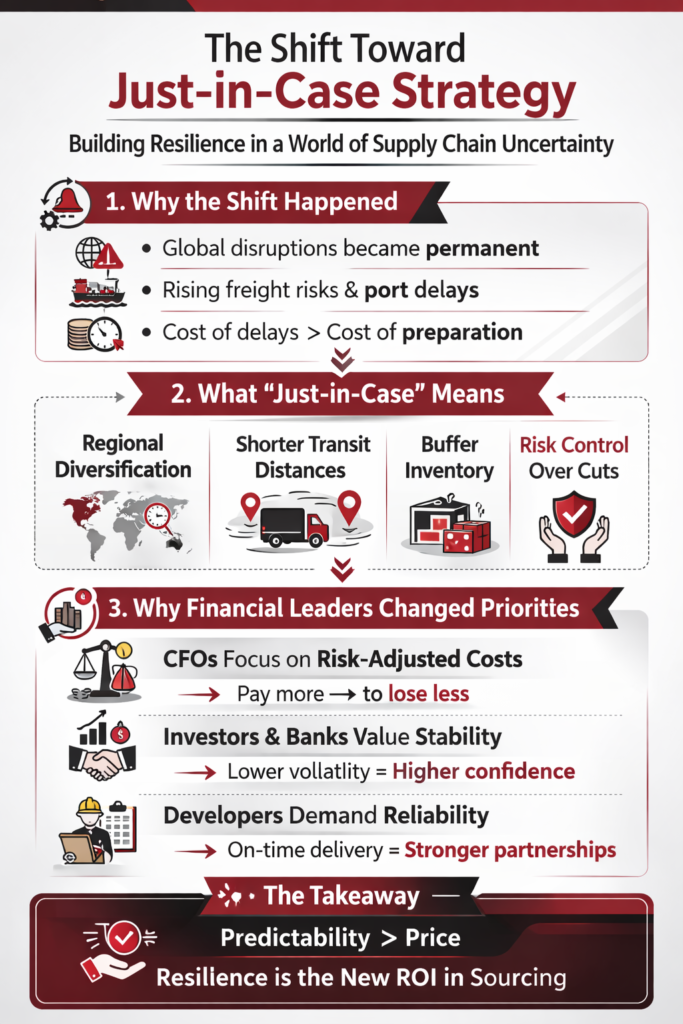
“Just-in-Case” does not mean inefficiency. It means resilience by design.
It involves regional diversification.
It shortens transit distances.
It reduces exposure to unpredictable global chokepoints.
The goal is not maximum cost reduction. It is controlled risk.
Predictability now holds more value than marginal savings.
Why Financial Leaders Changed Their Priorities
CFOs increasingly evaluate sourcing decisions through risk-adjusted modeling. A slightly higher unit price becomes acceptable if it reduces exposure to costly disruption.
Investors favor companies with stable supply chains. Banks prefer predictable cash cycles. Developers reward reliable delivery partners.
Resilience is no longer operational it is financial strategy.
Nearshoring vs. Long Distance Offshoring
Transit time tells the story clearly.
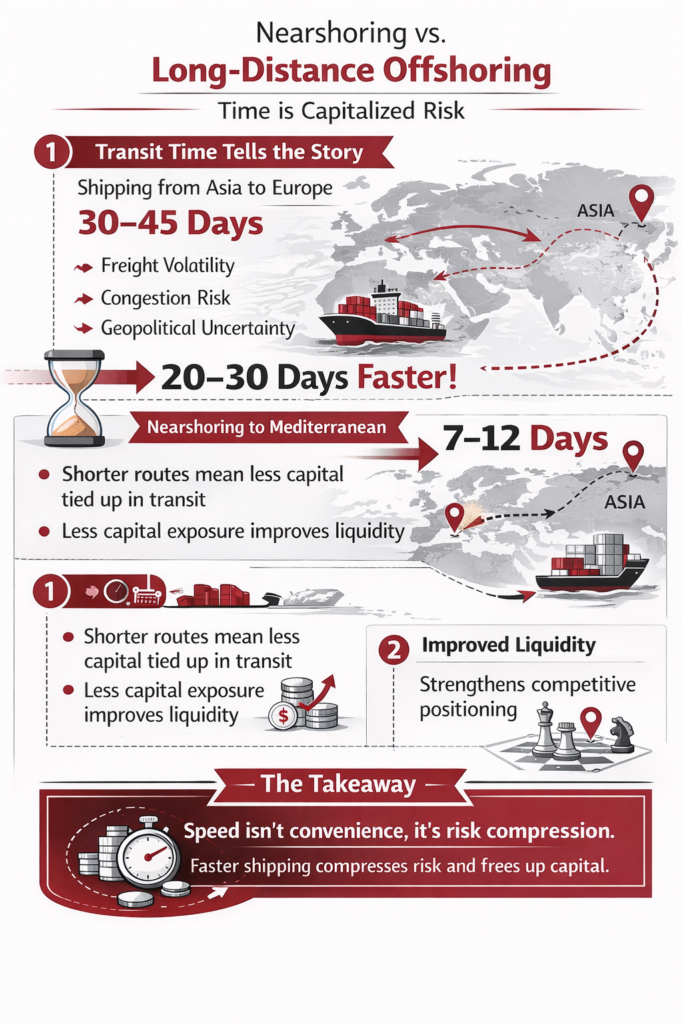
Shipping from Asia to Europe typically requires 30 – 45 days. That timeline includes exposure to freight volatility, congestion risk, and geopolitical uncertainty.
By contrast, Mediterranean sourcing reduces transit time to approximately 7–12 days.
That 20–30 day difference transforms operations.
Shorter routes mean less capital tied up in transit.
Less capital exposure improves liquidity.
Improved liquidity strengthens competitive positioning.
Speed, in this context, is not convenience. It is risk compression.
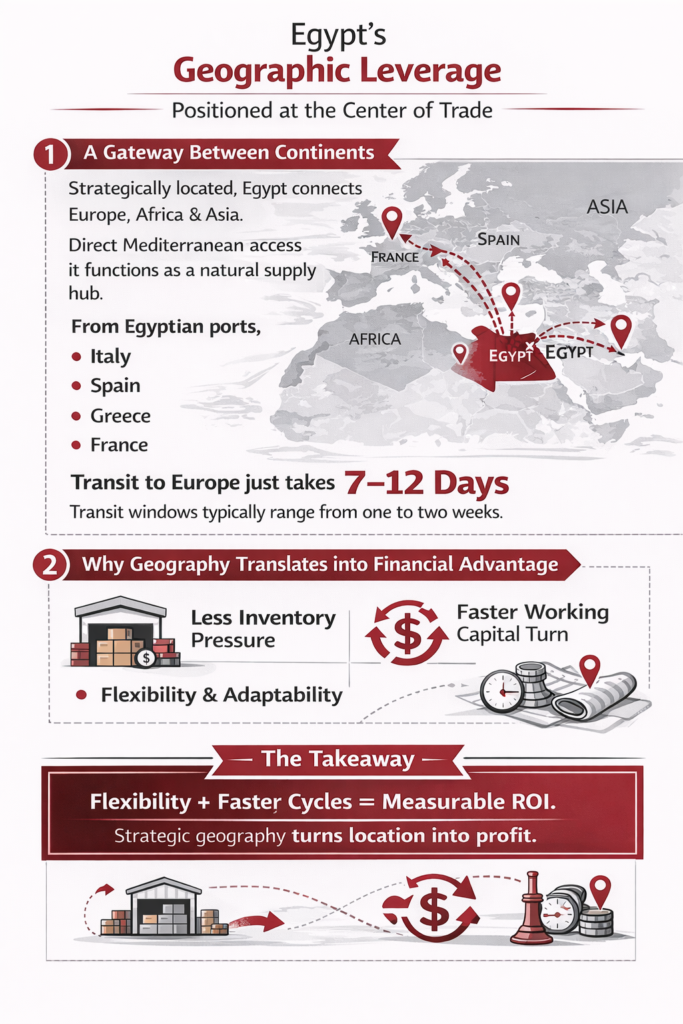
Egypt’s Geographic Leverage
Positioned at the Center of Trade
Egypt sits at a strategic crossroads connecting Europe, Africa, and Asia. With direct Mediterranean access, it functions as a natural regional supply hub.
From Egyptian ports, efficient routes serve:
- Italy
- Spain
- Greece
- France
Transit windows typically range between seven and twelve days, depending on the destination.
That proximity changes the economics of supply.
Why Geography Translates into Financial Advantage
A shorter shipping cycle reduces inventory pressure. Importers no longer need to hold excessive buffer stock. Working capital turns faster. Cash flow stabilizes.
Moreover, proximity allows flexibility. When architects adjust specifications or contractors accelerate timelines, importers can respond quickly.
Geography, when leveraged strategically, becomes measurable ROI.
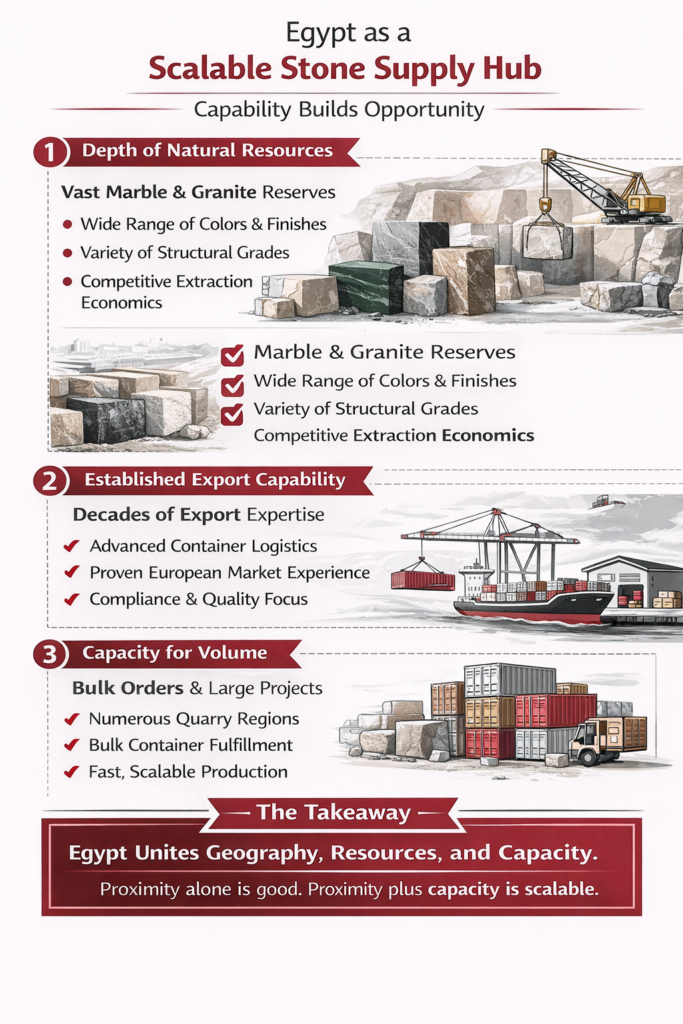
Egypt as a Scalable Stone Supply Hub
Location alone is not enough. Production capacity must support opportunity.
Depth of Natural Resources
Egypt holds substantial reserves of marble and granite across multiple quarry regions. The range of colors, finishes, and structural grades supports both residential and commercial projects.
Competitive extraction economics further strengthen export viability.
Established Export Capability
Egyptian exporters have long-standing experience serving European markets. Containerized logistics systems are mature. Suppliers understand EU compliance requirements and quality expectations.
This reduces onboarding risk and simplifies partnership integration.
Capacity for Volume
As European distributors reconsider nearshoring, scalability becomes decisive. Egyptian producers can manage bulk container orders and large commercial projects without compromising lead times.
Few sourcing regions combine proximity with volume capacity.
Egypt does.
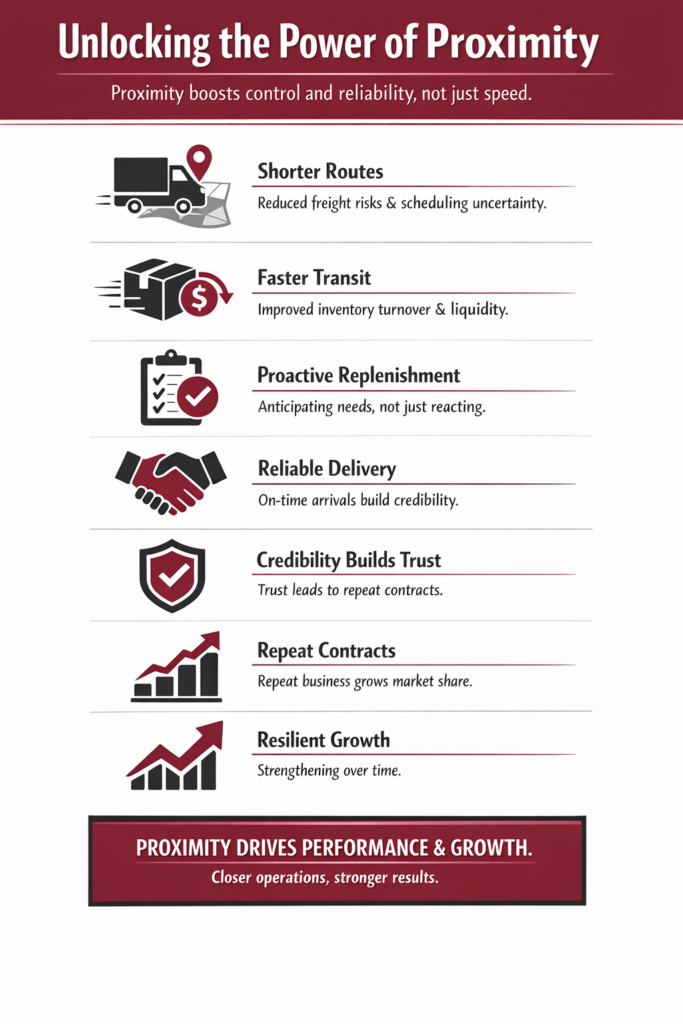
The Real Return on Proximity
Proximity delivers more than speed it delivers control.
Shorter routes reduce freight exposure and scheduling uncertainty. Faster transit improves inventory turnover and strengthens liquidity ratios. Replenishment becomes proactive rather than reactive.
Most importantly, reliable delivery enhances credibility.
Credibility builds trust.
Trust builds repeat contracts.
Repeat contracts build market share.
Resilience compounds over time.
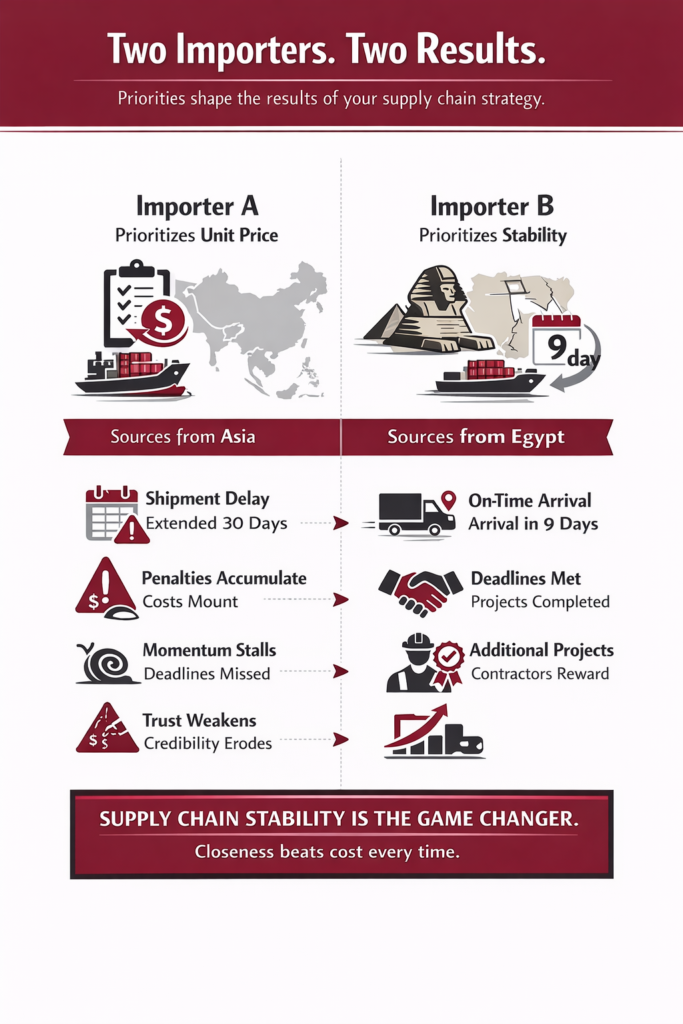
Two Importers. Two Results.
Importer A prioritizes unit price and sources from Asia. A shipment delay extends delivery by 30 days. Penalties accumulate. Project momentum stalls. Trust weakens.
Importer B sources from Egypt. The shipment arrives in nine days. Deadlines are met. Contractors award additional projects.
The difference is not cost structure.
It is supply chain stability.
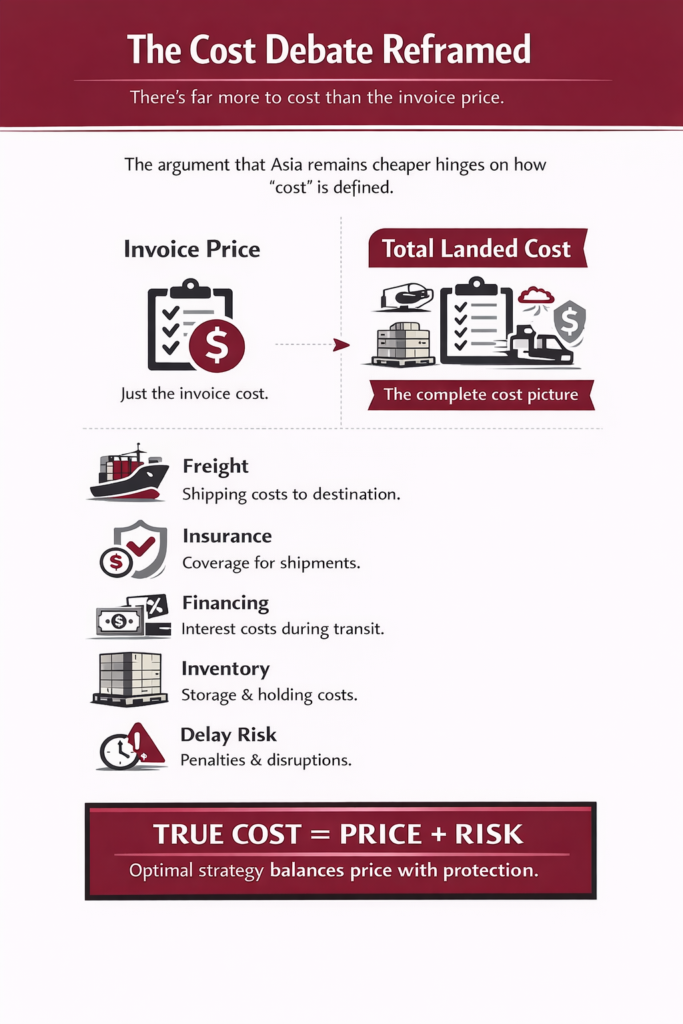
The Cost Debate Reframed
The argument that Asia remains cheaper depends entirely on how “cost” is defined.
If cost means invoice price alone, the answer may appear obvious.
But total landed cost includes freight, insurance, financing, inventory carrying cost, and delay risk. When these variables are included, the gap narrows sometimes dramatically.
Choosing a regional supplier functions like strategic insurance. The premium may seem marginally higher, but the downside protection is substantial.
The lowest price rarely equals the lowest risk.
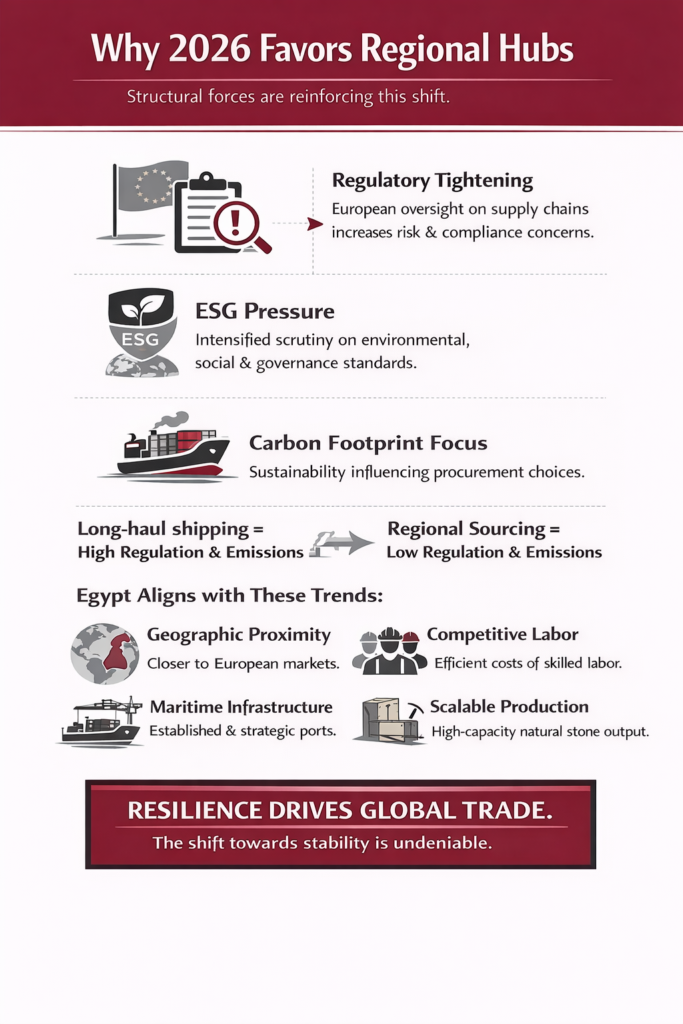
Why 2026 Favors Regional Hubs
Structural forces are reinforcing this shift.
European regulatory oversight on supply chains is tightening. ESG scrutiny continues to intensify. Carbon footprint considerations influence procurement decisions more than ever before.
Long-haul shipping increases both regulatory exposure and environmental impact.
Regional sourcing reduces both.
Egypt aligns with these macro trends through geographic proximity, competitive labor economics, established maritime infrastructure, and scalable natural stone production.
The direction of global trade is clear: resilience is becoming the dominant metric.
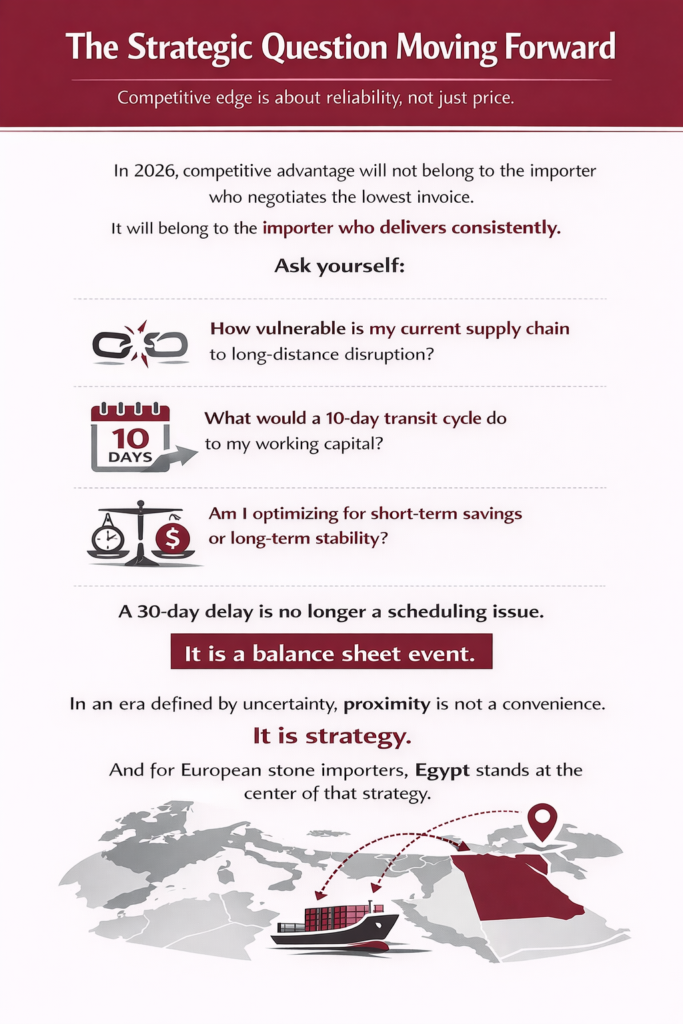
The Strategic Question Moving Forward
In 2026, competitive advantage will not belong to the importer who negotiates the lowest invoice.
It will belong to the importer who delivers consistently.
Ask yourself:
How vulnerable is my current supply chain to long-distance disruption?
What would a 10-day transit cycle do to my working capital?
Am I optimizing for short-term savings or long-term stability?
A 30-day delay is no longer a scheduling issue.
It is a balance sheet event.
In an era defined by uncertainty, proximity is not a convenience.
It is strategy.
And for European stone importers, Egypt stands at the center of that strategy.