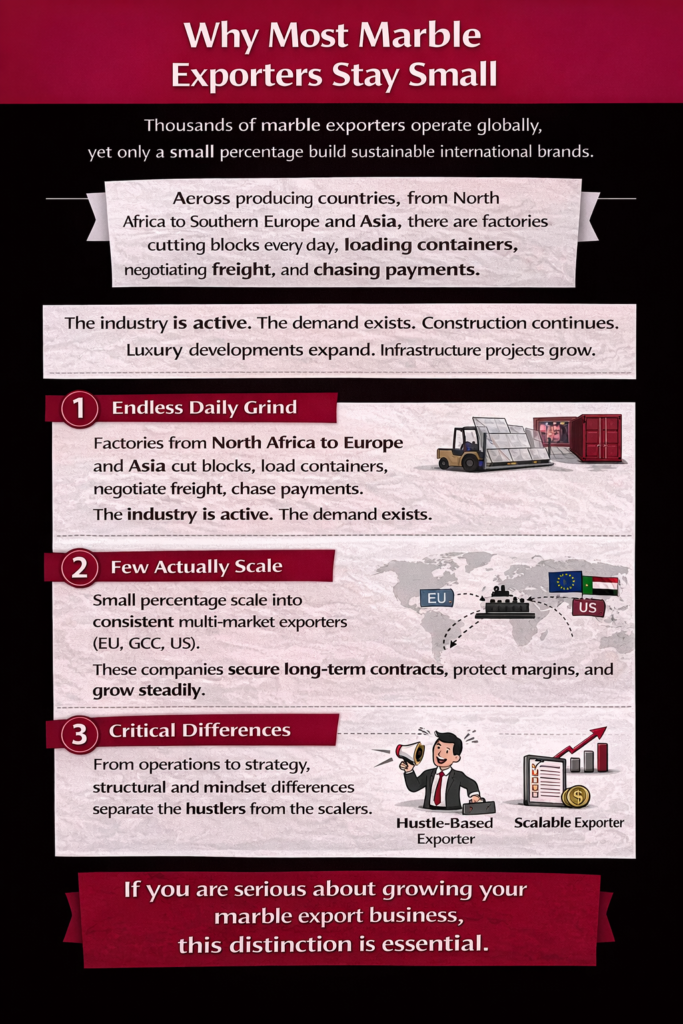
Marble exporters in Egypt Thousands of marble exporters operate globally yet only a small percentage build sustainable international brands.
Across producing countries, from North Africa to Southern Europe and Asia, there are factories cutting blocks every day, loading containers, negotiating freight, and chasing payments. The industry is active. The demand exists. Construction continues. Luxury developments expand. Infrastructure projects grow.
And still, most marble exporters remain stuck at 3–5 containers per month.
Meanwhile, a smaller group of companies scale into multi-market operations exporting consistently to the EU, GCC, US, and beyond. They secure long-term contracts. They protect margins. They grow year after year.
So what separates a small marble exporter from a scalable international marble company?
Is it quarry ownership? Capital size? Access to better stone?
Not necessarily.
This article breaks down the structural, operational, and strategic differences between exporters who stay small and those who scale internationally. If you are serious about growing your marble export business, understanding this distinction is essential.
Why Some Marble Exporters in Egypt Stay Small While Others Scale Internationally
Let’s begin with the most common profile in the stone industry: the transactional exporter.
Define the Profile
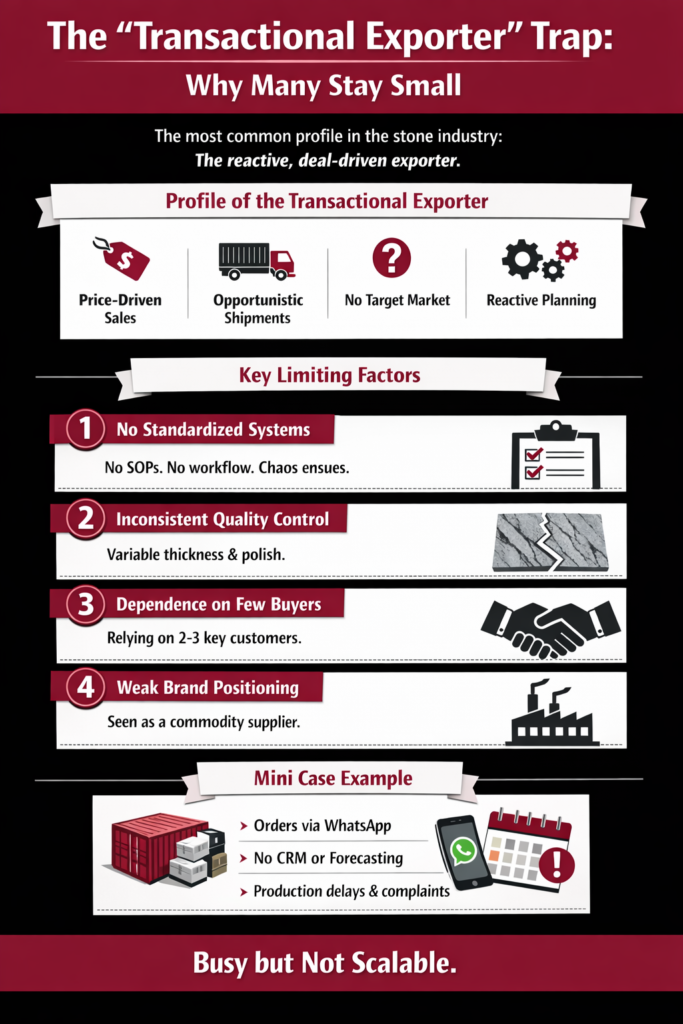
The transactional exporter typically operates with:
- A price-driven sales approach
- Opportunistic shipments
- No defined target market
- Reactive production planning
Sales are usually initiated by incoming inquiries. Orders depend on whoever asks first. Pricing is flexible sometimes too flexible because the main goal is to close the deal.
This model can generate cash flow. But it rarely generates scalability.
Key Limiting Factors
1. No Standardized Systems
There is no documented production workflow. No quality control checklist. No container loading SOP. Everything depends on individual experience rather than structured processes.
When the owner is present, things work. When the owner is absent, chaos increases.
This is one of the core marble export challenges that keeps companies small.
2. Inconsistent Quality Control
One shipment may be excellent. The next slightly different in thickness, polish level, or packing quality.
In international trade, inconsistency destroys trust.
3. Dependence on a Few Buyers
Many small marble exporters rely on two or three key customers. If one stops ordering, monthly revenue drops dramatically.
This creates pricing pressure and negotiation weakness.
4. Weak Brand Positioning
The company is perceived as a commodity supplier. No differentiation. No specialization. No authority.
Buyers compare them purely on price.
Mini Case Example
Consider a factory exporting 4 containers per month.
Orders come mainly through WhatsApp. There is no CRM. No structured follow-up. No sales forecasting. Production planning starts only after payment is received.
If two clients request different slab thicknesses at the same time, confusion occurs. Delivery delays happen. Clients complain.
This exporter is busy but not scalable.
These are classic small marble exporter problems. And they are structural, not temporary.
The Scalable Exporter Model (What Sets Them Apart)
Now let’s analyze the exporters who break through the plateau.
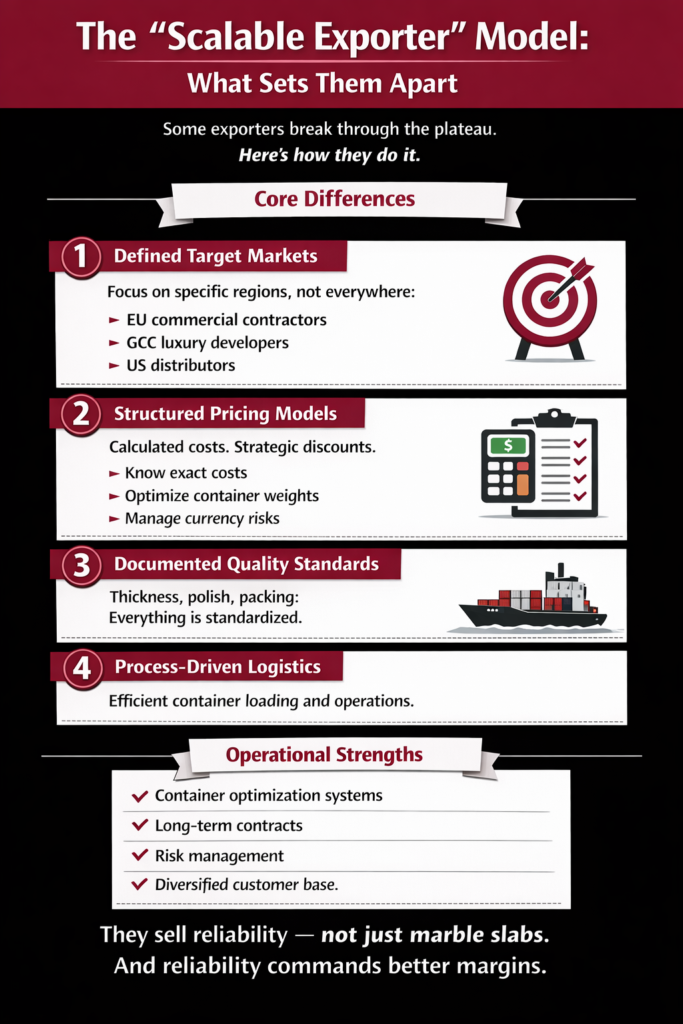
Core Differences
Scalable marble exporters operate differently from the inside out.
Defined Target Markets
They do not “sell everywhere.”
Instead, they focus on specific regions — for example:
- EU commercial contractors
- GCC luxury developers
- US distributors
They understand regulations, aesthetic preferences, certification requirements, and logistics patterns.
Structured Pricing Models
Pricing is not emotional. It is calculated.
They know:
- Exact cost per square meter
- Container weight optimization margins
- Currency exposure
- Minimum acceptable profit percentage
Discounts are strategic, not desperate.
Documented Quality Standards
Thickness tolerance. Polish gloss level. Slab selection criteria. Packing procedures.
Everything is defined.
Process-Driven Logistics
They optimize container loading. Balance weight. Minimize breakage. Control documentation flow.
Operational Strengths
- Container optimization systems
- Long-term contracts with recurring volumes
- Risk management for currency and freight
- Diversified customer base
Most importantly, they sell reliability — not just marble slabs.
And reliability commands better margins.
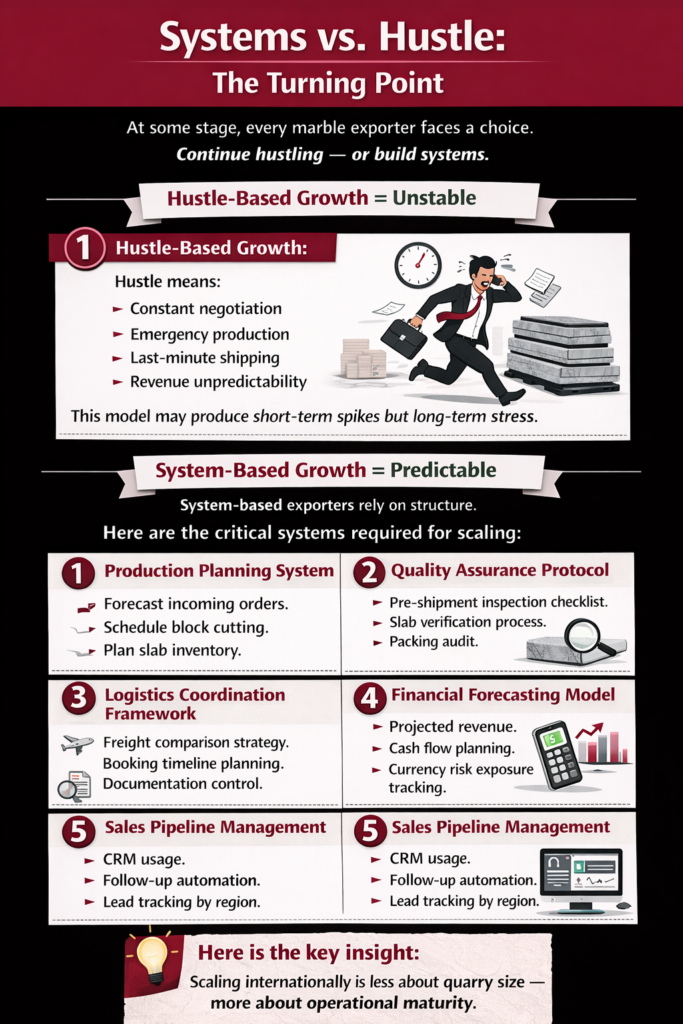
Systems vs. Hustle: The Turning Point
At some stage, every marble exporter faces a choice.
Continue hustling or build systems.
Hustle-Based Growth = Unstable
Hustle means:
- Constant negotiation
- Emergency production
- Last-minute shipping
- Revenue unpredictability
This model may produce short-term spikes but long-term stress.
System-Based Growth = Predictable
System-based exporters rely on structure.
Here are the critical systems required for scaling:
1. Production Planning System
Forecast incoming orders. Schedule block cutting. Plan slab inventory. Reduce idle time.
2. Quality Assurance Protocol
Pre-shipment inspection checklist. Slab verification process. Packing audit.
3. Logistics Coordination Framework
Freight comparison strategy. Booking timeline planning. Documentation control.
4. Financial Forecasting Model
Projected revenue. Cash flow planning. Currency risk exposure tracking.
5. Sales Pipeline Management
CRM usage. Follow-up automation. Lead tracking by region.
Here is the key insight:
Scaling internationally is less about quarry size — more about operational maturity.
A small factory with strong systems can outperform a large quarry with weak structure.
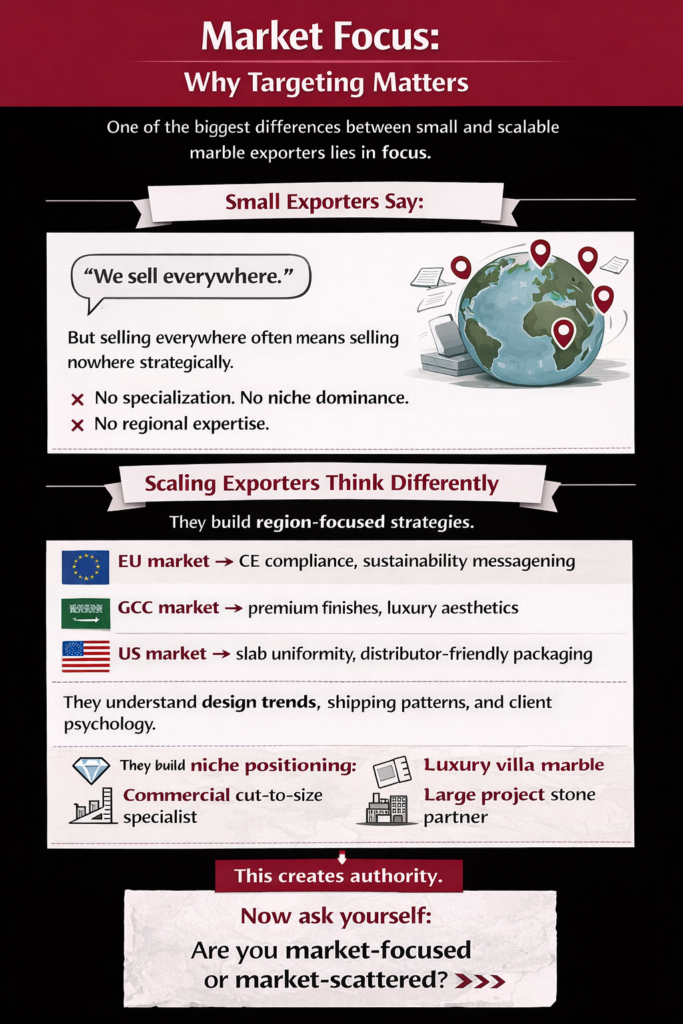
Market Focus: Why Targeting Matters
One of the biggest differences between small and scalable marble exporters lies in focus.
Small Exporters Say:
“We sell everywhere.”
But selling everywhere often means selling nowhere strategically.
There is no specialization. No niche dominance. No regional expertise.
Scaling Exporters Think Differently
They build region-focused strategies.
For example:
- EU market → CE compliance, sustainability messaging
- GCC market → premium finishes, luxury aesthetics
- US market → slab uniformity, distributor-friendly packaging
They understand design trends, shipping patterns, and client psychology.
They build niche positioning:
- Luxury villa marble supplier
- Commercial cut-to-size specialist
- Large project stone partner
This creates authority.
Now ask yourself: Are you market-focused or market-scattered?
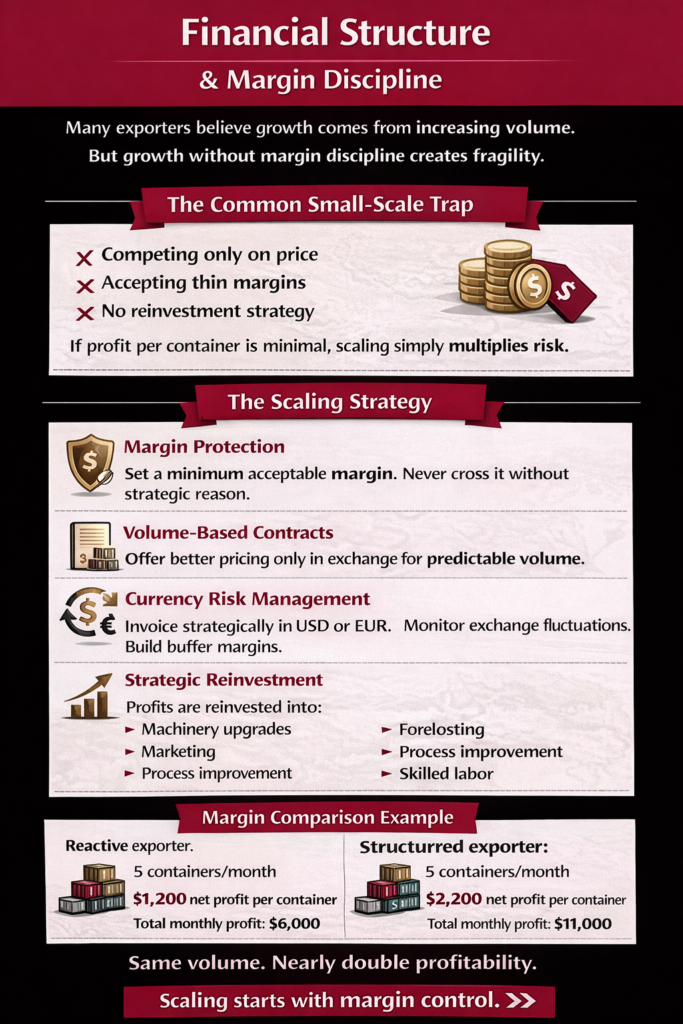
Financial Structure & Margin Discipline
Many exporters believe growth comes from increasing volume.
But growth without margin discipline creates fragility.
The Common Small-Scale Trap
- Competing only on price
- Accepting thin margins
- No reinvestment strategy
If profit per container is minimal, scaling simply multiplies risk.
The Scaling Strategy
Margin Protection
Set a minimum acceptable margin. Never cross it without strategic reason.
Volume-Based Contracts
Offer better pricing only in exchange for predictable volume.
Currency Risk Management
Invoice strategically in USD or EUR. Monitor exchange fluctuations. Build buffer margins.
Strategic Reinvestment
Profits are reinvested into:
- Machinery upgrades
- Marketing
- Process improvement
- Skilled labor
Margin Comparison Example
Reactive exporter:
- 5 containers/month
- $1,200 net profit per container
- Total monthly profit: $6,000
Structured exporter:
- 5 containers/month
- $2,200 net profit per container
- Total monthly profit: $11,000
Same volume. Nearly double profitability.
Scaling starts with margin control.
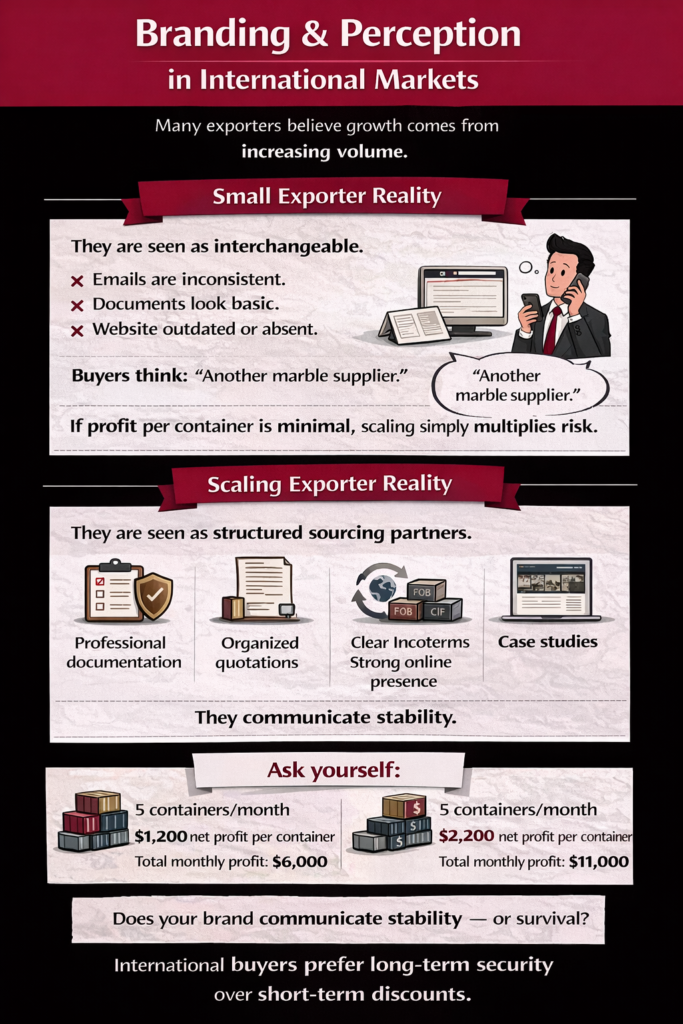
Branding & Perception in International Markets
Perception shapes negotiation power.
Small Exporter Reality
They are seen as interchangeable.
Emails are inconsistent. Documents look basic. Website outdated or absent.
Buyers think: “Another marble supplier.”
Scaling Exporter Reality
They are seen as structured sourcing partners.
- Professional documentation
- Organized quotations
- Clear Incoterms
- Strong online presence
- Case studies
They communicate stability.
Ask yourself:
Does your brand communicate stability or survival?
International buyers prefer long-term security over short-term discounts.
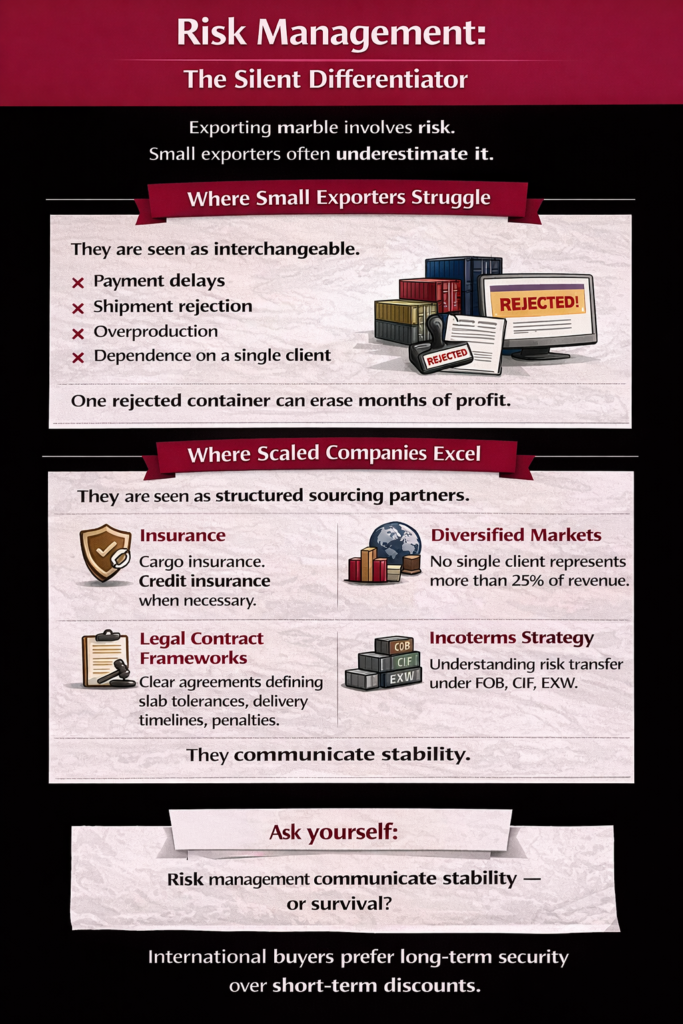
Risk Management: The Silent Differentiator
Exporting marble involves risk.
Small exporters often underestimate it.
Where Small Exporters Struggle
- Payment delays
- Shipment rejection
- Overproduction
- Dependence on a single client
One rejected container can erase months of profit.
Where Scaled Companies Excel
Insurance
Cargo insurance. Credit insurance when necessary.
Diversified Markets
No single client represents more than 25% of revenue.
Legal Contract Frameworks
Clear agreements defining slab tolerances, delivery timelines, penalties.
Incoterms Strategy
Understanding risk transfer under FOB, CIF, EXW.
Risk management is invisible when done well — but devastating when ignored.
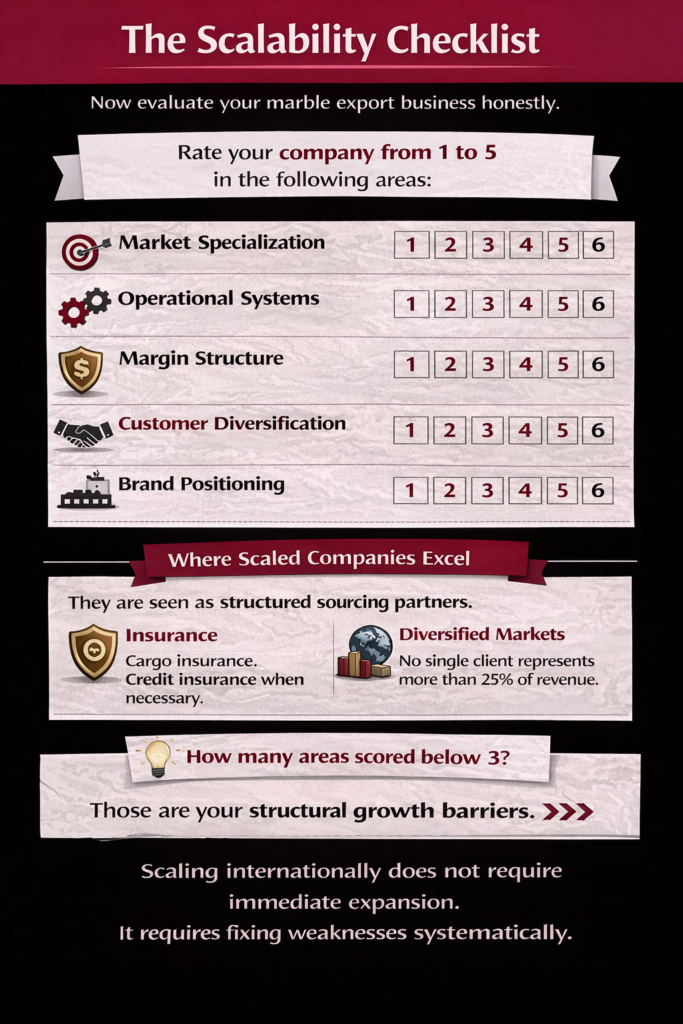
The Scalability Checklist
Now evaluate your marble export business honestly.
Rate your company from 1 to 5 in the following areas:
- Market specialization
- Operational systems
- Margin structure
- Customer diversification
- Brand positioning
How many areas scored below 3?
Those are your structural growth barriers.
Scaling internationally does not require immediate expansion. It requires fixing weaknesses systematically.
Conclusion: Scaling Is a Structural Decision, Not Luck
The marble export industry is competitive but not random.
Staying small is rarely about production capacity.
It is about:
- Strategy
- Systems
- Market focus
- Margin discipline
- Risk management
- Brand perception
The exporters who scale internationally are not simply more aggressive.
They are more structured.
They replace hustle with systems.
They replace opportunistic sales with market positioning.
They replace price competition with reliability.
So here is the final question:
Are you building a shipment-based business… or an international export company?
According to industry data, Egypt’s marble and granite exports saw significant growth in 2024, expanding to over 115 countries and reflecting rising global demand for Egyptian stone products.