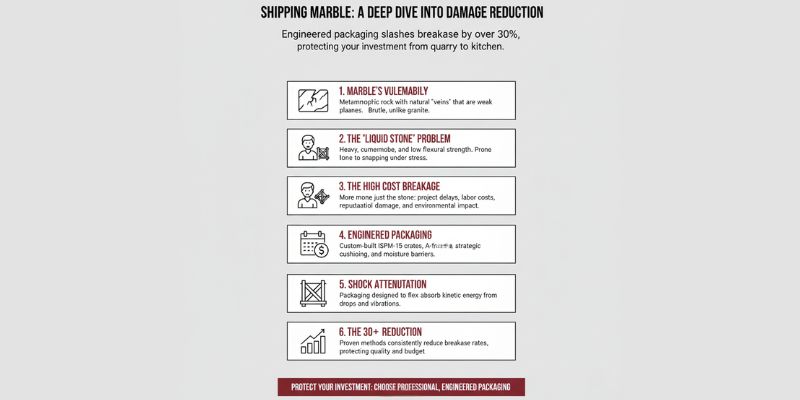
Marble Packaging for Export is a critical yet often underestimated factor in high-end construction and interior design projects. There is a specific kind of dread known only to architects, interior designers, and high-end contractors the moment a heavy wooden crate arrives on-site and reveals a broken Carrara marble slab.
Marble is a contradiction. It is a symbol of permanence and strength, yet in the world of logistics, it is essentially “liquid stone.” It is heavy, cumbersome, and incredibly brittle.
Industry data suggests that improper handling and “budget” packaging lead to breakage rates that can exceed 10–15% in international transit. However, by shifting to professional, engineered packaging solutions, suppliers and distributors have seen those breakage rates plummet, consistently reducing damage by over 30%.
In this deep dive, we’ll explore why marble is so prone to failure, the physics of transit damage, and the specific professional packaging techniques that protect your investment from the quarry to the kitchen.
1. Marble Packaging for Export and the Anatomy of Marble Breakage
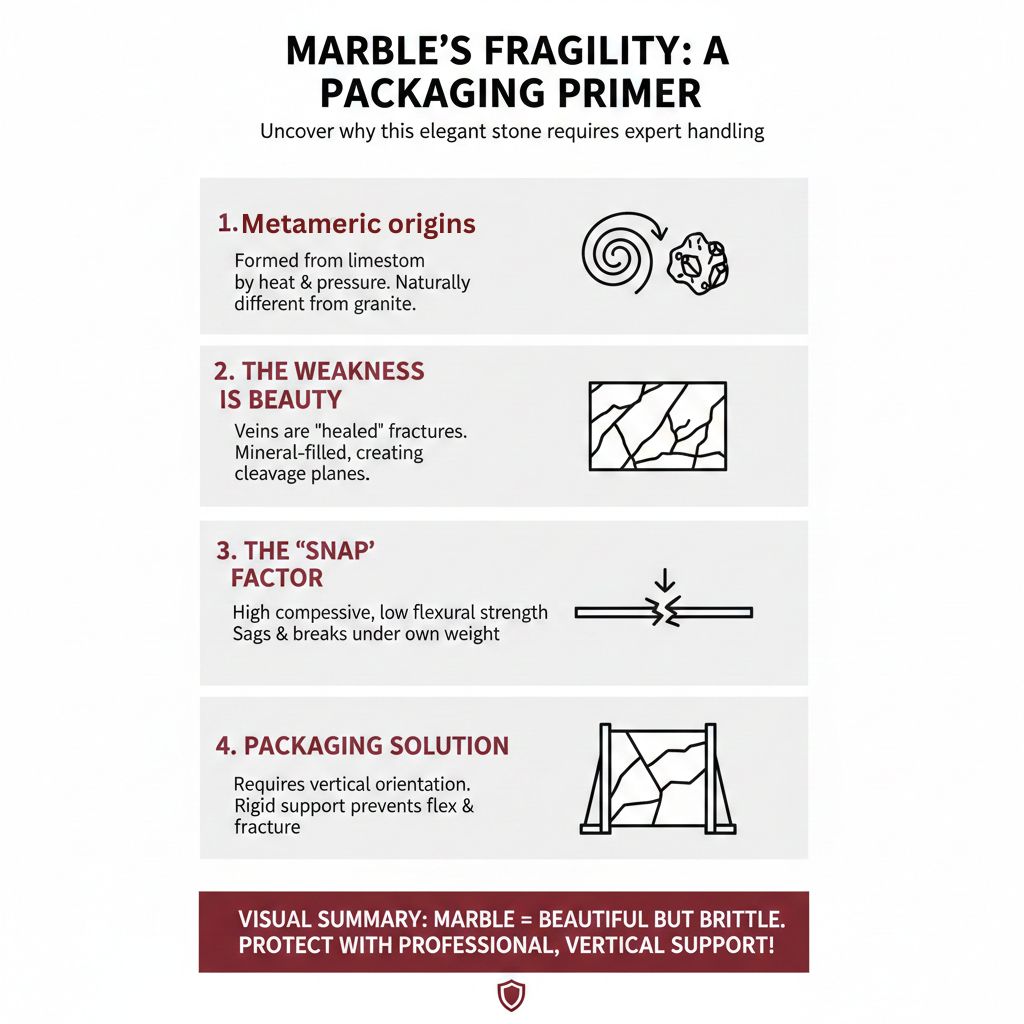
To understand why professional packaging is necessary, we first have to understand the stone itself. Unlike granite, which is an igneous rock formed from cooled magma, marble is metamorphic. It began as limestone and was transformed by heat and pressure.
The Role of Veining
The very thing that makes marble beautiful—its veins—is its greatest structural weakness. These veins are often “healed” fractures filled with minerals like iron oxide or carbon. While they look solid, they represent natural cleavage planes. Under the stress of a vibrating shipping container or a sudden jolt from a forklift, these planes are the first to give way.
The “Snap” Factor
Marble has high compressive strength (it can support a lot of weight sitting on it) but low flexural strength. If a slab is laid flat and supported only at the ends, the middle will eventually sag and snap under its own weight. This is why professional packaging focuses almost entirely on vertical orientation and rigid support.
2. The True Cost of Breakage (It’s More Than Just the Stone)
When a slab breaks, the financial impact ripples far beyond the cost of the material. This is why a 30% reduction in breakage isn’t just a logistical win; it’s a massive bottom-line protector.
- Project Delays: High-quality marble is often sourced from specific batches or “lots” in Italy, Greece, or Turkey. If a slab breaks, you can’t just buy a replacement at a local hardware store. Sourcing a matching slab can delay a project by 8–12 weeks.
- Labor Costs: Your installation team is often booked months in advance. If the stone arrives broken, you are still likely paying for their time or facing “dry run” fees.
- Reputational Damage: For contractors and architects, a broken shipment looks like poor planning. Clients rarely blame the shipping company; they blame the person who managed the order.
- Environmental Impact: Shipping a 500lb slab across the ocean consumes significant carbon. If that slab arrives broken and must be scrapped, the carbon footprint of that project essentially doubles.
3. Why Marble Packaging for Export Requires Engineered Solutions
At a professional level, Marble Packaging for Export is governed by engineering principles rather than cost-saving shortcuts. Every crate, support angle, and cushioning material is selected to control stress points and absorb kinetic energy during handling and ocean freight.
A. Custom-Built ISPM-15 Wood Crates
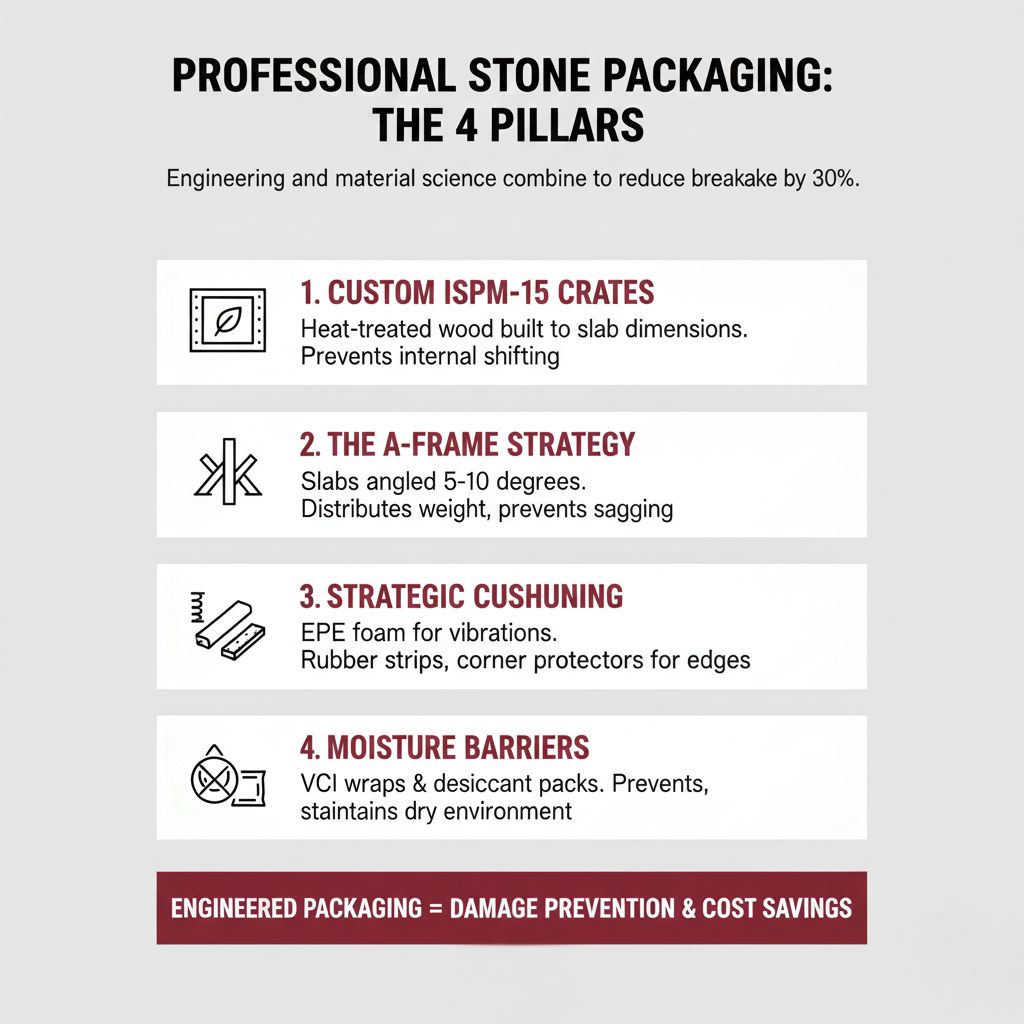
Generic pallets are the enemy of marble. Professional packaging utilizes custom-built crates made from heat-treated wood (compliant with ISPM-15 international standards). These crates are built to the specific dimensions of the slab to prevent “internal shifting.”
B. The A-Frame Strategy
Large slabs should almost never be shipped flat. Professionals use internal A-frames. By leaning the slabs at a slight angle (usually 5–10 degrees) against a central support structure, the weight is distributed through the thickness of the stone rather than across its face.
C. Strategic Cushioning and “Point Loading” Prevention
Standard foam isn’t enough. Professional packaging uses:
- High-Density EPE Foam: To absorb micro-vibrations from truck engines.
- Rubber Strips: Placed at the base of the crate to prevent the stone from “chattering” against the wood.
- Corner Protectors: Plastic or reinforced cardboard guards that prevent the edges from chipping during crate movement.
D. Moisture Barriers and Desiccants
Marble is porous. If moisture gets trapped inside a crate during a trans-oceanic voyage, it can cause “blooming” or oxidation of minerals within the stone, leading to permanent staining. Professional packers use vapor-corrosion inhibitors (VCI) or heavy-duty plastic wrapping with desiccant packs to maintain a dry micro-environment.
4. The Physics of the “30% Reduction”
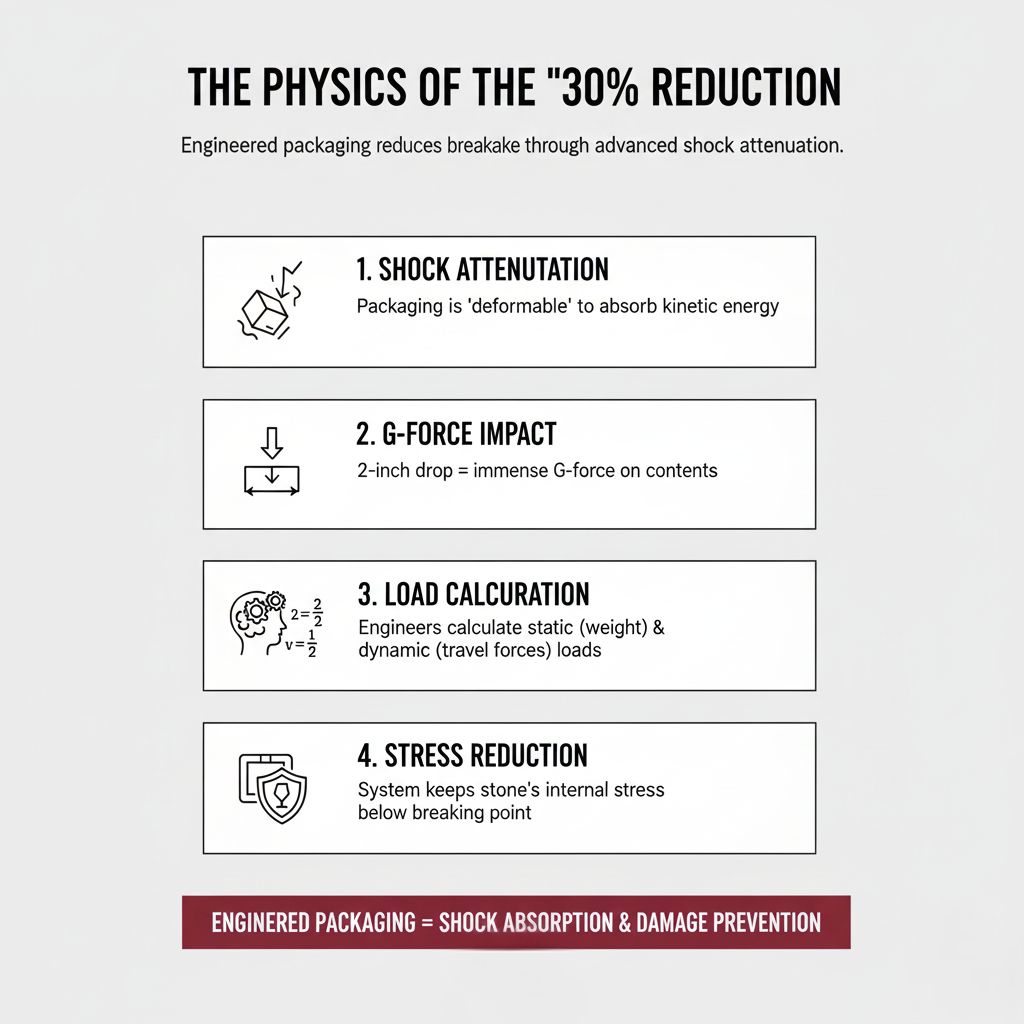
Why does this specific approach work so much better than traditional methods? It comes down to Shock Attenuation.
When a shipping container is dropped just two inches by a crane, the G-force exerted on the contents can be immense. Professional packaging is designed to be “deformable.” This means the crate and the internal bracing are designed to flex slightly, absorbing the kinetic energy before it reaches the brittle stone.
By calculating the static load (the weight of the stone) and the dynamic load (the forces of travel), engineers create a packaging system that keeps the stone’s internal stress levels well below its breaking point.
This is precisely why professional Marble Packaging for Export focuses on deformable crate systems that dissipate energy before it reaches the stone surface.
5. How to Audit Your Supplier’s Packaging
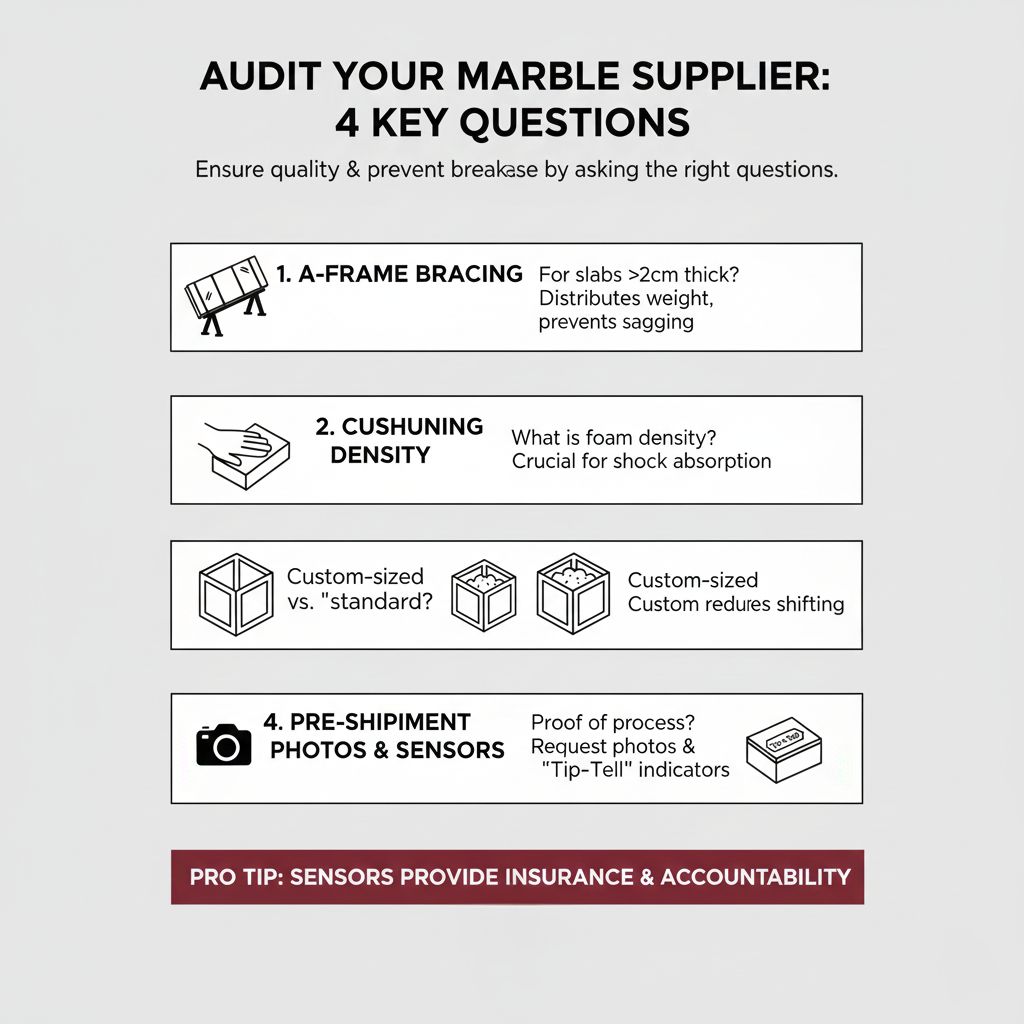
If you are importing marble or managing a high-end build, you shouldn’t leave packaging to chance. Ask your supplier the following questions to ensure they are using the methods that lead to that 30% safety margin:
- “Do you use A-frame internal bracing for all slabs over 2cm thickness?”
- “What is the density of the foam used at the pressure points?”
- “Are the crates custom-sized, or are you using ‘standard’ sizes with extra filler?” (Hint: Custom-sized is always better.)
- “Do you provide photos of the crating process before the container is sealed?”
Pro Tip: Always request “Tip-N-Tell” or “ShockWatch” sensors on your crates. These are small indicators that turn red if the crate has been tilted or dropped beyond a certain threshold. It provides immediate proof of mishandling for insurance purposes.
For importers and project managers, evaluating a supplier’s standards for Marble Packaging for Export is often the fastest way to predict shipment reliability and long-term risk.
6. The Future of Stone Logistics: Automation and Sustainability
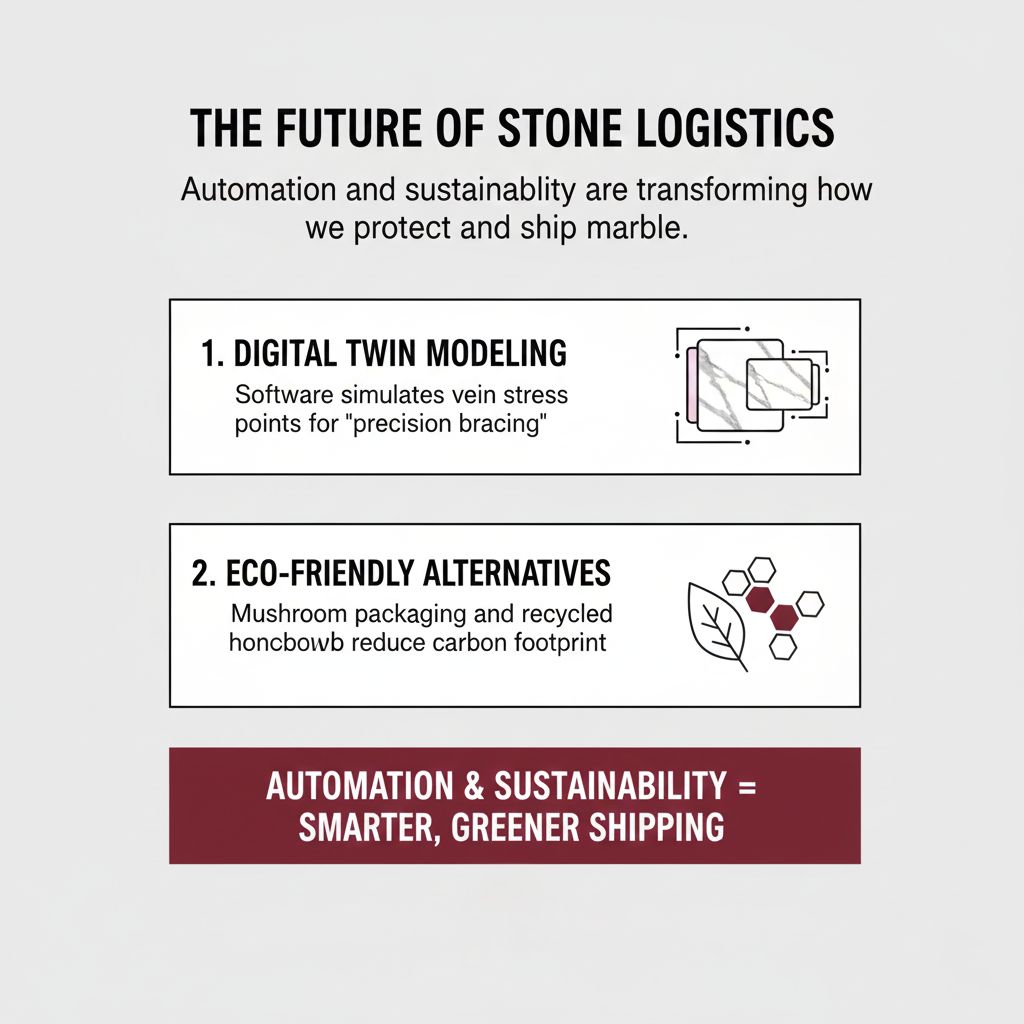
The industry is moving toward even more sophisticated ways to protect marble while reducing the environmental impact of packaging.
- Digital Twin Modeling: Some high-end distributors now use software to simulate how a specific slab’s unique vein patterns will react to stress, allowing for “precision bracing” at the weakest points.
- Eco-Friendly Alternatives: The industry is moving away from Styrofoam in favor of mushroom-based packaging or recycled honeycomb cardboard, which offers incredible structural strength with a lower carbon footprint. know more
Conclusion: An Investment, Not an Expense
When you are spending thousands of dollars on premium marble, the “cheapest” shipping option is often the most expensive mistake you can make. Professional packaging is more than just wood and foam; it is a calculated insurance policy.
Reducing breakage by over 30% doesn’t just save the stone it saves the timeline, the budget, and the sanity of everyone involved in the project. When the crate finally opens on-site, the only sound you should hear is the client’s intake of breath as they see their beautiful, unbroken stone for the first time.
Investing in professional Marble Packaging for Export protects not only the stone itself, but also project timelines, budgets, and client trust.
Ready to Secure Your Supply Chain?
If you’re tired of “crossing your fingers” every time a shipment arrives, it’s time to upgrade your logistics standards. At Shawkat stone we specialize in the end-to-end protection of premium natural stone.
Would you like me to create a custom “Packaging Inspection Checklist” you can send to your suppliers to ensure your next shipment arrives in perfect condition?