
A construction project can run perfectly on schedule for months then a single stone shipment fails to arrive, and everything unravels. The installation crew is standing by. The site is prepped. The containers were supposed to clear the port days ago.
Somewhere between quarry extraction, factory production, and export logistics, a delay crept in. Now, contractors are rescheduling labor, developers are absorbing penalty costs, and a project that was on track is suddenly behind.
In the natural stone industry, this is not an edge case. It is a recurring reality, and it creates financial pressure across the entire supply chain.
For importers and distributors, unreliable lead times damage client relationships and inventory planning. For developers, a single late shipment can affect handover dates, trigger penalties, and hurt reputation. This is especially true in Egyptian marble and granite export, where international buyers depend on accurate scheduling and dependable shipping coordination.
The solution is not faster promises. It is a structured system.
This article explains the Lead Time Protocol, a systematic framework designed to minimize delays in marble and granite export operations, from raw material verification to final container loading. Rather than reacting to problems after they occur, the protocol identifies risks early, maintains production visibility, and creates predictable export schedules that protect project timelines..
Why Production Delays Happen in the Stone Industry
Before understanding how delays can be prevented, it is important to understand why they happen so frequently in the natural stone sector.
Unlike mass-produced industrial materials, marble and granite manufacturing involves multiple variables that can shift unexpectedly during production.
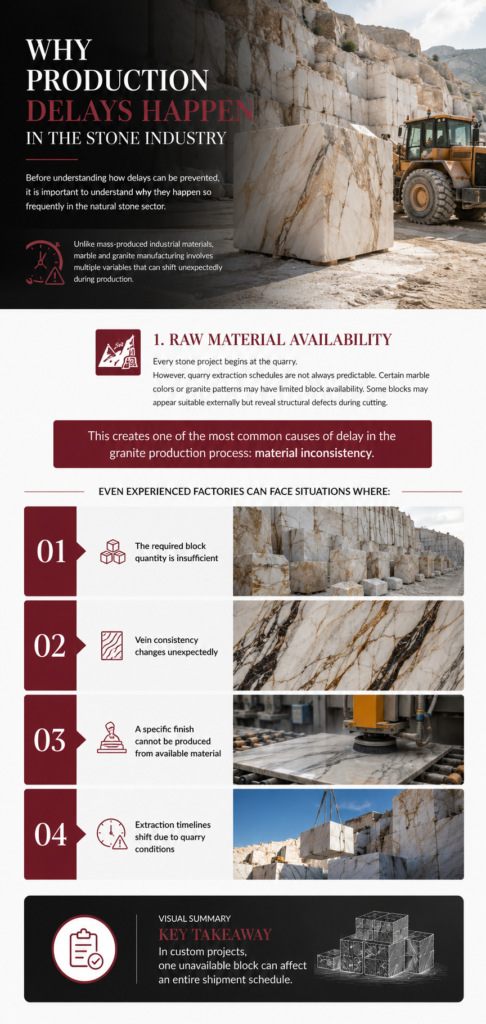
Raw Material Availability
Every stone project begins at the quarry.
However, quarry extraction schedules are not always predictable. Certain marble colors or granite patterns may have limited block availability. Some blocks may appear suitable externally but reveal structural defects during cutting.
This creates one of the most common causes of delay in the granite production process: material inconsistency.
Even experienced factories can face situations where:
- The required block quantity is insufficient
- Vein consistency changes unexpectedly
- A specific finish cannot be produced from available material
- Extraction timelines shift due to quarry conditions
In custom projects, one unavailable block can affect an entire shipment schedule.
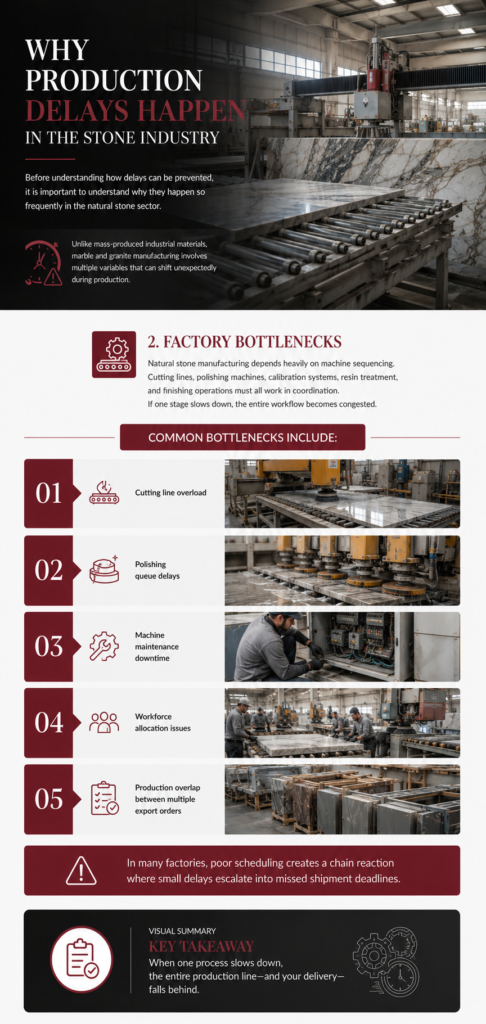
Factory Bottlenecks
Natural stone manufacturing depends heavily on machine sequencing.
Cutting lines, polishing machines, calibration systems, resin treatment, and finishing operations must all work in coordination. If one stage slows down, the entire workflow becomes congested.
Common bottlenecks include:
- Cutting line overload
- Polishing queue delays
- Machine maintenance downtime
- Workforce allocation issues
- Production overlap between multiple export orders
In many factories, poor scheduling creates a chain reaction where small delays escalate into missed shipment deadlines.

Custom Order Complexity
Custom orders add another layer of operational difficulty.
Projects involving:
- Special dimensions
- Bookmatching
- Vein continuity
- Mixed materials
- Complex finishing requirements
require much tighter coordination than standard slab production.
A single missing slab can hold an entire container.
This is one of the hidden realities of marble factory delays. Because projects are interconnected, even minor production errors can delay packing, loading, customs clearance, and final delivery.

Export and Logistics Disruptions
Even when production is completed successfully, export logistics can still create delays.
Challenges in natural stone export logistics often include:
- Container shortages
- Port congestion
- Shipping line schedule changes
- Documentation delays
- Customs inspection timing
- Freight coordination issues
Without proper planning, completed material may sit at the factory waiting for export clearance while shipment deadlines continue to move.
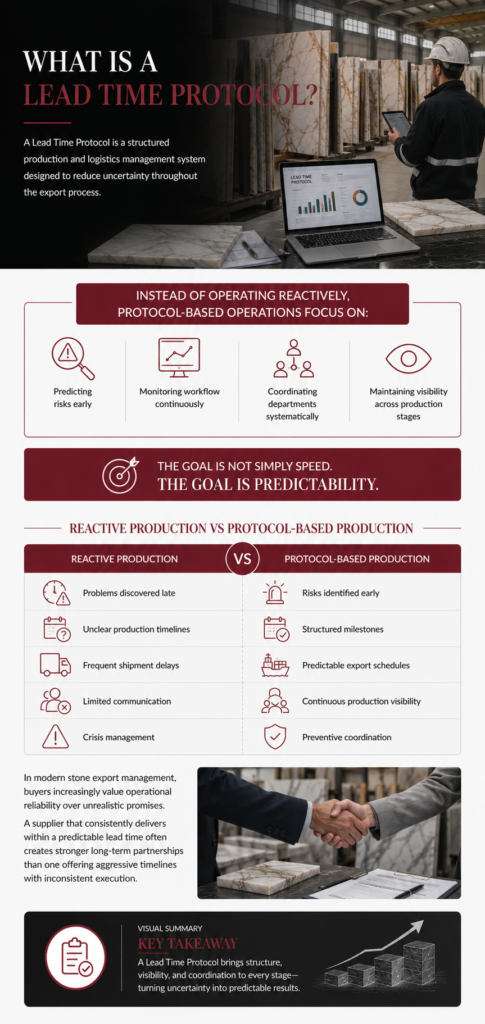
What Is a Lead Time Protocol?
A Lead Time Protocol is a structured production and logistics management system designed to reduce uncertainty throughout the export process.
Instead of operating reactively, protocol-based operations focus on:
- Predicting risks early
- Monitoring workflow continuously
- Coordinating departments systematically
- Maintaining visibility across production stages
The goal is not simply speed.
The goal is predictability.
Reactive Production vs Protocol-Based Production
| Reactive Production | Protocol-Based Production |
| Problems discovered late | Risks identified early |
| Unclear production timelines | Structured milestones |
| Frequent shipment delays | Predictable export schedules |
| Limited communication | Continuous production visibility |
| Crisis management | Preventive coordination |
In modern stone export management, buyers increasingly value operational reliability over unrealistic promises.
A supplier that consistently delivers within a predictable lead time often creates stronger long-term partnerships than one offering aggressive timelines with inconsistent execution.
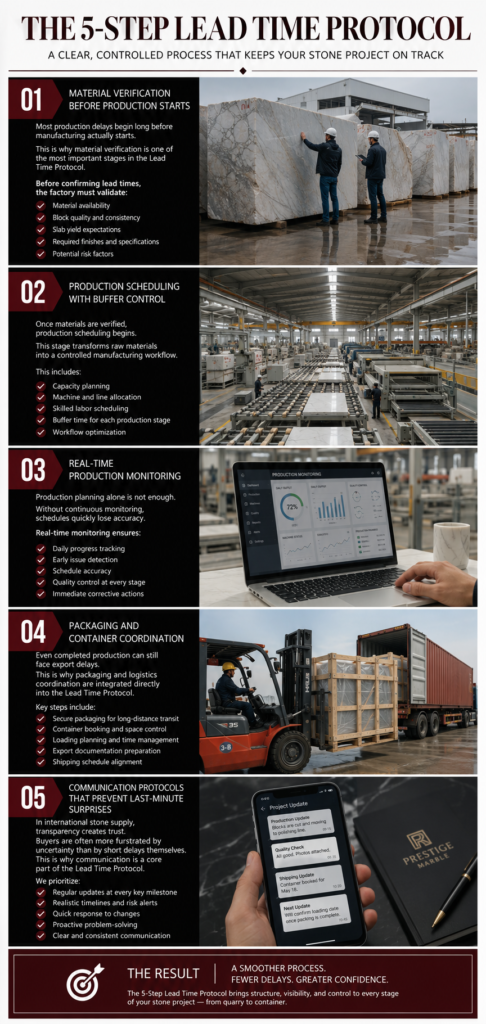
Step 1 Material Verification Before Production Starts
Most production delays begin long before manufacturing actually starts.
This is why material verification is one of the most important stages in the Lead Time Protocol.
Before confirming lead times, the factory must validate:
- Block availability
- Material consistency
- Slab yield estimates
- Client specifications
- Finishing requirements
Block Inspection Procedures
Every marble or granite block must be inspected for:
- Structural integrity
- Vein direction
- Surface defects
- Color consistency
- Fracture risks
This step significantly reduces surprises during cutting.
In marble slab production, inaccurate block assessment often leads to material shortages after processing begins. Re-cutting additional slabs later can create major scheduling disruptions.
Slab Yield Calculations
Professional exporters calculate expected slab yield before production begins.
This helps determine:
- Whether enough material exists for the project
- The expected waste percentage
- Backup requirements
- Production feasibility within the requested deadline
Without accurate estimation, factories may discover shortages halfway through production — forcing quarry reorders, schedule adjustments, and shipment delays.
Specification Matching
Many delays occur because client expectations are clarified too late.
The protocol requires early confirmation of:
- Thickness
- Surface finish
- Edge processing
- Tolerance requirements
- Packaging specifications
- Material selection approval
Strong natural stone quality control begins before cutting starts.
Step 2 Production Scheduling with Buffer Control
Once materials are verified, production scheduling begins.
This stage transforms raw materials into a controlled manufacturing workflow.
Capacity Planning
Professional factories do not schedule production randomly.
They allocate:
- Machine hours
- Workforce capacity
- Processing priorities
- Finishing sequences
- Packaging timelines
This creates balanced production flow across departments.
In high-volume Egyptian granite suppliers, poor capacity planning often causes hidden congestion where machines appear operational but output efficiency collapses.
Built-In Safety Buffers
Experienced exporters never schedule at maximum capacity.
Why?
Because real-world production always includes variables:
- Tool replacement
- Machine maintenance
- Material adjustments
- Re-polishing
- Quality corrections
The Lead Time Protocol includes controlled safety buffers to absorb operational fluctuations without affecting shipment schedules.
These buffers protect marble project deadlines from collapsing due to minor production interruptions.
Priority Mapping
Not all orders have equal urgency.
Production sequencing must consider:
- Vessel departure schedules
- Project deadlines
- Container booking windows
- Material complexity
- Client commitments
Urgent export orders are strategically prioritized without disrupting overall workflow stability.
A typical workflow timeline may look like this:
Block Arrival → Cutting → Calibration → Polishing → Inspection → Packing → Container Loading
Step 3 Real-Time Production Monitoring
Production planning alone is not enough.
Without continuous monitoring, schedules quickly lose accuracy.
Daily Production Tracking
Modern marble manufacturing workflow systems rely on daily reporting and production visibility.
Factories monitor:
- Cutting progress
- Polishing completion rates
- Quality inspection status
- Packing readiness
- Container preparation
This reduces operational uncertainty dramatically.
Early Issue Escalation
The protocol emphasizes early problem detection.
For example:
If polishing begins falling behind schedule, production managers can immediately:
- Reallocate machine time
- Adjust workforce distribution
- Prioritize critical slabs
- Shift packing sequences
This proactive coordination prevents small disruptions from becoming shipment failures.
Quality Checkpoints
Continuous inspection also prevents delays caused by late-stage quality rejection.
Instead of discovering issues during final packing, quality checkpoints are integrated throughout production.
This improves:
- Export quality consistency
- Rework reduction
- Packing efficiency
- Shipment readiness
Strong export order management depends heavily on visibility
Step 4 Packaging and Container Coordination
Even completed production can still face export delays.
This is why packaging and logistics coordination are integrated directly into the Lead Time Protocol.
Crate Preparation
Natural stone shipments require export-grade packaging capable of protecting heavy materials during international transportation.
Proper crate preparation includes:
- Reinforced wooden structures
- Moisture protection
- Slab separation systems
- Weight distribution planning
- Shock protection measures
Poor packaging can result in:
- Damage claims
- Customs inspection complications
- Repacking delays
- Shipment rejection
Container Booking Coordination
Container scheduling must begin before production completion.
Factories coordinate:
- Shipping line availability
- Port schedules
- Documentation readiness
- Customs timing
- Trucking arrangements
In granite export from Egypt, shipment timing is often just as important as production timing itself.
Load Optimization
Efficient container loading improves:
- Space utilization
- Shipment stability
- Customs clearance speed
- Damage prevention
Improper loading can create expensive demurrage charges and inspection delays at destination ports.
Step 5 Communication Protocols That Prevent Last-Minute Surprises
In international stone supply, transparency creates trust.
Buyers are often more frustrated by uncertainty than by short delays themselves.
This is why communication is a core part of the Lead Time Protocol.
Structured Client Updates
Professional exporters maintain regular communication through:
- Production progress reports
- Photo and video updates
- Packing confirmations
- Shipment timelines
- Delay alerts when necessary
This allows importers and contractors to plan proactively instead of reacting blindly.
Predictability Builds Confidence
Reliable communication positions suppliers as:
- Organized
- Accountable
- Solution-oriented
- Operationally mature
In global B2B trade, buyers prefer partners who communicate clearly during operational pressure.
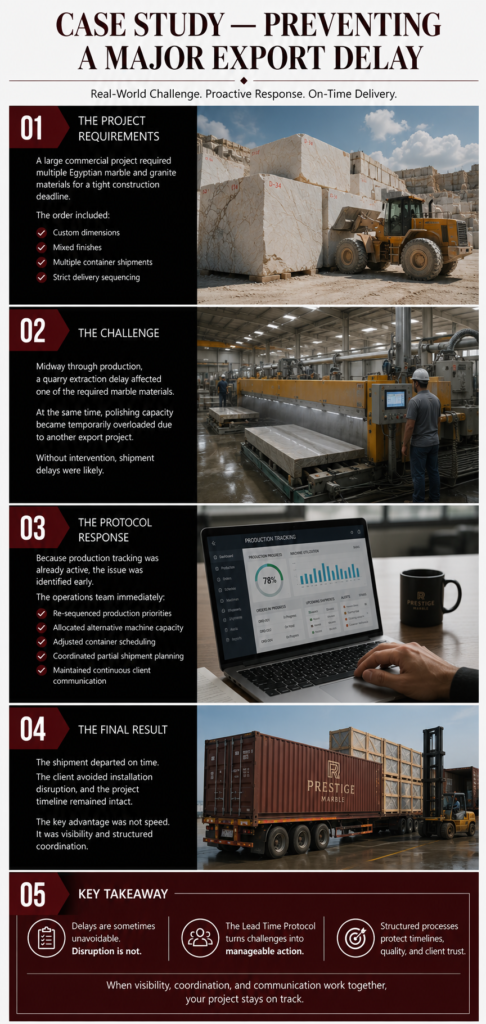
Case Study: Preventing a Major Export Delay
A large commercial project required multiple Egyptian marble and granite materials for a tight construction deadline.
The order included:
- Custom dimensions
- Mixed finishes
- Multiple container shipments
- Strict delivery sequencing
Midway through production, a quarry extraction delay affected one of the required marble materials.
At the same time, polishing capacity became temporarily overloaded due to another export project.
Without intervention, shipment delays were likely.
The Protocol Response
Because production tracking was already active, the issue was identified early.
The operations team immediately:
- Re-sequenced production priorities
- Allocated alternative machine capacity
- Adjusted container scheduling
- Coordinated partial shipment planning
- Maintained continuous client communication
Final Result
The shipment departed on time.
The client avoided installation disruption, and the project timeline remained intact.
The key advantage was not speed.
It was visibility and structured coordination.

The Future of Stone Export Operations
The natural stone industry is becoming increasingly data-driven and operationally sophisticated.
Modern Egyptian stone factory operations are adopting:
- Digital production tracking
- ERP integration
- Real-time logistics visibility
- AI forecasting systems
- Automated workflow coordination
These technologies improve:
- Production accuracy
- Shipment predictability
- Export transparency
- Resource allocation
As global buyers demand higher operational standards, structured systems will continue becoming a competitive advantage in Egyptian marble export and natural stone manufacturing.
Conclusion
Production delays in marble and granite export are not unavoidable.
In many cases, they are the result of poor visibility, weak coordination, and reactive operations.
The Lead Time Protocol reduces these risks through:
- Early material verification
- Structured production scheduling
- Real-time monitoring
- Packaging coordination
- Transparent communication
Reliable export operations are built through systems, not promises.
According to industry studies on Construction Project Risk Management by PMI, supply chain disruptions are among the leading causes of critical project failure worldwide.
In international stone supply, the difference between smooth project execution and costly disruption often comes down to planning long before production begins.
If you are looking for a reliable partner in Egyptian marble export and granite export from Egypt, structured operational systems can make the difference between uncertainty and dependable delivery.