
If you choose your marble supplier based solely on the lowest price, you are not saving money. In fact, you are simply deferring the costs of poor calibration, uneven polishing, and inconsistent resin work that your team will have to fix later.
Then continue:
This single statement encapsulates a problem that plagues countless businesses in the fabrication, construction, and design industries. The allure of competitive pricing is undeniable. However, in the marble and stone supply business, pursuing the lowest price per square meter is a false economy that often results in catastrophic financial and operational consequences.
The Hidden Truth Behind Marble Supllier Price Per Square Meter
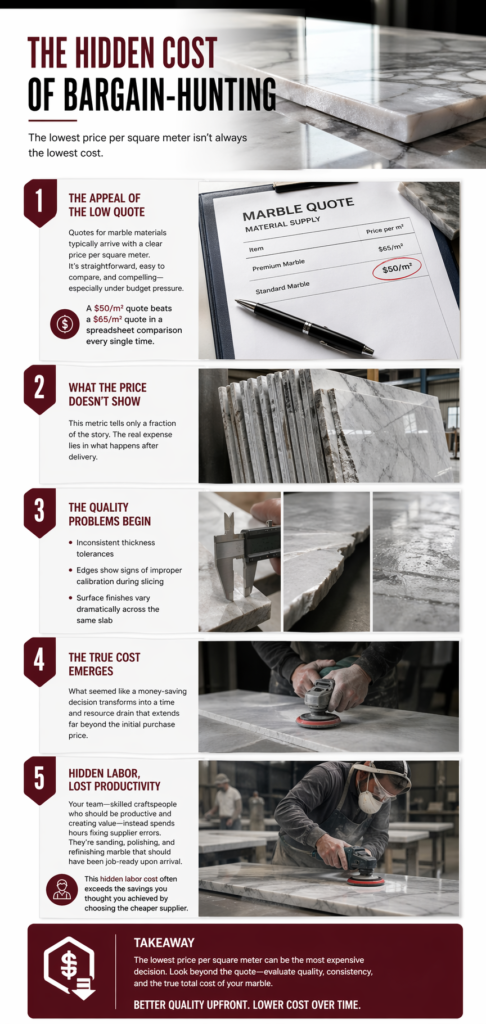
When you receive quotes for marble materials, they typically arrive with a clear price per square meter. For instance, a $50/m² quote looks straightforward, easy to compare, and compelling especially under budget pressure. A $50/m² quote beats a $65/m² quote in a spreadsheet comparison every single time. But this metric tells only a fraction of the story.
The real expense lies in what happens after delivery. Poor-quality marble from cut-rate suppliers arrives with inconsistent thickness tolerances. Edges show signs of improper calibration during slicing. Surface finishes vary dramatically across the same slab, requiring extensive rework. What seemed like a money-saving decision transforms into a time and resource drain that extends far beyond the initial purchase price.
Your team skilled craftspeople who should be creating value instead spends hours fixing supplier errors. Time gets wasted sanding, polishing, and refinishing marble that should have arrived job-ready. This hidden labor cost often exceeds the savings you thought you achieved by choosing the cheaper supplier.
The True Cost of Poor Calibration
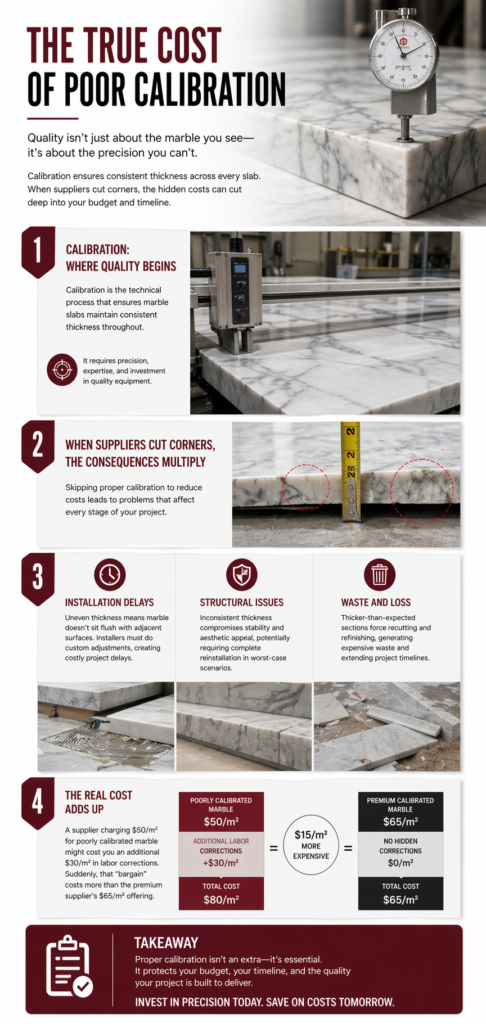
Calibration is where quality marble suppliers prove their worth. This technical process ensures that marble slabs maintain consistent thickness throughout a requirement that seems simple but, in reality, demands precision, expertise, and investment in quality equipment.
When suppliers skip corners on calibration to reduce costs, the consequences multiply:
- Installation delays: Uneven thickness means marble doesn’t sit flush with adjacent surfaces. Installers must do custom adjustments, creating costly project delays.
- Structural issues: Inconsistent thickness compromises stability and aesthetic appeal, potentially requiring complete reinstallation in worst-case scenarios.
- Waste and loss: Thicker-than-expected sections force recutting and refinishing, generating expensive waste and extending project timelines.
A supplier charging $50/m² for poorly calibrated marble might cost you an additional $30/m² in labor corrections. Suddenly, that “bargain” costs more than the premium supplier’s $65/m² offering.
Uneven Polishing: The Silent Killer of Quality
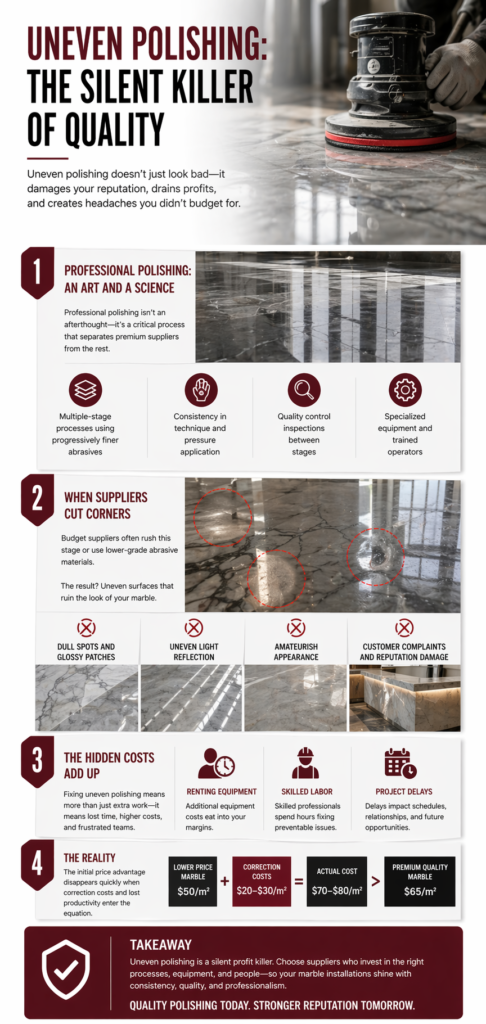
Professional polishing isn’t an afterthought it’s an art and science that distinguishes premium suppliers from mediocre ones. Quality polishing requires:
- Multiple-stage processes using progressively finer abrasives
- Consistency in technique and pressure application
- Quality control inspections between stages
- Specialized equipment and trained operators
Budget suppliers often rush this stage or use lower-grade abrasive materials. The result? Marble that looks dull in some areas and glossy in others. Light reflects unevenly across surfaces. Your beautiful marble installations look amateurish and poorly executed damaging your reputation while generating customer complaints.
The cost to fix uneven polishing? Renting equipment, dedicating skilled labor, and potentially delaying projects. Your team’s frustration grows as they troubleshoot problems that shouldn’t exist. Meanwhile, the price advantage you gained evaporates in the face of correction costs and lost productivity.
According to the Natural Stone Institute, improper fabrication significantly increases installation failure rates.
Inconsistent Resin Work: A Quality Wildcard
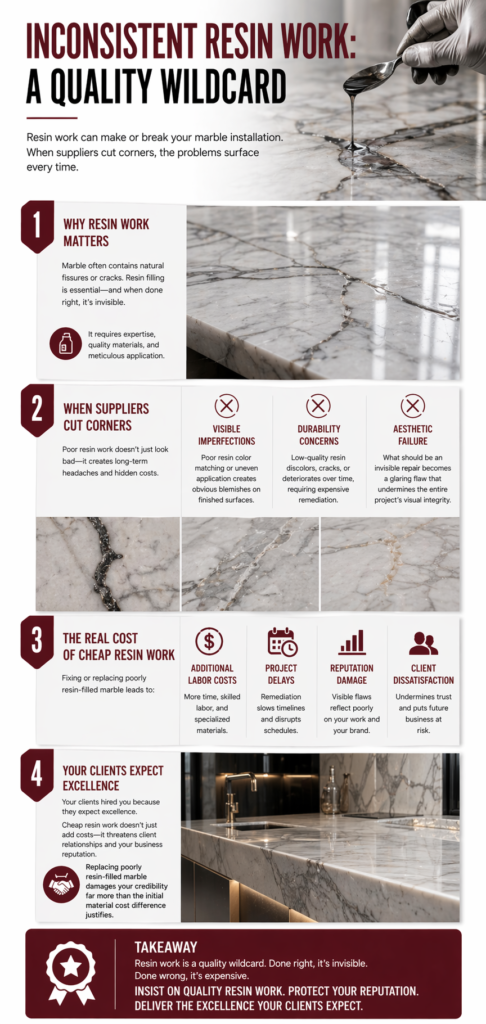
For marble containing natural fissures or cracks which is common in premium stone resin filling is essential. This specialized work requires expertise, quality materials, and meticulous application.
When suppliers cut corners on resin work:
- Visible imperfections: Poor resin color matching or uneven application creates obvious blemishes on finished surfaces.
- Durability concerns: Low-quality resin discolors, cracks, or deteriorates over time, requiring expensive remediation.
- Aesthetic failure: What should be an invisible repair becomes a glaring flaw that undermines the entire project’s visual integrity.
Your clients hired you because they expect excellence. Cheap resin work doesn’t just add costs it threatens client relationships and your business reputation. Replacing poorly resin-filled marble damages your credibility far more than the initial material cost difference justifies.
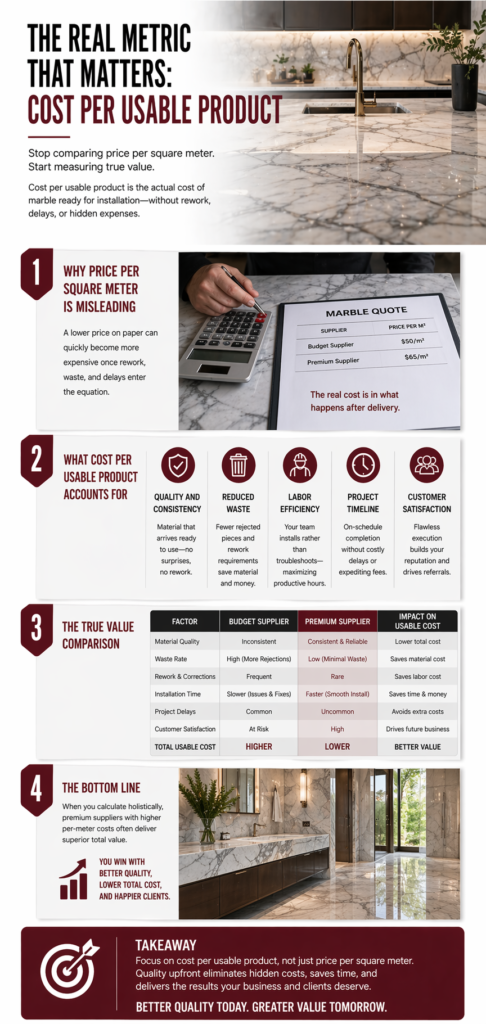
The Real Metric That Matters: Cost Per Usable Product
Rather than obsessing over price per square meter, sophisticated businesses focus on cost per usable product the actual cost of marble ready for installation without rework.
This metric accounts for:
- Quality and consistency: Material that arrives ready to use
- Reduced waste: Fewer rejected pieces and rework requirements
- Labor efficiency: Your team installs rather than troubleshoots
- Project timeline: On-schedule completion without delays
- Customer satisfaction: Flawless execution that builds reputation and referrals
When you calculate this holistically, premium suppliers with higher per-meter costs often deliver superior total value. Your projects complete faster, your team stays focused and productive, and your clients remain delighted.
Making the Strategic Shift
Breaking the price-per-square-meter obsession requires a mindset shift in procurement and project management:
1. Build relationships with quality suppliers. Develop partnerships with suppliers who prioritize calibration, polishing, and resin work. These relationships often yield better pricing over time and consistent quality that reduces hidden costs.
2. Evaluate total cost of ownership. Request quotes that include quality guarantees, rework provisions, and warranty terms. A supplier willing to stand behind their work deserves consideration.
3. Track hidden costs. Monitor rework hours, waste percentages, and project delays attributed to material quality. Data reveals the true cost of cheap suppliers.
4. Invest in supplier visits. Understanding your supplier’s equipment, processes, and quality controls takes minutes but yields invaluable insight into whether they can deliver consistent quality.
5. Implement quality metrics. Establish acceptance criteria for thickness, finish consistency, and resin work before material arrives. Reject substandard shipments immediately rather than discovering problems after installation begins.
Conclusion: The Math of True Savings
The marble industry’s dirty secret is that the lowest price per square meter rarely translates to the lowest total cost. The businesses that thrive long-term aren’t those chasing the cheapest quotes—they’re the ones who build quality-focused supplier relationships and evaluate total cost of ownership.
Your team’s skills are too valuable to waste on fixing supplier mistakes. A single bad shipment puts your reputation at risk. Clients deserve installations that reflect their investment and your professionalism.
The next time you’re tempted by an extraordinarily low price per square meter, pause. Calculate what rework, delays, and customer dissatisfaction would cost. Then call your quality supplier, confirm their terms, and invest in material that arrives job-ready.
That’s how you actually save money in this business.
What’s your experience with supplier quality versus price? Share your story with us .