
Marble Profit Margins are often misunderstood in the natural stone industry, the allure of a low “price per square meter” is often the siren song that leads importers into a financial graveyard. For high-volume distributors, the purchase price of a slab is only one variable in a complex equation. The real battle for profitability is won or lost in the supply chain the invisible space between the Egyptian quarry and the European job site.
Recently, a leading Mediterranean distributor found themselves at a crossroads. While their sourcing costs were theoretically low, their annual reports told a different story. They were losing ground. This case study explores how we moved beyond traditional “vendor” roles to engineer a 15% increase in their net profitability.
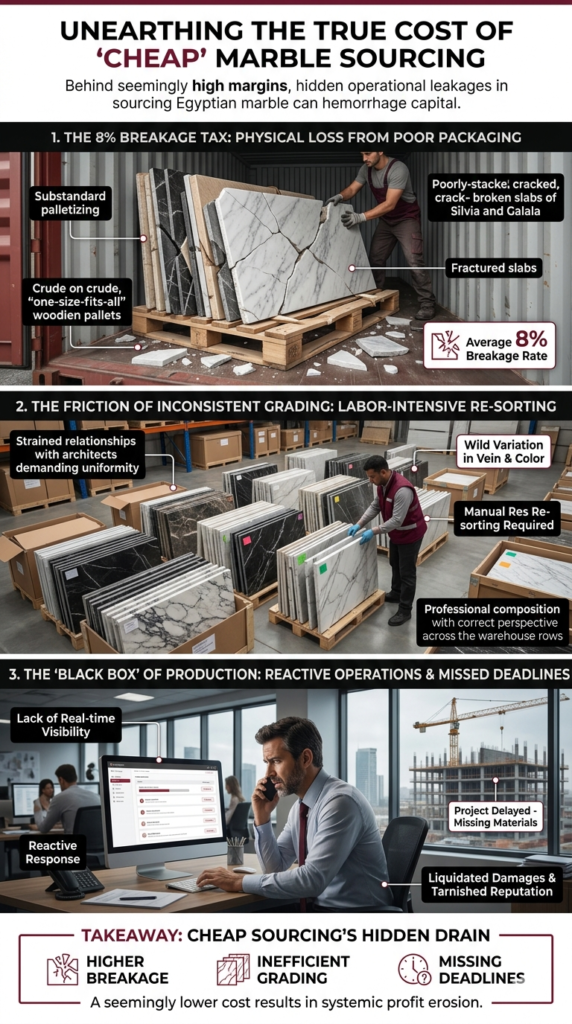
1. The Challenge: The High Cost of “Cheap” Sourcing
Our partner was sourcing Egyptian marblea product renowned for its timeless aesthetic and durability. On paper, the margins looked healthy. However, a deep dive into their operational “leakage” revealed three systemic bottlenecks that were hemorrhaging capital.
The 8% Breakage Tax
The most immediate drain was physical loss. Due to substandard palletizing and a “one-size-fits-all” approach to crating, the importer was experiencing an average 8% breakage rate per container. In a high-end material like Silvia or Galala, an 8% loss isn’t just a nuisance; it’s the difference between a profitable quarter and a deficit.
The Friction of Inconsistent Grading
In the world of luxury architecture, consistency is the product. Our client’s previous suppliers provided inconsistent grading, where vein density and background color varied wildly within a single shipment. This forced the distributor to perform manual re-sorting upon arrival adding labor costs and led to strained relationships with tier-1 architects who demanded “First Choice” uniformity.
The “Black Box” of Production
Perhaps the most frustrating issue was a total lack of visibility. Without real-time data on production timelines, the importer was constantly reactive. Missed deadlines for major construction projects led to liquidated damages and a tarnished reputation in a competitive European market.
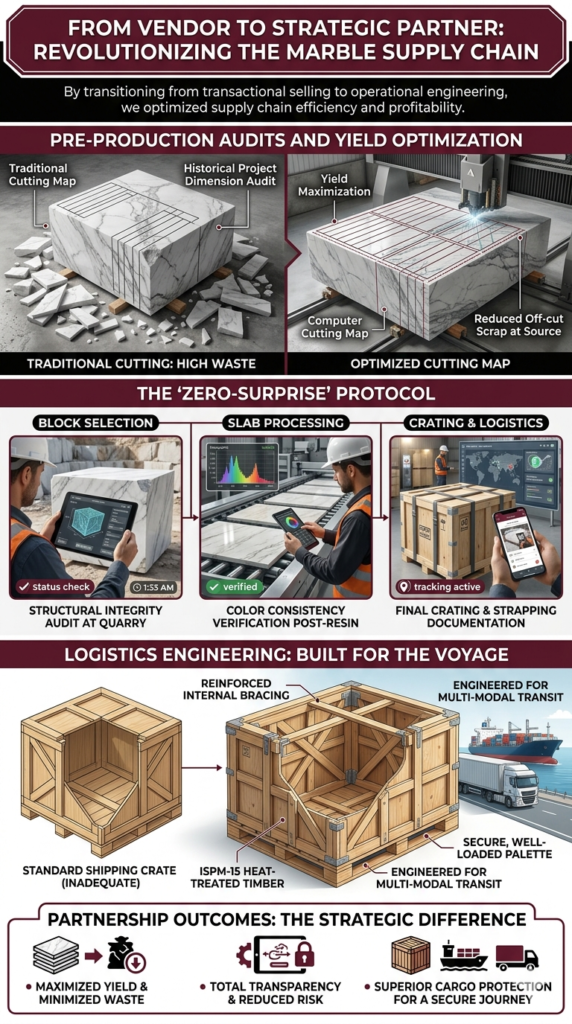
2. The Solution: Transitioning from Vendor to Strategic Partner
We realized that to fix the client’s margins, we had to fix the supply chain. We moved away from the transactional model of “selling stone” and toward a model of operational engineering. Our strategy was built on three pillars:
Pre-Production Audits and Yield Optimization
Profitability begins at the gang-saw. We conducted a historical audit of the client’s project dimensions. By redesigning the slab-cutting maps to align with their most common order sizes, we maximized the yield from every block. This reduced “off-cut” waste at the source, ensuring the client paid for usable stone, not scrap.
The “Zero-Surprise” Protocol
To solve the transparency crisis, we implemented a digital tracking system. This wasn’t just an email update; it was a comprehensive real-time photo documentation workflow. The client received visual verification at every critical milestone:
- Block Selection: Ensuring structural integrity at the quarry.
- Slab Processing: Confirming color consistency after the resin line.
- Crating: Documenting the final strapping and securing of the cargo.
Logistics Engineering: Built for the Voyage
We replaced standard shipping crates with ISPM-15 heat-treated timber featuring reinforced internal bracing. These crates were specifically engineered to withstand the rigors of multi-modal transit from the heat of the Red Sea to the damp ports of Southern Europe. You could learn more about Supply chain optimization principles
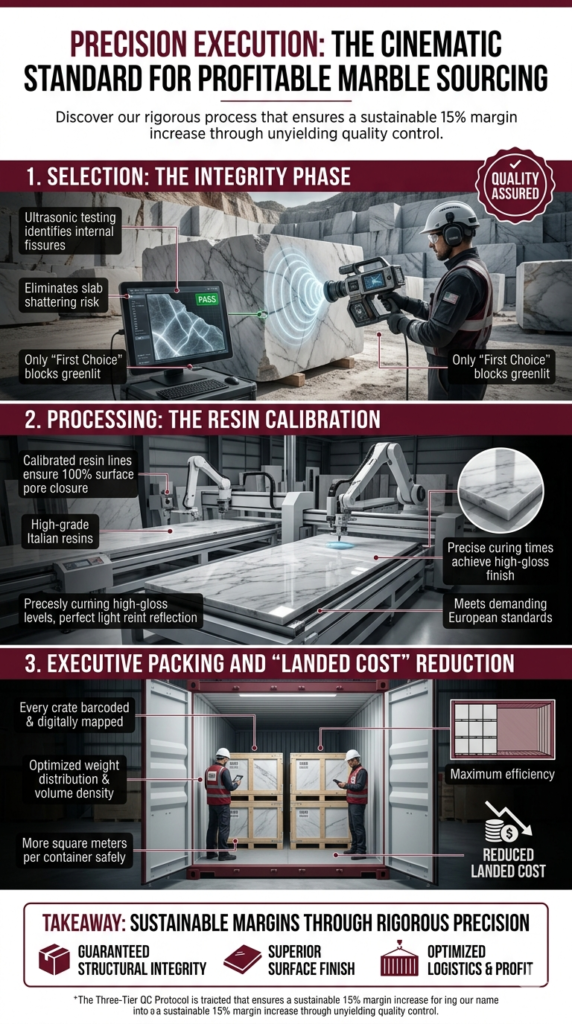
3. The Execution: A Cinematic Standard of Precision
Quality is not an accident; it is the predictable result of a rigorous process. To ensure the 15% margin increase was sustainable, we codified our Three-Tier QC Protocol.
Selection: The Integrity Phase
We utilized ultrasonic testing on raw blocks to identify internal fissures that the naked eye might miss. Only “First Choice” blocks with guaranteed structural integrity were greenlit for processing. This eliminated the risk of slabs shattering during the polishing phase or, worse, during installation.
Processing: The Resin Calibration
Surface finish is what sells marble. We calibrated our automated resin lines to ensure 100% surface pore closure. By using high-grade Italian resins and precise curing times, we achieved a high-gloss finish that met the exacting standards of the European market without requiring secondary treatments on-site.
Executive Packing and “Landed Cost” Reduction
The final step was logistical optimization. Every crate was barcoded and digitally mapped within the container. By optimizing weight distribution and volume density, we were able to fit more square meters per container safely. This effectively reduced the “Landed Cost” per unit, as the fixed shipping rates were spread across a larger volume of sellable material.
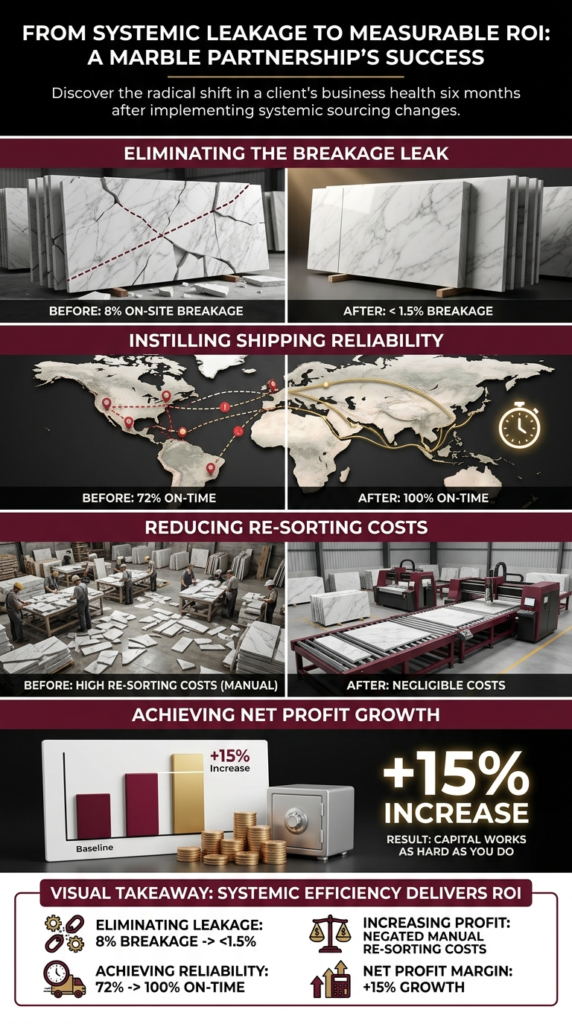
4. The Impact: Measurable ROI
After six months of implementing these systemic changes, the data confirmed a radical shift in the client’s business health.
| Metric | Before Partnership | After 6 Months |
| On-site Breakage | 8.0% | < 1.5% |
| Shipping Reliability | 72% On-time | 100% On-time |
| Re-sorting Costs | High (Manual) | Negligible |
| Net Profit Margin | Baseline | +15% Increase |
The 15% increase in net profitability wasn’t just a result of “better stone.” It was the result of eliminating invisible costs. By removing the need for shipping claims, reducing labor for re-sorting, and stopping the 8% breakage leak, the client’s capital was finally working as hard as they were.
5. Conclusion: Scalability Built on Trust
In the modern stone industry, peace of mind is the ultimate luxury. For this European importer, the partnership provided more than just marble it provided the operational stability required to scale. With the “quality gamble” removed, they were able to bid for larger, more prestigious contracts with the absolute confidence that their supply chain would hold.
We believe that in 2026 and beyond, transparency is the only currency that matters. You cannot build a global empire on a foundation of “cheap” sourcing if that foundation is riddled with hidden waste.
Is your current supply chain equipped for the demands of today’s market? Don’t let your margins bleed out through inefficient logistics and inconsistent quality. Let’s look under the hood of your procurement flow to identify the hidden leakages in your profitability.