When evaluating Egyptian Marble vs The World In the global natural stone market, the “Made in Italy” stamp has long been the gold standard for luxury. But in 2026, savvy B2B buyers like distributors, architects, and large-scale developers are looking past the label and toward the ledger.
As energy costs fluctuate in Europe and logistics networks reorganize, a new strategic play has emerged: Geographic Arbitrage. By sourcing from Egypt, global buyers are discovering they can secure a product that often outperforms Italian or Turkish alternatives in durability, while benefiting from a logistical and economic “cheat code” that protects their project margins. Here is why Egyptian marble is winning the global tug-of-war.
Egyptian Marble vs The World: Understanding Durability Differences
The most common misconception in the stone industry is that price equals performance. While Italian Carrara is world-renowned for its delicate veining, it is a relatively soft and porous calcite marble.
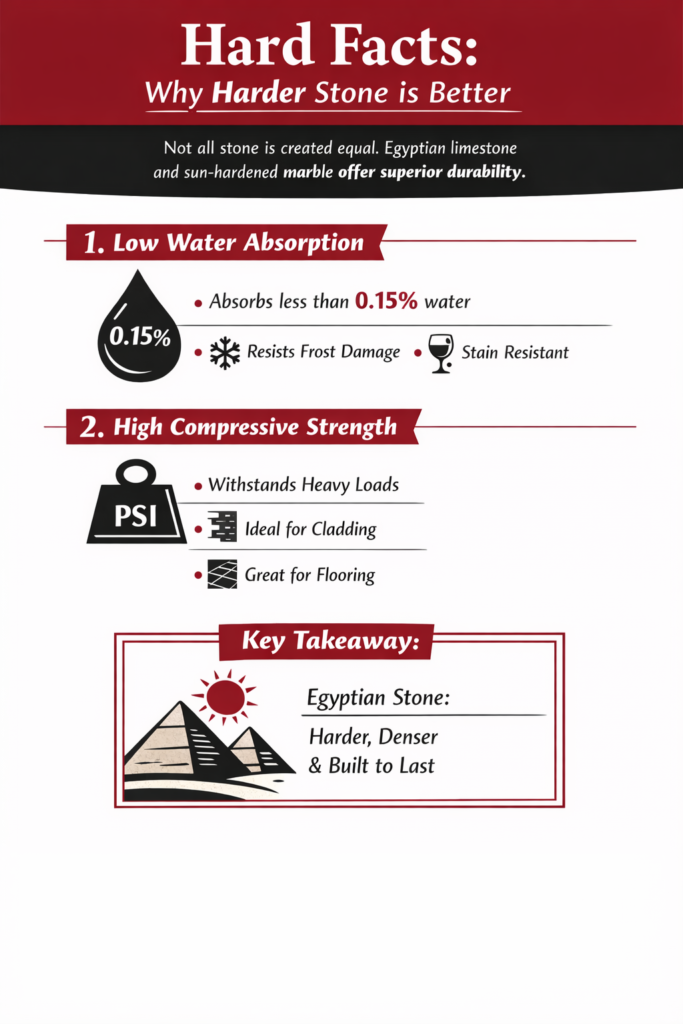
In contrast, many Egyptian varieties such as Galala, Sinai Pearl, and Sunny Gold are technically high-density limestones or “sun-hardened” marbles. Because these stones were formed under the intense pressure and heat of the North African climate, they offer distinct physical advantages:
- Low Water Absorption: Egyptian stone typically tests below 0.15% for water absorption, which is significantly lower than many European counterparts. This makes it virtually immune to frost damage in Northern European climates and resistant to staining in high-traffic Gulf hospitality projects.
- Compressive Strength: When used for exterior cladding or heavy-duty flooring, Egyptian varieties often provide a higher PSI (pounds per square inch) rating. This ensures the stone does not crack under the mechanical stresses of modern infrastructure.
The Price-Point Paradox
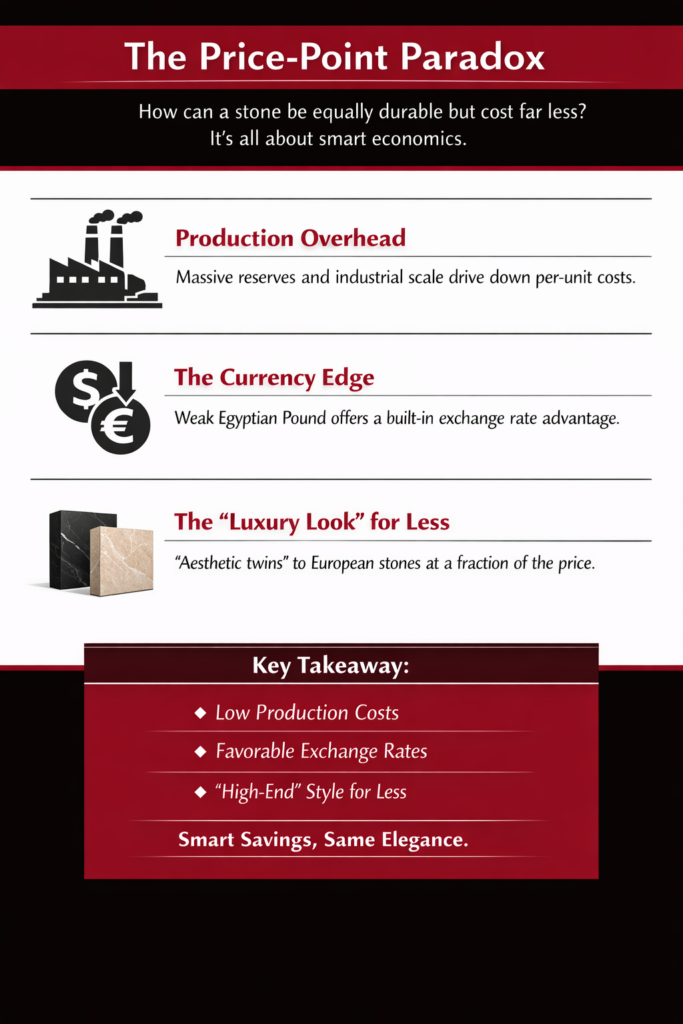
How can a stone of equal or superior durability cost 30% to 50% less than a Turkish or Italian equivalent? It is not a lack of quality; it is a masterpiece of economic arbitrage.
- Production Overhead: Egypt sits on some of the world’s largest accessible reserves. With massive industrial hubs like Shak El Thoban, the sheer scale of production drives down the per-unit cost.
- The Currency Edge: For buyers dealing in USD or EUR, the Egyptian Pound’s positioning offers an immediate “discount” on purchasing power that European quarries, burdened by high labor and energy costs, simply cannot match.
- The “Luxury Look” for Less: Many Egyptian stones are “aesthetic twins” to premium European varieties. A buyer can specify an Egyptian “Grey” that mimics the prestigious Italian Pietra Grey, achieving the same high-end architectural finish for a fraction of the material cost.
Logistic Supremacy: The Suez Advantage
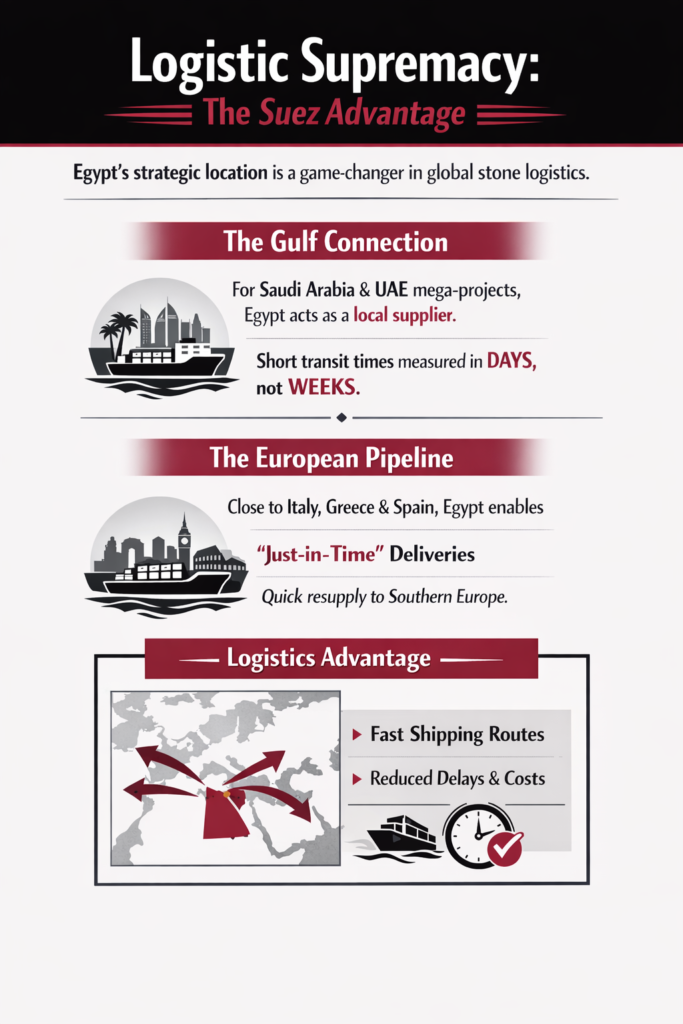
Geographic arbitrage is not just about the price at the quarry; it is about the cost at the port. Egypt’s location at the crossroads of three continents provides a logistical “fast track” that is unmatched:
- The Gulf Connection: For the Giga-projects in Saudi Arabia and the UAE, Egypt is effectively a local supplier. Short-sea shipping and direct trucking routes mean transit times are measured in days instead of weeks, drastically reducing the risk of project delays.
- The European Pipeline: Proximity to Southern European ports such as those in Italy, Greece, and Spain allows for a “Just-in-Time” delivery model. Instead of tying up capital in massive inventories, distributors can replenish stock quickly via the busiest shipping lanes in the Mediterranean.
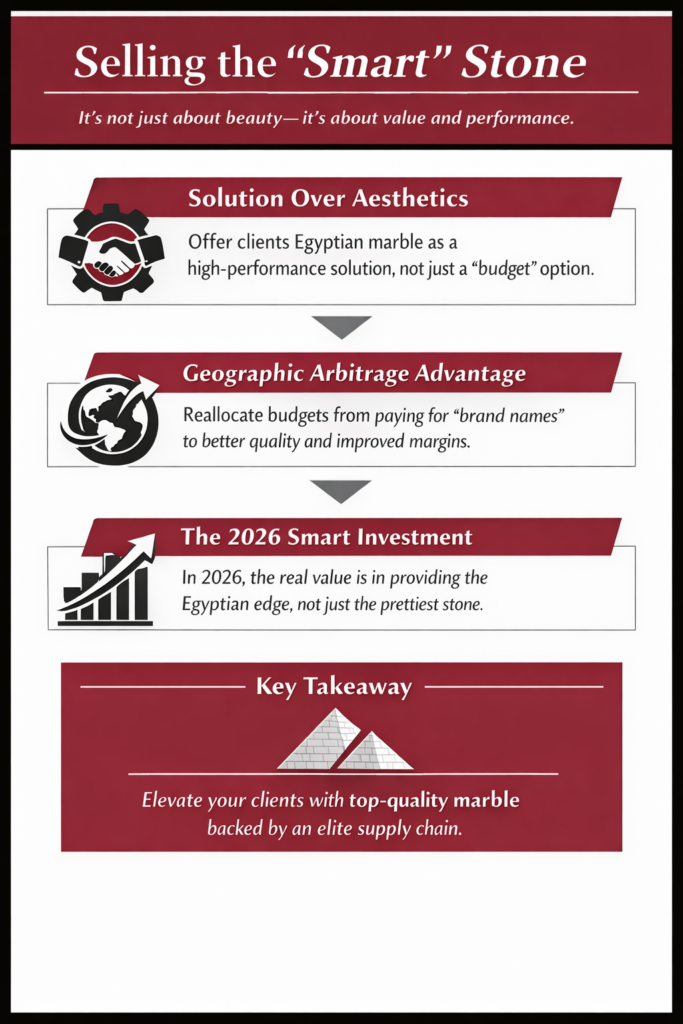
Conclusion: Selling the “Smart” Stone
For the modern distributor, the goal is no longer just to sell “pretty” stone; it is to provide solutions. When you offer your clients Egyptian marble, you are not selling a “budget” alternative. You are providing a high-performance material backed by a superior supply chain.
By leveraging Geographic Arbitrage, you allow your clients to reallocate their budget from “paying for a brand name” into “higher quality finishes and better margins.” In 2026, the smart money is not just looking for beauty; it is looking for the Egyptian edge.