

Reduce Marble and Granite Shipping Damage is not luck it’s a system built on packaging, loading, and securing precision.
“Your container arrives at the port in Hamburg. The crates are offloaded. The client is waiting. Then the inspection begins and 30% of the Black Aswan granite is shattered.”
The project stops dead. Replacement stone must be quarried, cut, and re-shipped. Weeks become months. Costs double. And the trust you spent years building? Gone in a single shipment.
Stone breakage during international shipping is one of the most costly and preventable problems in the natural stone export industry. Yet it happens every day not because the sea is rough, not because stone is fragile by nature, but because the systems that protect it are wrong, incomplete, or simply absent.
This guide reveals the exact systems that professional granite and marble exporters use to achieve near zero breakage rates on every shipment. Whether you’re shipping Black Aswan granite to Germany, Carrara marble to France, or engineered stone to the UK, the principles here are non-negotiable and they work.
30% Average breakage in poorly packed shipments
2× Cost multiplier when re-shipping is required
0%Breakage rate with the right system in place
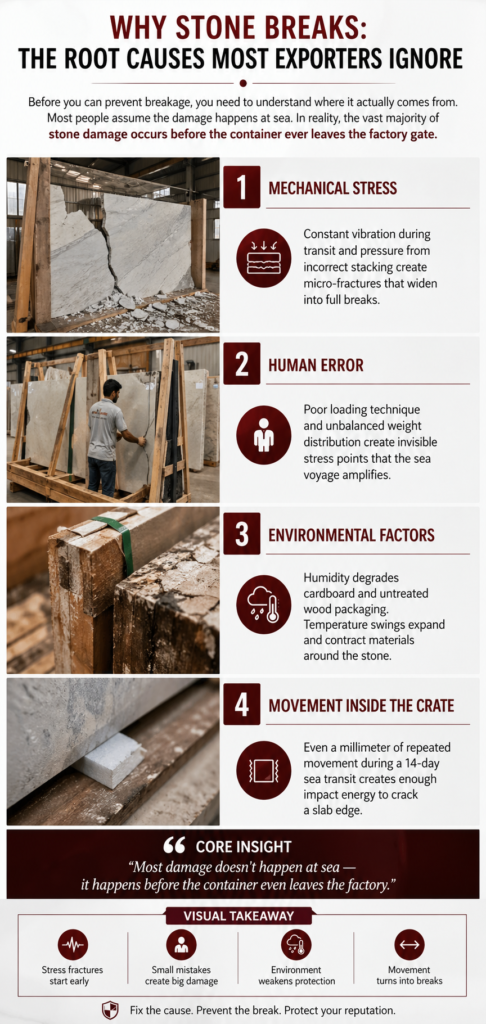
Marble And Granite Shipping Without Breakage: Why Stone Breaks The Root Causes Most Exporters Ignore
Before you can prevent breakage, you need to understand where it actually comes from. Most people assume the damage happens at sea. In reality, the vast majority of stone damage occurs before the container ever leaves the factory gate.
Mechanical stress : Constant vibration during transit and pressure from incorrect stacking create micro-fractures that widen into full breaks.
Human error : Poor loading technique and unbalanced weight distribution create invisible stress points that the sea voyage amplifies.
Environmental factors : Humidity degrades cardboard and untreated wood packaging. Temperature swings expand and contract materials around the stone.
Movement inside the crate : Even a millimeter of repeated movement during a 14-day sea transit creates enough impact energy to crack a slab edge.
Core Insight“Most damage doesn’t happen at sea it happens before the container even leaves the factory.”
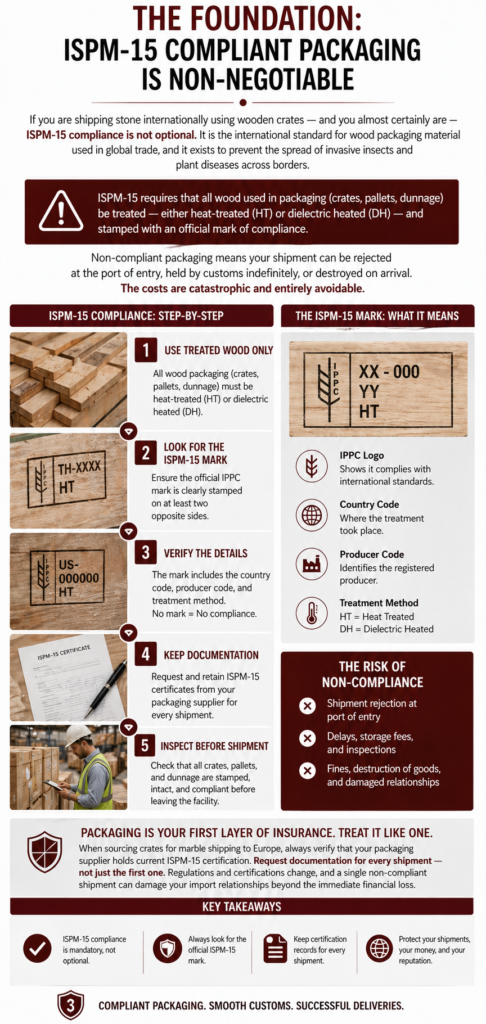
The Foundation: ISPM-15 Compliant Packaging Is Non-Negotiable
If you are shipping stone internationally using wooden crates and you almost certainly are ISPM-15 compliance is not optional. It is the international standard for wood packaging material used in global trade, and it exists to prevent the spread of invasive insects and plant diseases across borders.
ISPM-15 requires that all wood used in packaging (crates, pallets, dunnage) be treated either heat-treated (HT) or dielectric heated (DH) and stamped with an official mark of compliance. Non-compliant packaging means your shipment can be rejected at the port of entry, held by customs indefinitely, or destroyed on arrival. The costs are catastrophic and entirely avoidable.
Packaging is your first layer of insurance. Treat it like one.
When sourcing crates for marble shipping to Europe, always verify that your packaging supplier holds current ISPM-15 certification. Request documentation for every shipment not just the first one. Regulations and certifications change, and a single non-compliant shipment can damage your import relationships beyond the immediate financial loss.
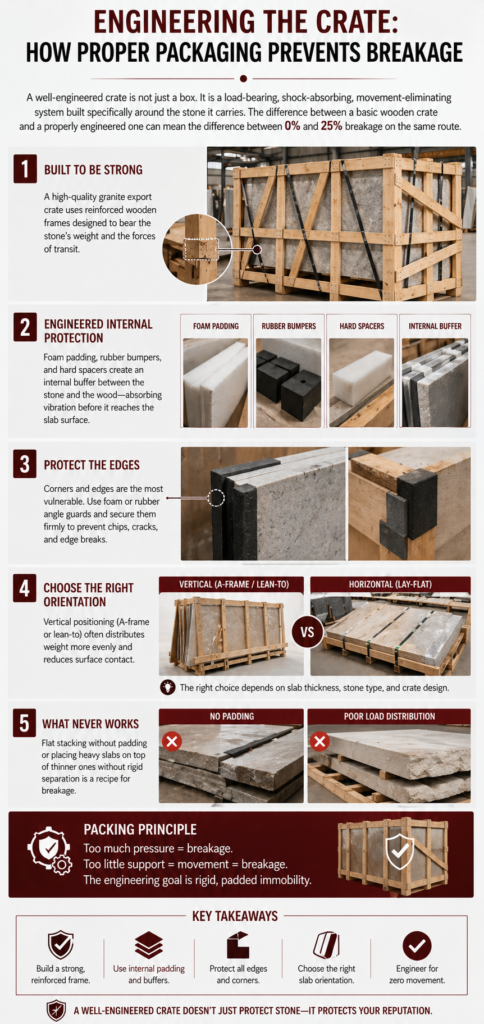
Engineering the Crate: How Proper Packaging Prevents Breakage
A well-engineered crate is not just a box. It is a load-bearing, shock-absorbing, movement-eliminating system built specifically around the stone it carries. The difference between a basic wooden crate and a properly engineered one can mean the difference between 0% and 25% breakage on the same route.
The structure of a high-quality granite export crate includes reinforced wooden frames capable of bearing both the stone’s weight and the forces of transit. Inside the frame, foam padding, rubber bumpers, and hard spacers form an internal buffer between the stone and the wood absorbing vibration before it reaches the slab surface. Edge protection is particularly critical: the corners and edges of granite and marble slabs are the most vulnerable points, and they require dedicated foam or rubber angle guards secured firmly in place.
The question of slab orientation vertical versus horizontal stacking is one of the most debated topics in stone shipping logistics. In most cases, vertical positioning (A-frame or lean-to style) distributes the stone’s weight more evenly and reduces the surface contact area. However, the right answer depends on slab thickness, stone type, and crate design. What is never acceptable is flat stacking without adequate inter-layer padding, or placing heavy slabs on top of thinner ones without rigid separation.
Packing principleToo much pressure = breakage. Too little support = movement = breakage. The engineering goal is rigid, padded immobility.
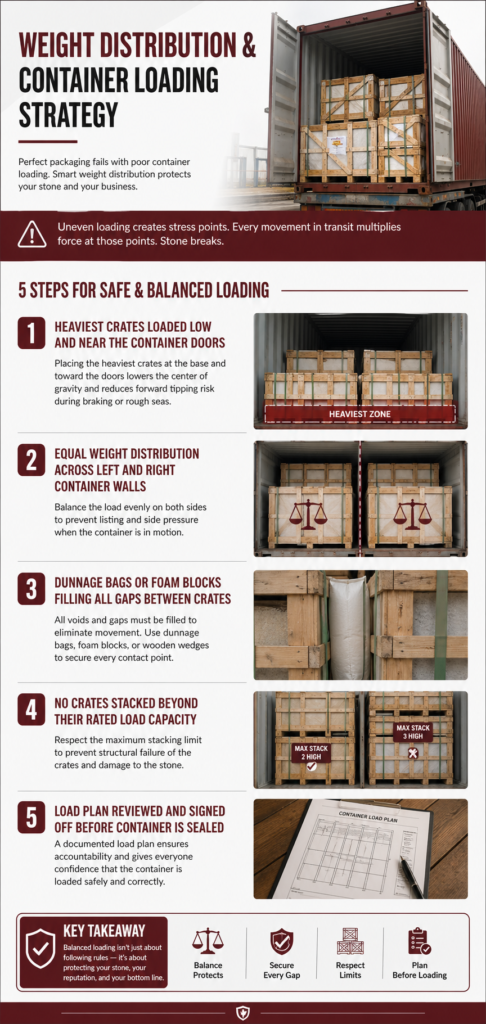
Weight Distribution & Container Loading Strategy
Perfect packaging fails with poor container loading. This is one of the most frequently overlooked variables in stone shipping logistics and one of the most damaging when ignored.
When a container is loaded unevenly heavier crates on one side, lighter crates stacked on top of dense ones it creates stress points that act like levers during transit. Every time the ship rolls, every time the truck brakes, the uneven weight distribution concentrates force at those points. Stone is strong in compression but brittle under lateral or bending stress. This is how perfect crates produce broken slabs.
Best practices for container loading for stone export include distributing weight evenly across the container floor, placing heavier crates at the base and toward the container doors, and using dunnage (filler material) and separators between crates to prevent contact and movement. The load plan should be documented before loading begins not improvised on the factory floor.
- Heaviest crates loaded low and near the container doors
- Equal weight distribution across left and right container walls
- Dunnage bags or foam blocks filling all gaps between crates
- No crates stacked beyond their rated load capacity
- Load plan reviewed and signed off before container is sealed
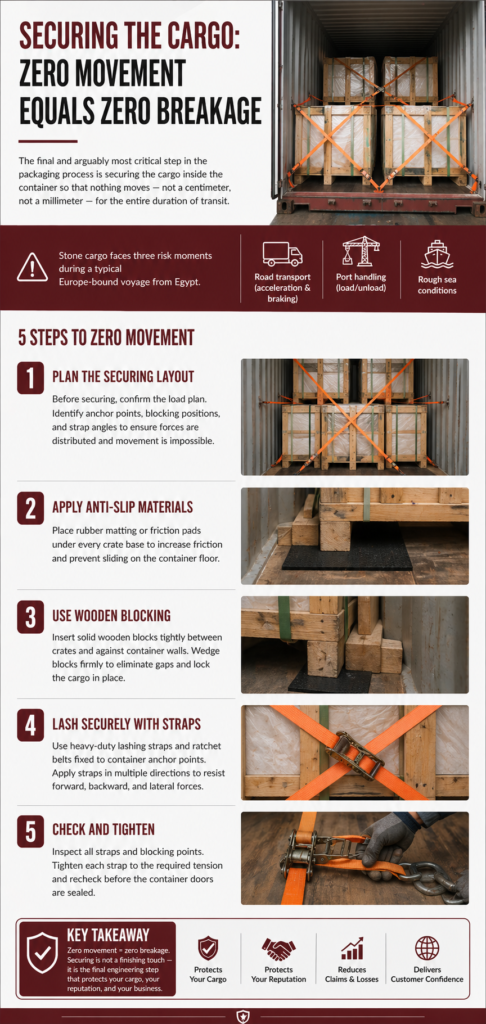
Securing the Cargo: Zero Movement Equals Zero Breakage
The final and arguably most critical step in the packaging process is securing the cargo inside the container so that nothing moves not a centimeter, not a millimeter for the entire duration of transit.
Stone cargo faces three risk moments during a typical Europe-bound voyage from Egypt: acceleration and braking during road transport to the port, loading and unloading at port terminals, and rough sea conditions in open water. Each of these creates forces that push, pull, and rattle unsecured cargo against the container walls and against itself.
Professional stone exporters use a combination of securing tools: heavy-duty lashing straps and ratchet belts fixed to container anchor points, wooden blocking wedged firmly between crates, and anti-slip materials (rubber matting or friction pads) placed under every crate base. Together, these elements create a fully immobilized load where no single crate can shift in any direction under any realistic force.
Zero movement = zero breakage. Securing is not a finishing touch it is the final engineering step.
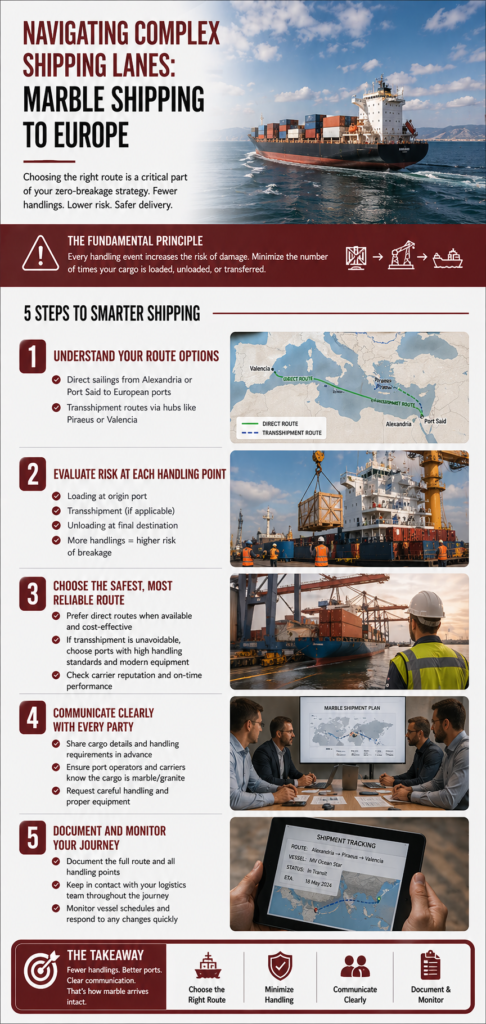
Navigating Complex Shipping Lanes: Marble Shipping to Europe
Marble and granite exports from Egypt to Europe typically travel one of several routes direct sailings from Alexandria or Port Said to European ports, or transshipment routes through hubs such as Piraeus or Valencia. Each has its own risk profile, and choosing the right route is part of your zero-breakage strategy.
The fundamental principle is this: every time your cargo is handled loaded, unloaded, transferred between vessels the risk of damage increases. Each handling event is an opportunity for impact, for improper lifting, for rushed port workers who don’t know there’s granite in the crate. Minimizing the number of handling events should be a core objective of your shipping strategy.
Direct routes are preferable when available and cost-effective. When transshipment is unavoidable, select routes through ports known for high cargo handling standards. Document your route, share it with your logistics team, and communicate handling requirements clearly to every party in the chain.
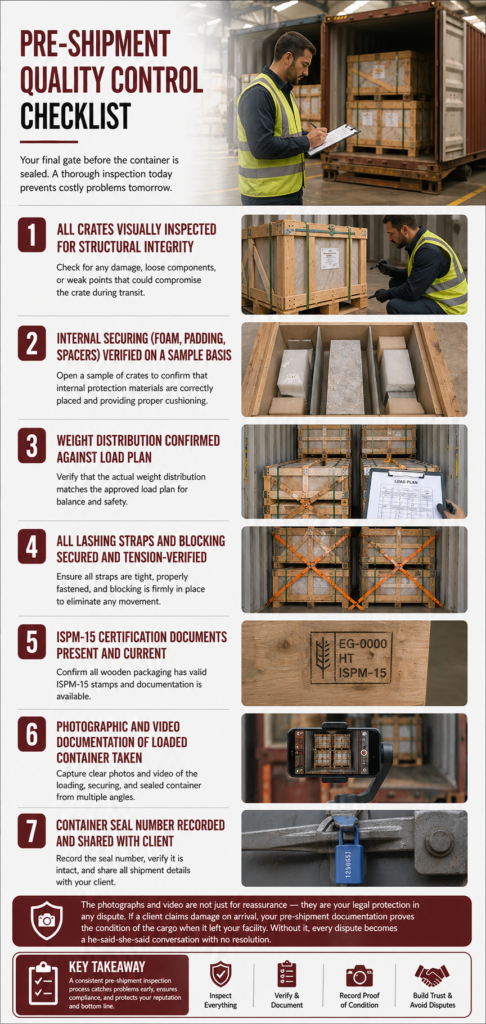
Pre-Shipment Quality Control Checklist
No shipment should leave without a documented pre-shipment inspection. This is your final gate the last opportunity to catch a packaging error, a securing problem, or a loading mistake before the container is sealed and the ship sets sail.
- All crates visually inspected for structural integrity
- Internal securing (foam, padding, spacers) verified on a sample basis
- Weight distribution confirmed against load plan
- All lashing straps and blocking secured and tension-verified
- ISPM-15 certification documents present and current
- Photographic and video documentation of loaded container taken
- Container seal number recorded and shared with client
The photographs and video are not just for reassurance they are your legal protection in any dispute. If a client claims damage on arrival, your pre-shipment documentation proves the condition of the cargo when it left your facility. Without it, every dispute becomes a he-said-she-said conversation with no resolution.
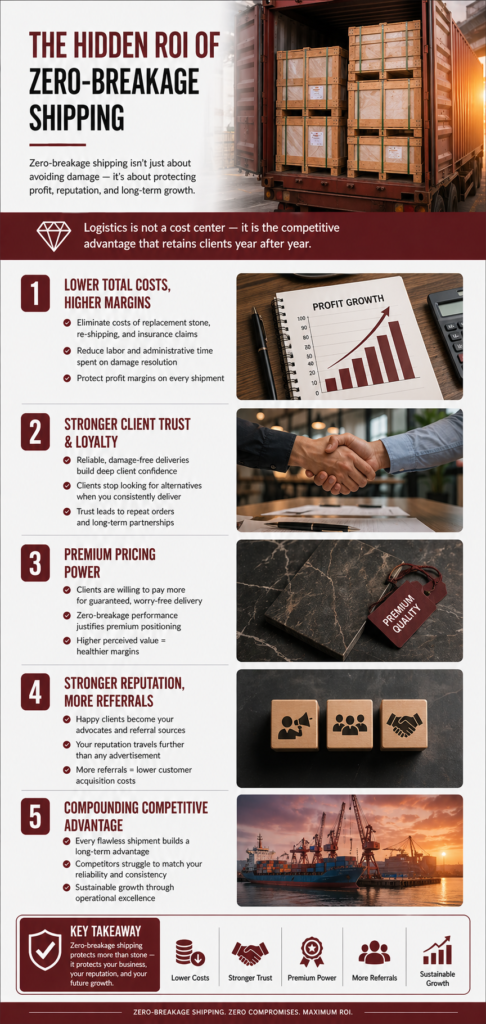
The Hidden ROI of Zero-Breakage Shipping
Stone breakage is almost never accounted for correctly in export business models. The visible cost replacement stone, re-shipping is painful but calculable. The invisible costs are far greater.
Every broken shipment delays a client’s project. Construction timelines slip. Contractors lose money. Architects miss deadlines. And the supplier the exporter absorbs the reputational damage of every downstream consequence, even when the shipping company shares the liability. In a business built on relationships and repeat orders, one catastrophic shipment can end a client partnership worth hundreds of thousands of dollars annually.
Conversely, the exporter who delivers flawlessly every time, without drama becomes irreplaceable. Clients stop shopping for alternatives. They refer new clients. They accept premium pricing because the premium is justified. Zero-breakage shipping transforms logistics from a cost center into a competitive advantage that compounds over time.
Logistics is not a cost center it is the competitive advantage that retains clients year after year.
Conclusion
Every stone exporter who achieves near-zero breakage rates does so through the same four disciplines: engineered, ISPM-15 compliant packaging built for the specific stone being shipped; a documented, weight-balanced container loading strategy; comprehensive cargo securing that eliminates all movement; and a direct, minimal-handling shipping lane to the destination port.
None of these are complex. None require exotic equipment or exclusive expertise. They require consistency, documentation, and the discipline to treat every shipment the hundredth as carefully as the first.
Zero breakage is not the result of luck or favorable seas. It is the output of a system that leaves nothing to chance between your factory floor and your client’s project site.