
Every marble wholesaler knows this painful truth: The cost of a bad supplier isn’t just the price of a ruined container it’s the lost clients, the warehouse bottlenecks, and the endless hours spent fixing paperwork.
The reality of sourcing Egyptian marble is that most importers still rely on “trial and error” to find a trustworthy exporter. You send one container, hope the quality holds, and pray the documentation clears customs without a hitch. But in today’s tight-margin wholesale market, that approach is simply too expensive. A single failed shipment doesn’t just cost money it costs client relationships, damages your reputation, and drains your team’s time on problems that should never have happened.
The good news? You don’t have to gamble. There is a systematic way to audit any natural stone exporter before you wire a single dollar of deposit. Below is a practical 4-step framework that separates strategic long-term partners from risky, unreliable brokers and it takes less than 15 minutes to run.
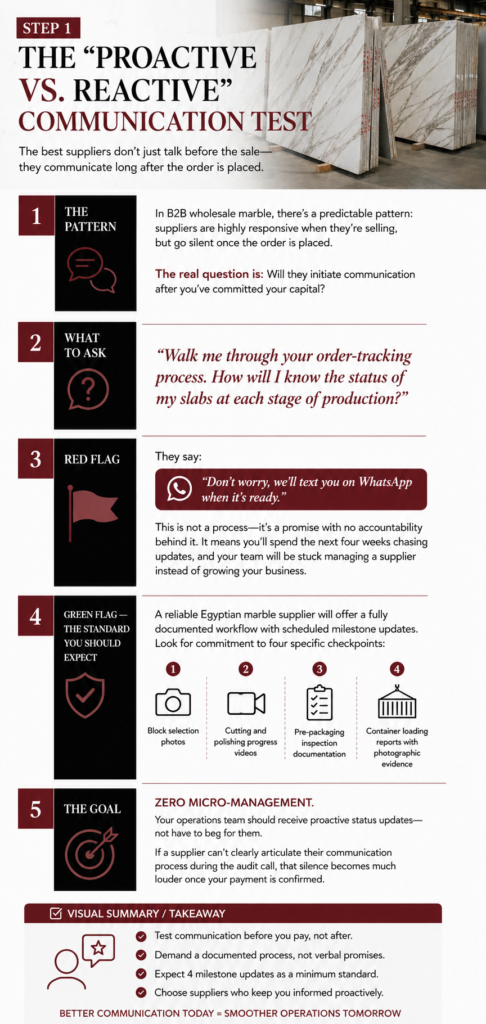
Step 1: The “Proactive vs. Reactive” Communication Test
Here is one of the most predictable patterns in B2B wholesale marble: suppliers are extremely responsive when they’re selling, and go completely silent once the order is placed. The question isn’t whether a supplier answers your messages before purchase it’s whether they’ll initiate communication after you’ve committed your capital.
What to ask: “Walk me through your order-tracking process. How will I know the status of my slabs at each stage of production?”
Red Flag: They say, “Don’t worry, we’ll text you on WhatsApp when it’s ready.” This is not a process it’s a promise with no accountability behind it. It means you’ll spend the next four weeks chasing updates, and your team will be stuck managing a supplier instead of growing your business.
Green Flag The Standard You Should Expect: A reliable Egyptian marble supplier will offer a fully documented workflow with scheduled milestone updates. Look for commitment to four specific checkpoints: (1) block selection photos, (2) cutting and polishing progress videos, (3) pre-packaging inspection documentation, and (4) container loading reports with photographic evidence.
The Goal: Zero micro-management. Your operations team should receive proactive status updates not have to beg for them. If a supplier can’t clearly articulate their communication process during the audit call, that silence becomes much louder once your payment is confirmed.
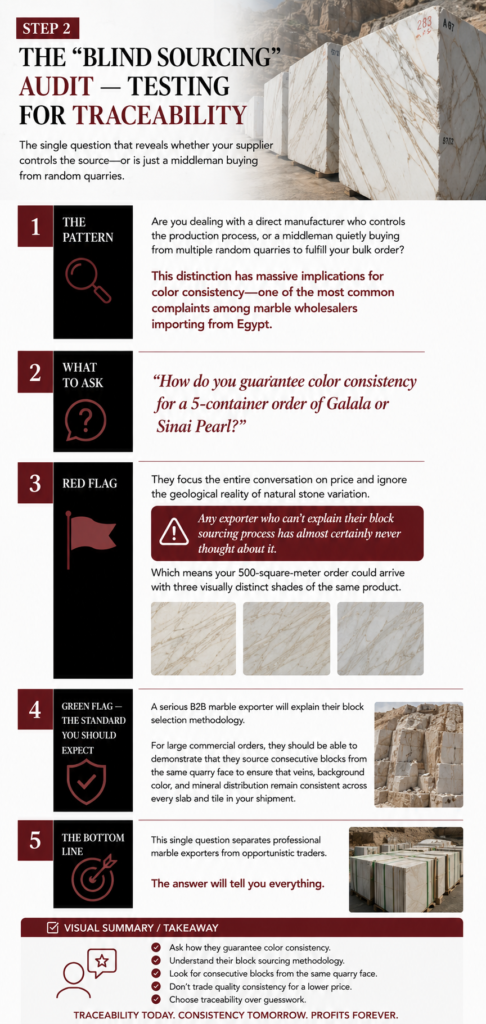
Step 2: The “Blind Sourcing” Audit Testing for Traceability
Are you dealing with a direct manufacturer who controls the production process, or a middleman quietly buying from multiple random quarries to fulfill your bulk order? This distinction has massive implications for color consistency one of the most common complaints among marble wholesalers importing from Egypt.
Natural stone is not a manufactured product. Every block carries the unique geological fingerprint of its quarry face. For varieties like Galala, Sinai Pearl, or Sunny Menia, even blocks from the same quarry can vary significantly in vein pattern and background tone if they come from different extraction points.
What to ask: “How do you guarantee color consistency for a 5-container order of Galala or Sinai Pearl?”
Red Flag: They focus the entire conversation on price and ignore the geological reality of natural stone variation. Any exporter who can’t explain their block sourcing process has almost certainly never thought about it which means your 500-square-meter order could arrive with three visually distinct shades of the same product.
Green Flag The Standard You Should Expect: A serious B2B marble exporter will explain their block selection methodology. For large commercial orders, they should be able to demonstrate that they source consecutive blocks from the same quarry face to ensure that veins, background color, and mineral distribution remain consistent across every slab and tile in your shipment.
This single question separates professional marble exporters from opportunistic traders. The answer will tell you everything.
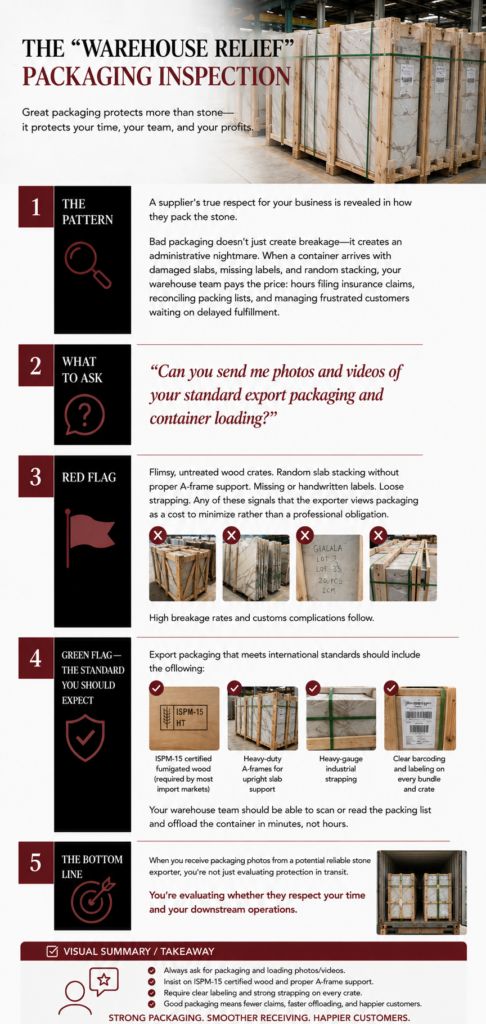
Step 3: The “Warehouse Relief” Packaging Inspection
A supplier’s true respect for your business is revealed in how they pack the stone. Bad packaging doesn’t just create breakage it creates an administrative nightmare. When a container arrives with damaged slabs, missing labels, and random stacking, your warehouse team pays the price: hours filing insurance claims, reconciling packing lists, and managing frustrated customers waiting on delayed fulfillment.
What to ask: “Can you send me photos and videos of your standard export packaging and container loading?”
Red Flag: Flimsy, untreated wood crates. Random slab stacking without proper A-frame support. Missing or handwritten labels. Loose strapping. Any of these signals that the exporter views packaging as a cost to minimize rather than a professional obligation. High breakage rates and customs complications follow.
Green Flag The Standard You Should Expect: Export packaging that meets international standards should include ISPM-15 certified fumigated wood (required by most import markets to prevent pest contamination), heavy-duty A-frames for upright slab support, heavy-gauge industrial strapping, and critically clear barcoding and labeling on every bundle and crate. Your warehouse team should be able to scan or read the packing list and offload the container in minutes, not hours.
When you receive packaging photos from a potential reliable stone exporter, you’re not just evaluating protection in transit. You’re evaluating whether they respect your time and your downstream operations.

Step 4: The Documentation and Compliance Stress-Test
A single typo on a Commercial Invoice can trigger a customs hold. A missing Certificate of Origin can block a shipment for weeks. In international stone trade, paperwork errors are not minor inconveniencesthey translate directly into demurrage fees, delayed deliveries, and client dissatisfaction.
Yet documentation is consistently treated as an afterthought by exporters who are excellent at selling but poor at delivering.
What to ask: “What is your internal SOP (Standard Operating Procedure) for export documentation? Walk me through the process from draft to final submission.”
Red Flag: They treat paperwork as something their logistics team handles “automatically.” There’s no mention of review processes, no mention of draft approvals, and no acknowledgment that errors happen unless there are systems to catch them.
Green Flag The Standard You Should Expect: A professional Egyptian marble supplier operating at scale will have a structured, dual-review process for every critical export document: the Bill of Lading, the Certificate of Origin, and the Commercial Invoice. More importantly, they will send you draft copies for your review and approval before the vessel sails giving you the opportunity to catch discrepancies before they become expensive customs problems.
This is what a genuine “Zero-Human Error Framework” looks like in practice. It’s not about being perfectit’s about having the systems in place to catch mistakes before they reach your end.
The Takeaway: Build a Predictable Supply Chain, Not a Risky One
Importing Egyptian marble whether Galala Light, Sunny Menia, Sinai Pearl, or any other variety should not feel like a gamble every time you place an order. The difference between a frustrating supplier experience and a smooth, scalable supply chain almost always comes down to the same four pillars:
- Communication: Proactive updates, not reactive apologies
- Traceability: Block-level sourcing transparency, not vague guarantees
- Packaging: Warehouse-ready exports, not damaged containers
- Documentation: Dual-reviewed paperwork, not last-minute surprises
By running this 15-minute audit before your next order, you transform supplier selection from a leap of faith into a structured, evidence-based decision.
At Shawkat Stone, we didn’t just meet these audit standards we built our entire operational framework around them. From block selection documentation to pre-shipment inspection reports, every order we ship is designed to land at your warehouse exactly as expected: on time, on spec, and with zero surprises.
Ready to put us to the test? Contact us directly