The Most Expensive Mistake Isn’t in the Quarry
Picture this. You’ve extracted premium Egyptian marble, polished it to flawless specification, won over an international buyer, booked the container, and watched the cargo loaded and sealed without a single scratch. The stone is perfect. The timing is perfect. Then a phone call comes in from the destination port: the shipment is frozen. The reason isn’t a cracked slab or a damaged crate. It’s a single misspelled word on a shipping document.
Most importers and distributors instinctively blame shipment problems on the obvious culprits production defects, cargo damage in transit, or a logistics partner dropping the ball. But ask any seasoned stone exporter where the real money disappears, and they’ll tell you the same thing: the costliest disruptions almost never happen in the quarry or on the vessel. They happen on paper.
Marble export documentation mistakes are among the most underestimated risks in the entire international stone trade. They’re invisible until the moment they aren’t, and by then the meter is already running. In this article, you’ll learn exactly how a tiny documentation slip can cost thousands of dollars, which shipping documents carry the highest risk, the hidden costs that rarely make it onto any invoice, and the practical systems professional exporters use to make sure it never happens to them.
The Real Story: How One Wrong Letter Became a $5,000 Problem
Here’s a scenario that plays out in real ports more often than the industry likes to admit.
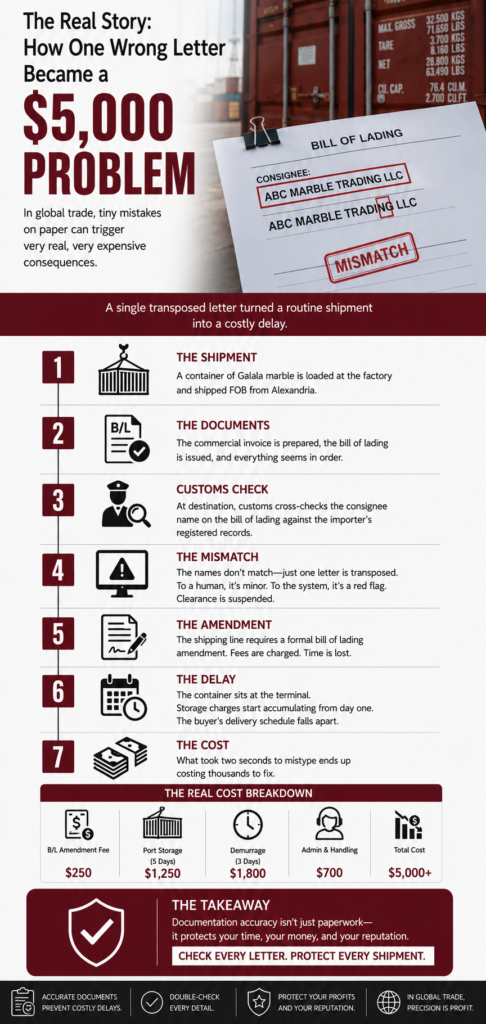
A container of Galala marble is loaded at the factory and shipped FOB from Alexandria. The commercial invoice is prepared, the bill of lading is issued by the shipping line, and everything moves smoothly until the cargo reaches the destination. During customs clearance, an officer cross-checks the consignee name on the bill of lading against the importer’s registered company records. The names don’t match. Not because of a major error because a single letter in the company name was transposed during data entry.
To a human, the intent is obvious. To a customs system, a mismatch is a mismatch. Document matching fails, and clearance is suspended on the spot.
The immediate consequences cascade quickly. Customs clearance halts entirely. The shipping line requires a formal bill of lading amendment, which carries its own fee and processing time. Meanwhile, the container sits at the terminal, and port storage charges begin accumulating from day one. The buyer, who had a stone installation scheduled, watches their delivery window slip.
The lesson is brutal in its simplicity: a mistake that took two seconds to make can take days or weeks to unwind. By the time the corrected paperwork clears, the “small typo” has quietly turned into a five-figure problem.
Why Marble and Granite Shipments Are Especially Vulnerable
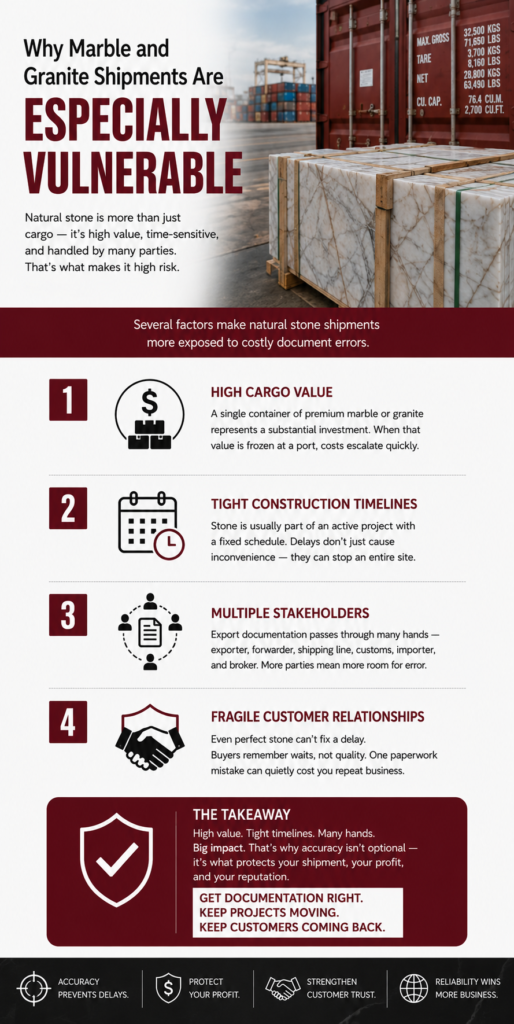
Not all cargo carries the same exposure to shipping document errors, and natural stone sits squarely in the high-risk category for several reasons.
High cargo value. A single container of premium marble or granite represents a substantial sum tied up in inventory. When that value is frozen at a port, the financial pressure builds far faster than it would for a low-value commodity.
Tight construction timelines. Stone rarely ships into a vacuum. Most buyers are feeding active projects — a hotel lobby, a residential tower, a commercial fit-out where the material has a fixed slot in the construction schedule. Marble shipment delays don’t just inconvenience the buyer; they can stall an entire job site.
Multiple stakeholders. Export documentation passes through a long chain: the exporter, the freight forwarder, the shipping line, customs authorities on both ends, the importer, and often a customs broker. Each additional party is one more set of hands that can introduce or fail to catch an error.
Fragile customer relationships. Here’s the part that stings most. The stone can be flawless and the delay can still erode trust. A buyer who waited an extra three weeks because of a paperwork error remembers the wait, not the quality. Egyptian marble exports compete on reliability as much as on material, and one disrupted shipment can quietly cost you the reorder.
The Five Documents That Cause Most Shipping Disasters
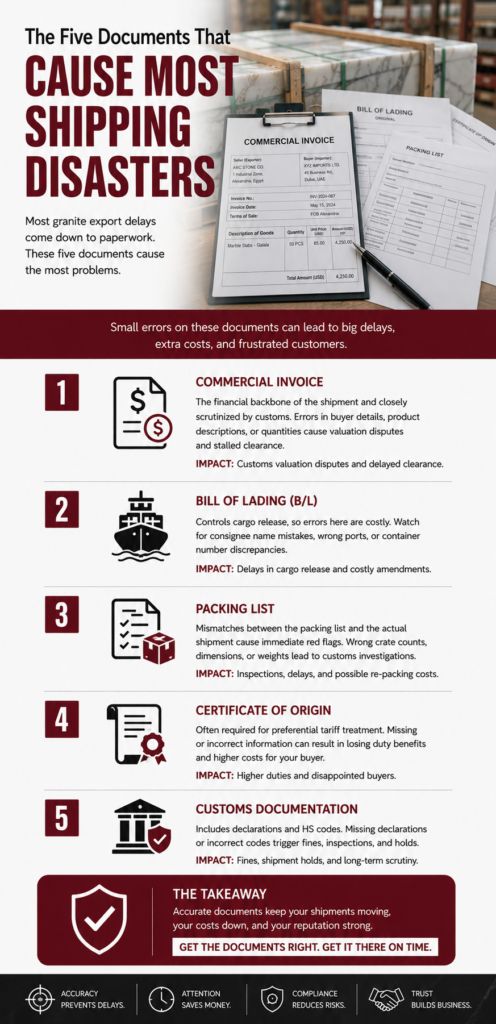
If you want to understand where most marble export documentation mistakes actually originate, focus on these five documents they generate the overwhelming majority of clearance problems in granite export paperwork.
1. Commercial Invoice
The commercial invoice is the financial backbone of the shipment, and customs authorities scrutinize it closely. Common errors include incorrect buyer details, vague or wrong product descriptions, and quantities that don’t reconcile with the other documents. The impact is direct: customs valuation disputes and stalled clearance while officers question why the numbers don’t add up.
2. Bill of Lading (B/L)
The bill of lading is the document that controls cargo release, which makes its errors among the most expensive. Watch for consignee name mistakes, incorrect port-of-loading or port-of-discharge information, and container number discrepancies. Any of these can delay release of the cargo and trigger amendment fees from the shipping line and amendments to a B/L are never quick.
3. Packing List
The packing list seems administrative until it doesn’t match reality. The usual culprits are wrong crate counts, incorrect dimensions, and weight mismatches against the declared figures. When physical inspection contradicts the paperwork, customs questions follow, and a routine clearance becomes an investigation.
4. Certificate of Origin
For Egyptian stone exporters, the certificate of origin is often the key to preferential tariff treatment under trade agreements. Missing information or incorrect product classification can strip away that tariff advantage entirely, leaving the buyer facing higher duties than they budgeted and looking to you for an explanation.
5. Customs Documentation
Finally, the customs declarations themselves. Missing declarations and incorrect HS codes are the classic failures here. The consequences escalate fast: fines, mandatory physical inspections, and shipment holds that can freeze cargo for an extended period. Customs clearance issues rooted in HS code errors are particularly painful because they can flag your shipments for heightened scrutiny on future orders too.
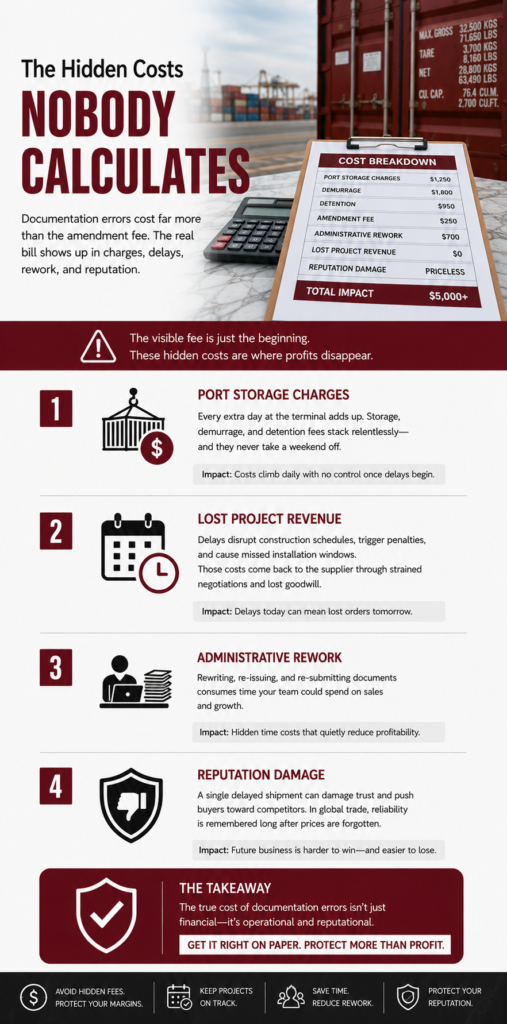
The Hidden Costs Nobody Calculates
When exporters tally the price of a documentation error, they usually count the amendment fee and stop there. The real bill is far larger.
Port storage charges. Every additional day a container sits at the terminal adds cost. Storage fees, demurrage charges (for using the container beyond the free time), and detention fees (for keeping the container outside the terminal too long) stack on top of each other relentlessly. These charges don’t pause for weekends.
Lost project revenue. When the buyer’s construction schedule depends on the delivery date, a delay can trigger project delays, contract penalties, and missed installation windows on their end. Even if those costs land on the importer first, they tend to flow back to the supplier in the form of strained negotiations and lost goodwill.
Administrative rework. Every hour your staff spends rewriting, re-issuing, and re-submitting documents is an hour not spent selling. This operational drain rarely shows up on any ledger, but it’s real money.
Reputation damage. This is the cost that outlives the shipment. A single delayed container can do more harm to your future order pipeline than the immediate financial loss ever did. In a market where buyers can choose between dozens of suppliers, reliability is the differentiator and export compliance is what protects it.
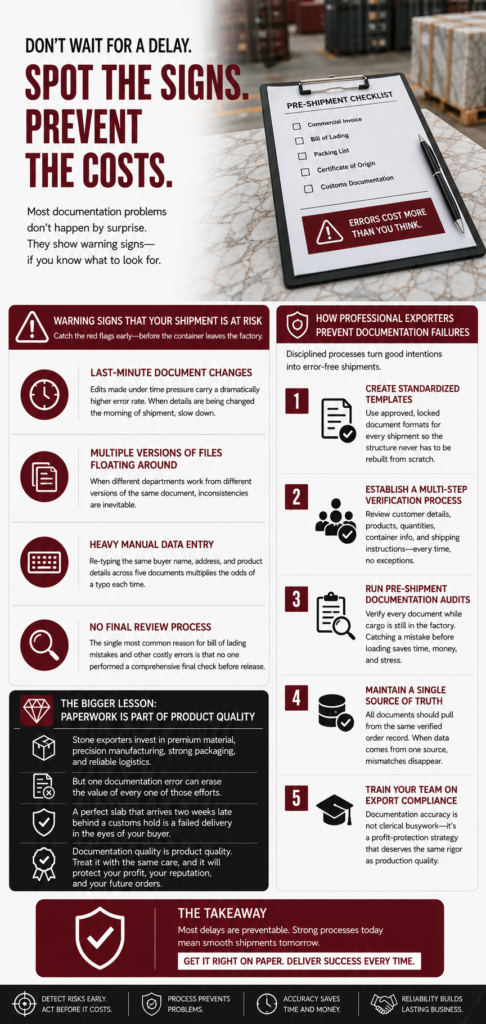
Warning Signs That Your Shipment Is at Risk
Most marble export documentation mistakes are preceded by one of these red flags learn to spot them before the container leaves the factory.
- Last-minute document changes. Edits made under time pressure carry a dramatically higher error rate. When details are being changed the morning of shipment, slow down.
- Multiple versions of files floating around. When different departments work from different versions of the same document, inconsistencies are inevitable.
- Heavy manual data entry. Re-typing the same buyer name, address, and product details across five documents multiplies the odds of a typo each time.
- No final review process. The single most common reason for bill of lading mistakes and other costly errors is that no one performed a comprehensive final check before release.
How Professional Exporters Prevent Marble Export Documentation Mistakes
The good news is that nearly every one of these failures is preventable with disciplined process. Here’s how the best operators in international stone shipping protect themselves.
Create standardized templates. Use approved, locked document formats for every shipment so the structure never has to be rebuilt from scratch.
Establish a multi-step verification process. Before any document is finalized, deliberately review the customer details, product specifications, quantities, container information, and shipping instructions — every time, no exceptions.
Run pre-shipment documentation audits. Verify every document while the cargo is still in the factory, when correcting an error costs nothing. Catching a mistake before loading is the difference between a quick fix and a port-side crisis.
Maintain a single source of truth. Every document invoice, B/L, packing list, certificate of origin should pull its information from the same verified order record. When all paperwork traces back to one master file, mismatches simply can’t happen.
Train your team on export compliance. The most important mindset shift is this: documentation accuracy is not clerical busywork. It’s a profit-protection strategy, and it deserves the same rigor your team applies to grading and polishing the stone itself.
The Bigger Lesson: Paperwork Is Part of Product Quality
Stone exporters invest enormous effort in the things they can see careful material selection, precision manufacturing, robust packaging, and well-planned logistics. Yet a single documentation error can quietly erase the value of every one of those investments.
The most successful marble and granite exporters have internalized a deceptively simple idea: documentation quality is product quality. A perfect slab that arrives two weeks late behind a customs hold is, from the buyer’s perspective, a failed delivery. The paperwork isn’t a formality wrapped around the product it is part of the product.
Is Your Next Shipment Protected From a $5,000 Typo?
A shipment rarely collapses because of one dramatic disaster. Far more often, it’s delayed by a small oversight that no one thought was worth a second look at the time.
So before your next marble or granite container leaves the factory, ask yourself one honest question: If customs reviewed every single document tomorrow, would every detail match perfectly?
That final verification may turn out to be the highest-return investment in your entire export process.
Need to reduce export risk and keep your stone shipments moving?
ake a hard look at your documentation workflow before your next container leaves the port — because preventing a mistake is always cheaper than correcting one. Talk to our export team about smoother, audit-ready shipments. Found this useful? Share it with your team, and bookmark the blog for more practical insights on exporting Egyptian marble and granite to the world.